Medical Disclaimer — Please Read First
This guide is for educational purposes only and is not a substitute for medical advice. Home blood pressure monitors do not replace care from a licensed healthcare provider. Always consult your doctor about diagnosis, treatment, and medication changes—and before acting on any reading from a home device.
Two things this guide will not do: diagnose hypertension, or tell you whether Medicare will pay in your specific case. For both, talk to your doctor and your plan administrator.
📌Key Takeaways
- Upper arm monitors are the most accurate and are recommended for seniors by the American Heart Association
- Look for clinically validated monitors (ESH or AHA) for reliable readings
- Large, backlit displays with one-touch operation are essential for ease of use
- Proper cuff fit directly affects accuracy—an undersized cuff can overstate readings by 10+ mmHg
- Original Medicare Part B generally does NOT cover routine home BP monitors; Medicare Advantage (Part C) or FSA/HSA often can
- Home monitoring may help track medication effectiveness between doctor visits
Quick Answer: Which Blood Pressure Monitor Should You Buy?
If you only have 30 seconds, here is the short version. The American Heart Association recommends upper arm monitors validated by the ESH (European Society of Hypertension) or AHA—these are the most accurate design for older adults, and they are what most doctors carry into the exam room.
| Need | Top Pick | Why | Price Range | Check Price |
|---|---|---|---|---|
| Best Overall | Omron Platinum BP5450 | Clinically validated, dual backlit display, Bluetooth, TruRead 3-reading average, 200-reading memory, cuff 9"-17" | $80-110 | Check Price on Amazonamazon |
| Best for Tracking | Omron 10 Series | TruRead averaging, 200-reading memory for 2 users, Bluetooth, ComFit cuff 9"-17" | $80-100 | Check Price on Amazonamazon |
| Best Value | Greater Goods Premium | FDA-cleared, two-user 120-reading memory, large backlit display, AC adapter included | $50-70 | Check Price on Amazonamazon |
| Best for Larger Arms | A&D Medical UA-767F | ESH-validated, extra-large cuff fits up to 20", lifetime warranty | $50-70 | Check Price on Amazonamazon |
| Best Budget | Omron Silver | Clinically validated, one-touch, 80-reading memory, cuff 9"-13", 5-year warranty | $40-60 | Check Price on Amazonamazon |
| Best for Large Arms + Smart | Withings BPM Connect Pro | Cuff 9"-22", color-coded LED, Wi-Fi/Bluetooth, rechargeable, HIPAA-compliant app | $100-150 | Check Price on Amazonamazon |
| Hospital-Grade Accuracy | Welch Allyn Home 1700 | Clinician-trusted, advanced averaging, smartphone sync, cuff 9"-17" | $150-200 | Check Price on Amazonamazon |
| Simplest Operation | A&D Medical UA-651BLE | One-button, clinical-grade accuracy, irregular heartbeat detection, cuff 9"-17" | $40-60 | Check Price on Amazonamazon |
The Medicare Reality (Read This Before You Buy)
Will Medicare pay for your home blood pressure monitor?
Short answer: usually not for routine hypertension. Original Medicare Part B does not cover standard home blood pressure monitors for general high blood pressure. Coverage may apply only when a doctor prescribes a device as Durable Medical Equipment (DME) for specific conditions such as end-stage renal disease (ESRD), or as part of a Remote Physiologic Monitoring (RPM) program.
What usually pays instead:
- Medicare Advantage (Part C) plans often include wellness benefits that reimburse a monitor
- Flexible Spending Accounts (FSA) and Health Savings Accounts (HSA) can be used (these monitors are FSA/HSA-eligible)
- Some state Medicaid programs cover home BP monitors with a prescription
For the full breakdown—including the exact wording to use with your plan administrator—see the Does Medicare Cover Home Blood Pressure Monitors? section below.
Why Trust This Guide
Home blood pressure monitoring is recommended by the American Heart Association for anyone with hypertension. For seniors in particular, the right monitor can do more than track numbers—it can reveal white-coat hypertension (high only at the doctor's office), masked hypertension (normal at the office but high at home), and patterns tied to medication timing.
The eight monitors below were selected based on: clinical validation (ESH, AHA, or FDA clearance), ease of use for older hands and eyes, cuff-size range (especially for larger arms), and real long-term reliability. Prices shown are typical retail ranges—check current pricing via the affiliate links provided on each product.
Why Home Blood Pressure Monitoring Matters
Picture the routine: cuff on a bare arm at the kitchen table before breakfast, feet flat on the floor, two readings a minute apart, both written in a notebook. That quiet morning log often gives your doctor a fuller picture than the single reading taken from an exam-room chair. The Mayo Clinic notes that home readings may help identify white coat hypertension (elevated readings only at the doctor's office) and masked hypertension (normal readings at the office but elevated at home).
For seniors specifically, the log does quiet work between visits: it shows whether a new medication dose is actually moving the numbers, turns isolated readings into morning-and-evening patterns, and hands a clinician something concrete to act on. It can also flag a genuine spike days before an appointment, and many people find office readings less alarming once they know their numbers at home.
Research published in the Journal of the American Medical Association suggests that regular home monitoring helps people better manage their blood pressure through increased awareness and better medication adherence.
Types of Blood Pressure Monitors
Monitors differ in where they take the reading — upper arm, wrist, or finger — and in whether the numbers live on paper or in an app.
Upper Arm Monitors
- Most accurate: Gold standard for home monitoring, recommended by the American Heart Association
- Easy to use: Simple cuff application with automatic inflation
- Large display: Easy to read results
- Widely recommended: Healthcare provider preference
- Best for: Most seniors and those needing reliable daily monitoring
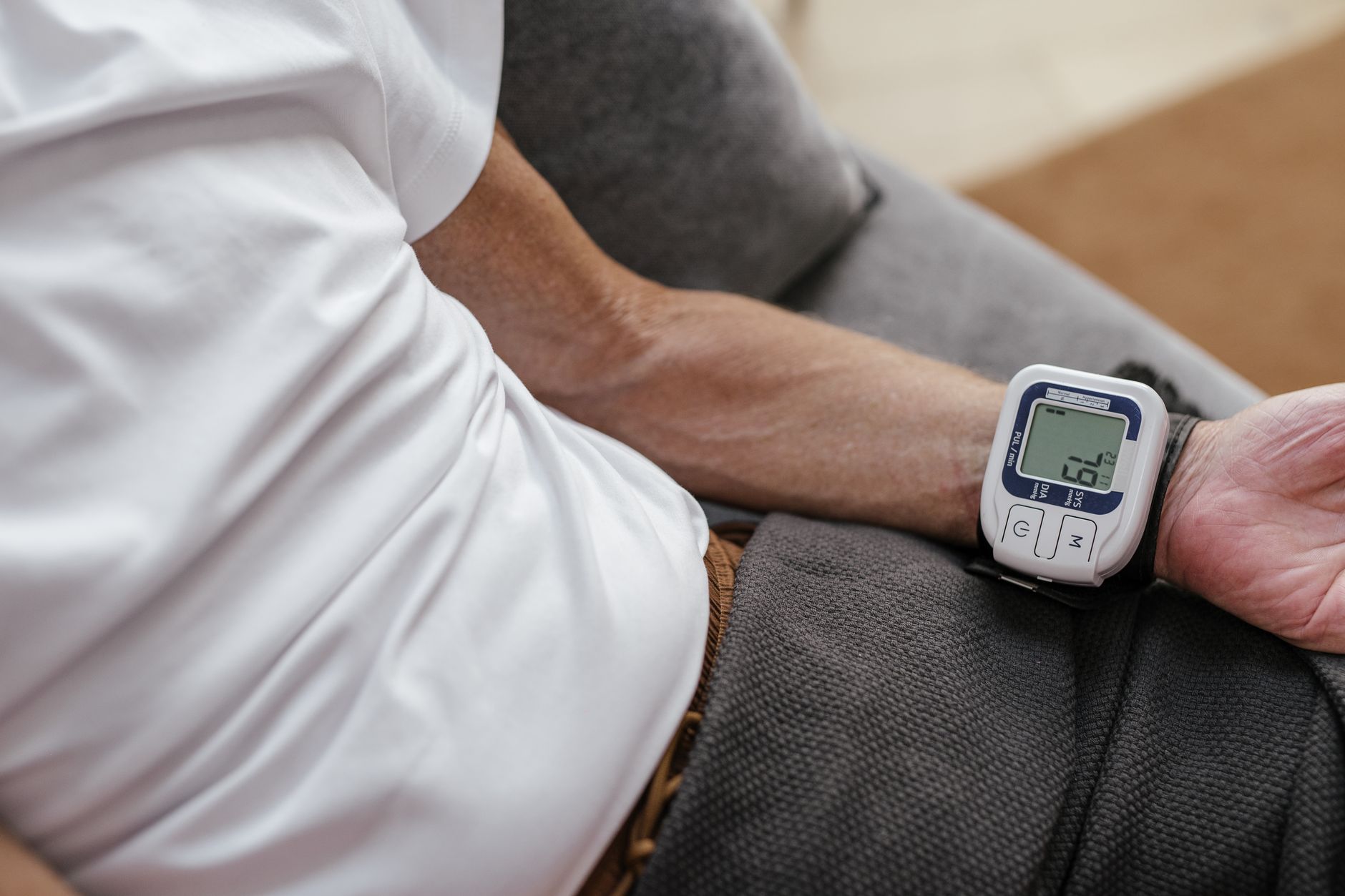
Wrist Monitors
- Compact: Smaller and more portable
- Convenient: Easy to travel with
- Less accurate: Position-sensitive readings, requires positioning at heart level
- Best for: Travel or occasional use, not primary monitoring
Finger Monitors
- Portable: Very small and convenient
- Quick readings: Fast measurements
- Least accurate: Not recommended for clinical use
- Limited use: Best avoided for serious health monitoring
Smart Monitors
- App integration: Connects to smartphones for data tracking
- Data tracking: Records and analyzes trends over time
- Sharing capabilities: Easy to share with doctors
- Advanced features: Irregular heartbeat detection, position sensors
Key Features to Consider
A handful of features separate a monitor you will actually use at 7 a.m. from one that ends up in a drawer.
Accuracy Features
- Validation: Look for monitors validated by ESH, AHA, or BHS
- Irregular heartbeat detection: Identifies potential arrhythmias
- Averaging: Takes multiple readings for greater accuracy
- Calibration: Properly calibrated for precision
Ease of Use Features
- Large display: Easy to read numbers, preferably backlit
- One-touch operation: Simple to use without complex menus
- Voice announcement: Reads results aloud for those with vision challenges
- Memory storage: Records past readings for trend tracking
Comfort Features
- Comfortable cuff: Soft, adjustable material that does not pinch
- Quick inflation: Faster measurements for less discomfort
- Quiet operation: Less noise during inflation
- Multiple cuff sizes: Fits various arm sizes
Additional Features
- Bluetooth/smartphone connectivity: Syncs readings to apps for tracking
- Multiple user profiles: Separate memory for different users
- Average reading calculation: Automatically averages recent readings
- Body position sensor: Alerts if positioned incorrectly
Top Blood Pressure Monitors for Seniors (In-Depth)
1. Omron Platinum BP5450 - Best Overall
Check Price on Amazonamazon- Best for: Seniors who want the most accurate, easiest-to-use monitor with all the features that matter
- Accuracy: Clinically validated by ESH and AHA
- Display: Large, backlit, high-contrast display with extra-big numbers
- Features: Pre-attached Easy-Wrap ComFit cuff, one-touch operation, stores 200 readings for 2 users, Bluetooth sync to smartphone app, irregular heartbeat detection, body position sensor
- Pros: Excellent accuracy, reliable performance, easy to use, advanced features
- Cons: Higher price point, app setup may be challenging for some users
2. Omron 10 Series - Best for Tracking
Check Price on Amazonamazon- Best for: Seniors who want comprehensive tracking and premium accuracy
- Accuracy: Validated by ESH and AHA
- Display: Large, easy-to-read display with backlight
- Features: TruRead mode takes three consecutive readings and averages them, stores up to 200 readings for two users, Bluetooth connectivity, ComFit cuff fits arms 9"-17"
- Pros: Very accurate, excellent tracking capabilities, reliable
- Cons: Higher price, similar to Omron Platinum
3. Greater Goods Premium Upper Arm - Best Value
Check Price on Amazonamazon- Best for: Seniors who want simplicity and value
- Accuracy: FDA cleared
- Display: Large, backlit display with clear readings
- Features: Simple one-button operation, comfortable adjustable cuff, stores up to 120 readings for two users, irregular heartbeat detection, includes AC adapter
- Pros: Affordable, easy to use, reliable, two-year warranty
- Cons: Basic features, less durable than premium models
4. A&D Medical UA-767F - Best for Larger Arms
If your upper arm measures more than 17 inches around, cuff fit decides everything before any other feature matters. This unit ships with a cuff rated to 20 inches and a warranty that lasts as long as you own it.
Check Price on Amazonamazon- Best for: Seniors with larger arms who need clinical accuracy
- Accuracy: Validated by ESH
- Display: Large, easy-to-read display
- Features: Extra-large cuff available (fits arms up to 20 inches), one-touch operation, stores up to 90 readings, irregular heartbeat detection, lifetime warranty
- Pros: Excellent for larger arms, very accurate, lifetime warranty
- Cons: Not Bluetooth enabled
5. Omron Silver - Best Budget
The anti-app pick: one big button, a five-year warranty, and nothing to pair with a phone. It caps at a 13-inch arm, so measure first.
Check Price on Amazonamazon- Best for: Budget-conscious seniors who want reliable accuracy
- Accuracy: Validated by ESH and AHA
- Display: Large display with clear readings
- Features: One-touch operation, stores up to 80 readings, irregular heartbeat detection, comfortable cuff fits arms 9"-13"
- Pros: Affordable, accurate, simple to use, five-year warranty
- Cons: Smaller memory, no Bluetooth, smaller cuff
6. Withings BPM Connect Pro - Best for Large Arms
Check Price on Amazonamazon- Best for: Seniors with large arms who want premium features
- Accuracy: Clinically validated
- Display: Color-changing display (green = good, orange = watch, red = high)
- Features: Extra-large cuff fits up to 22" arms, app syncs automatically to Apple Health/Google Fit, rechargeable battery, premium design
- Pros: Largest cuff range, beautiful display, smart features
- Cons: Premium price, app setup may be complex
7. Welch Allyn Home - Professional Accuracy
Check Price on Amazonamazon- Best for: Seniors wanting hospital-grade accuracy
- Accuracy: Hospital-grade precision
- Display: Extra-large display
- Features: Advanced averaging, data storage, smartphone connectivity, reliable performance
- Pros: Very accurate, clinical quality, excellent features
- Cons: Expensive, more complex than basic models
8. A&D Medical UA-651BLE - Simplest Option
Check Price on Amazonamazon- Best for: Seniors who want simplicity and accuracy above everything else
- Accuracy: Clinical-grade accuracy validated for medical use
- Display: Large, clear digits
- Features: Extremely simple one-button operation, irregular heartbeat detection included, affordable price
- Pros: Very simple to use, accurate, affordable, trusted by clinics
- Cons: Basic design, smaller memory, optional Bluetooth
Does Medicare Cover Home Blood Pressure Monitors?
This is one of the most-searched questions on this topic—and the answer is more nuanced than a simple yes or no. Here is the plain-language breakdown.
Original Medicare (Part A & Part B)
Generally, no. Original Medicare Part B does not cover standard home blood pressure monitors for routine hypertension management. Even with a doctor's prescription, a "regular" home BP cuff is not considered covered Durable Medical Equipment (DME) under the standard Part B benefit for uncomplicated high blood pressure.
There are limited exceptions where Part B may cover a device:
| Situation | Possible Coverage | What You Need |
|---|---|---|
| End-Stage Renal Disease (ESRD) on dialysis | May be covered as DME | Doctor's prescription + dialysis documentation |
| Remote Physiologic Monitoring (RPM) program | Doctor's device may be covered | Enrolled in a Medicare-participating RPM program with a treating physician |
| Post-organ transplant monitoring | Sometimes covered | Transplant team documentation |
| Clinical research study | Sometimes covered | Enrollment in qualifying NIH or Medicare-approved study |
Medicare Advantage (Part C) — Often the Best Route
Medicare Advantage plans (offered by private insurers like UnitedHealthcare, Humana, Aetna, Kaiser) frequently include wellness and preventive benefits not covered by Original Medicare. Many of these plans offer:
- Reimbursement for an OTC home blood pressure monitor (often up to $50-$150/year as part of an OTC catalog benefit)
- Direct coverage when prescribed by an in-network doctor
- Subsidized connected devices (e.g., Omron, Withings) when used in the plan's chronic care program
Action step: Call the member services number on the back of your Medicare Advantage card and ask specifically: "Does my plan include an OTC benefit or chronic-care benefit that covers a home blood pressure monitor?"
FSA and HSA — Yes, Eligible
Home blood pressure monitors are FSA/HSA-eligible medical devices. If you have a Flexible Spending Account (through an employer) or a Health Savings Account (paired with a high-deductible health plan), you can:
- Pay directly with your FSA/HSA debit card
- Submit the receipt for reimbursement
- Use pre-tax dollars (effectively a 20-30% discount depending on your tax bracket)
This is the route most seniors on Original Medicare end up using.
Medicaid and VA Coverage
- Medicaid: Coverage varies by state. Many state Medicaid programs will cover a home BP monitor with a doctor's prescription—check with your state's Medicaid office.
- VA (Veterans Affairs): Enrolled veterans can often receive a monitor through the VA's Chronic Care Management program or via a VA primary care provider.
What to Say to Your Doctor and Plan
When asking about coverage, use this exact phrasing:
"I'd like to manage my hypertension at home. Can you write a prescription for a home blood pressure monitor, and document in my chart that I have a diagnosis of hypertension (ICD-10 code I10)? I also want to know if I qualify for Remote Physiologic Monitoring (RPM) services under Medicare."
The ICD-10 code and RPM request are what trigger most coverage pathways.
Upper Arm vs Wrist Blood Pressure Monitor for Seniors
This is the second most-common decision seniors face when buying a monitor. The short answer: for most older adults, the American Heart Association recommends an upper arm monitor. Here is why, and when a wrist monitor may still make sense.
Why Upper Arm Monitors Win for Seniors
The American Heart Association (AHA) officially recommends upper arm monitors for home blood pressure monitoring. The reason is anatomical: the brachial artery at the upper arm sits at roughly the same level as the heart and produces the most reliable pressure reading—closest to what your doctor measures in the office.
| Factor | Upper Arm Monitor | Wrist Monitor |
|---|---|---|
| Accuracy | Highest—AHA-recommended | Position-sensitive (must be exactly at heart level) |
| Ease for arthritic hands | Easier—large cuff, easy to wrap | Can be tricky to position alone |
| Reading consistency | Very consistent between users | Less consistent—small positioning errors cause large swings |
| Cuff size range | Standard to XXL (9"-22"+) | Limited to average wrist sizes |
| Portability | Bulkier, needs case | Compact, fits in purse |
| Best for | Daily home use, seniors, anyone with hypertension | Travel, very large upper arms where no upper arm cuff fits |
When a Wrist Monitor May Be the Better Choice
A wrist monitor is not "wrong"—it is simply less forgiving. Consider a wrist monitor if:
- You have very large upper arms (above 22") and no upper arm cuff fits well
- You travel frequently and need something pocket-sized
- You have severe shoulder arthritis that makes wrapping an upper arm cuff painful
- You are willing to follow strict measurement protocol: arm crossed over chest, wrist exactly at heart level, motionless for the entire reading
If you choose a wrist monitor, validate its accuracy against an upper arm unit at your doctor's office at least once.
Why Finger Monitors Are Not Recommended
Skip finger blood pressure monitors entirely for home use. They measure pressure in the small finger arteries, which are far from the heart and heavily influenced by hand temperature, position, and circulation. They are not recommended by the AHA for clinical or home monitoring of hypertension.
For our detailed comparison, see our dedicated guide: Upper Arm vs Wrist Blood Pressure Monitor: Which Is Better for Seniors?.
Best Blood Pressure Monitor for Large Arms
Cuff fit is the single biggest factor in accuracy—bigger than brand, bigger than price, bigger than any feature. An undersized cuff can overstate your blood pressure by 10-20 mmHg, leading to false hypertension diagnoses and unnecessary medication. An oversized cuff can understate it by the same amount, masking real hypertension.
How to Measure Your Arm Correctly
- Use a soft tailor's tape measure (the kind used for sewing)
- Measure around the midpoint of your upper arm—halfway between your shoulder and elbow
- Keep the tape snug but not pinching
- Measure on your bare skin, not over a sleeve
- If between sizes, size up
| Arm Circumference | Cuff Size Needed | Our Top Picks |
|---|---|---|
| 7"-9" (small adult) | Small adult cuff | Omron small cuff accessory (HEM-CS24-B) |
| 9"-13" (standard adult) | Standard adult cuff | Omron Silver |
| 9"-17" (large adult, most common) | Wide-range cuff | Omron Platinum BP5450, Omron 10 Series, Greater Goods Premium |
| 9"-20" (extra large) | Extra-large cuff | A&D Medical UA-767F |
| 9"-22" (XXL / bariatric) | XXL cuff | Withings BPM Connect Pro |
Best Picks for Larger Arms
- Up to 20" arms: The A&D Medical UA-767F is ESH-validated and ships with a cuff rated to 20 inches. It is the most clinically accurate option for larger arms and includes a lifetime warranty.
- Up to 22" arms: The Withings BPM Connect Pro has the widest cuff range of any monitor on this list (9"-22") and pairs with a smart app for trend tracking.
- Above 22" arms: Consider a bariatric-specific cuff from ADC (American Diagnostic Corporation) or a wrist monitor used with strict heart-level positioning protocol.
Quick Tip: Check the Cuff Before Buying
Before you click "buy," check the cuff size range listed in the product specifications—not just the monitor model. Two Omron Platinum units can ship with different cuffs depending on the SKU. If you need a different cuff size, manufacturers sell replacement cuffs separately (typically $20-$40).
How to Choose the Right Monitor
Four measurements decide most of the purchase: your arm circumference, your eyesight, your hands, and your comfort with apps.
Assess Your Needs
- Arm size: Ensure cuff fits properly—measure around your bare upper arm midway between elbow and shoulder
- Vision needs: Large display or voice announcement may be important
- Dexterity: Easy cuff application and one-touch operation preferred
- Tech comfort: Smart features or simple operation depending on preference
Consider Accuracy Requirements
- Medical conditions: Consult your healthcare provider for specific needs
- Frequency of use: More frequent monitoring requires durability
- Budget: Balance features with affordability
- Warranty: Look for good warranty coverage
Must-Have Features for Seniors
- Upper arm cuff (more accurate than wrist)
- Large, easy-to-read display (avoid tiny digits)
- One-button simple operation
- Clinically validated accuracy
- Comfortable, easy-to-apply cuff
How to Use Your Monitor
The same validated monitor can read several points high or low depending on how you sit. The protocol below removes that variance.
30 Minutes Before Measurement
- Avoid caffeine, nicotine, and exercise for thirty minutes
- Empty your bladder—a full bladder may affect readings
- Sit quietly for five minutes to allow your body to relax
- Avoid measuring when stressed or anxious
During Measurement
- Position: Sit with back supported, feet flat on floor
- Arm position: Rest arm on flat surface at heart level
- Cuff placement: Position on bare upper arm about 1 inch above elbow
- Stay still: Do not talk or move during reading
- Proper cuff fit: Cuff should be snug but not tight—you should be able to fit 1-2 fingers underneath
- Multiple readings: Take two or three readings, one minute apart, and average them
After Measurement
- Record results: Note date, time, and reading
- Track trends: Keep log of daily readings
- Share with doctor: Bring records to appointments
- Regular calibration: Check accuracy periodically at your doctor's office
Tips for Accurate Readings
Prepare Properly
- Avoid caffeine, nicotine, and exercise for at least 30 minutes before measuring
- Empty your bladder before measuring
- Sit quietly for 5 minutes to allow your body to relax
- Avoid measuring when stressed or anxious
Position Correctly
- Sit with your back supported against a chair
- Keep your feet flat on the floor—do not cross your legs
- Support your arm at heart level on a table or armrest
- Place the cuff on bare skin, not over clothing
- Position the cuff about 1 inch above your elbow
Take Multiple Readings
- Take 2-3 readings, waiting 1-2 minutes between each
- Average the readings for a more accurate result
- Discard the first reading if it is significantly higher than others
- Take readings at the same time each day for consistency
Track Your Readings
- Record readings in a notebook, app, or the monitor's memory
- Note the date, time, and any relevant factors (stress, medication changes, sleep quality)
- Track patterns over weeks and months
- Bring your records to doctor appointments
Blood Pressure Guidelines
Use the table below to translate the two numbers on screen — and to know when to pick up the phone.
| Category | Systolic (mmHg) | Diastolic (mmHg) | Action |
|---|---|---|---|
| Normal | Less than 120 | Less than 80 | Maintain healthy lifestyle |
| Elevated | 120-129 | Less than 80 | Lifestyle changes recommended |
| Hypertension Stage 1 | 130-139 | 80-89 | Lifestyle changes, medication may be needed |
| Hypertension Stage 2 | 140 or higher | 90 or higher | Medication and lifestyle changes |
| Hypertensive Crisis | Higher than 180 | Higher than 120 | Seek immediate medical attention |
These guidelines from the American College of Cardiology and American Heart Association help categorize blood pressure readings. Work with your doctor to determine your personal target range.
Common Mistakes to Avoid
These are the top reasons for inaccurate readings:
- Wrong cuff size: Too big or too small produces unreliable readings; this is the most common error
- Talking during reading: Even casual conversation may raise readings by 5-10 points
- Crossed legs: Increases pressure and affects accuracy
- Unsupported arm: Arm must rest at heart level on a surface
- Full bladder: May increase readings by 10-15 points
- Measuring right after eating or exercise: Wait at least 30 minutes
- Cold room temperature: Cold may raise blood pressure; measure in a comfortable environment
- Single readings: Take 2-3 readings spaced 1-2 minutes apart and average them
Maintenance and Care
Keep your monitor working accurately for years.
Regular Care
- Clean: Wipe cuff and monitor with damp cloth
- Store: Keep in dry, cool place
- Replace batteries: Change when low battery indicator appears
- Check calibration: Verify accuracy annually at your doctor's office
Troubleshooting Common Issues
- Inconsistent readings: Check cuff placement and position
- Error messages: Consult user manual for specific codes
- Display problems: Replace batteries first
- Accuracy concerns: Compare with doctor's office reading
Top Brands to Consider
Omron
- Most popular brand in home monitoring, recommended by doctors and pharmacists
- Wide range of models from basic to advanced
- Many models validated by ESH and AHA
- Strong customer support and warranty
A&D Medical
- Known for clinical-grade accuracy
- Wide range of cuff sizes available, including extra-large
- Validated by major hypertension organizations
- Lifetime warranty on some models
Greater Goods
- Affordable options without sacrificing quality
- Simple, easy-to-use designs ideal for seniors
- Two-year warranties standard
- AC adapters included with many models
Welch Allyn
- Hospital-grade accuracy
- Professional-level features
- Trusted by medical professionals
- Best for those needing medical-grade monitoring
When to Contact Your Doctor
Contact your healthcare provider if you notice:
- Readings consistently above your target range
- Sudden significant changes in blood pressure
- Symptoms like headache, dizziness, or chest pain along with high readings
- Readings that vary widely between measurements
- Irregular heartbeat alert triggers repeatedly
Seek immediate medical care if your blood pressure reads above 180/120 or if you experience severe headache, vision changes, chest pain, or difficulty breathing.
Expert Recommendations
American Heart Association
- Home monitoring is recommended for all with hypertension
- Use clinically validated monitors
- Measure at same time daily for consistency
- Share results with your doctor at all appointments
Primary Care Physicians
- Consult before purchasing a monitor
- Learn proper measurement techniques
- Establish a regular checking routine
- Work together to achieve target readings
Related Articles
- Upper Arm vs Wrist Blood Pressure Monitor: Which Is Better for Seniors? — Full comparison and AHA recommendations
- Healthy Blood Pressure Lifestyle — Daily habits that may help lower blood pressure naturally
- Morning Routine for Blood Pressure — How to start your day for steadier readings
- Salt and Heart Health — Sodium guidelines for seniors with hypertension
- Magnesium and Blood Pressure — What the research says about magnesium and BP
- Vitamins and Supplements for Seniors — Evidence-based supplements for older adults
- Signs of Heart Problems in the Elderly — When to seek immediate care
- Atrial Fibrillation (AFib) in Seniors — Understanding the most common arrhythmia
- Best Medical Alert Systems for Seniors Living Alone
- Best Medication Organizers for Seniors
- Best Pulse Oximeters
- Fitness Trackers for Seniors
References
- CDC: High Blood Pressure Facts
- American Heart Association: Monitoring Your Blood Pressure at Home
- National Institute on Aging: High Blood Pressure
- American College of Cardiology: Blood Pressure Guidelines
- Mayo Clinic: Getting the Most Accurate Blood Pressure Reading
- Medicare.gov: Durable Medical Equipment (DME) Coverage
- Harvard Health: Choosing a Blood Pressure Monitor
- Journal of the American Medical Association: Home Blood Pressure Monitoring Accuracy
- StrideBP: Validated Blood Pressure Monitors List
Disclaimer: This information is for educational purposes only. Home blood pressure monitors are not a substitute for medical care. Consult your healthcare provider about blood pressure management and before making any changes to your treatment plan. Medicare coverage details are based on publicly available information at the time of writing—always verify current benefits with your plan administrator or 1-800-MEDICARE.