📌Key Takeaways
- Waist-deep water supports about 50% of body weight and chest-deep water 70-80%, easing stress on arthritic knees and hips
- Exercise in water heated to 83-88°F (28-31°C); pools below 82°F may stiffen arthritic joints
- Begin each session with 3-5 minutes of water walking, then knee lifts (10-15 per leg) and side leg raises (10-12 per leg)
- Aim for 30-45 minute sessions, 2-3 times weekly; add foam dumbbells or a pool noodle only after your form is solid
- No swimming ability needed—most exercises are done standing in waist-deep water within reach of the pool edge
Are pool exercises good for arthritis pain? Yes, pool exercises are one of the best forms of exercise for arthritis pain relief. Water's buoyancy reduces joint stress while providing resistance for strengthening. Many people report significant arthritis pain reduction within weeks.
Do I need to know how to swim for arthritis water exercises? No, swimming ability is not required. Most arthritis water exercises are performed standing in waist-to-chest-deep water with pool edge support available.
How often should I do pool exercises for arthritis? 2-3 sessions per week of 30-45 minutes each provides optimal arthritis benefits. Consistency is more important than intensity for arthritis pain relief.
What temperature should the pool be for arthritis exercise? The ideal pool temperature for arthritis exercise is 83-88°F (28-31°C). Warm water relaxes muscles and joints while allowing comfortable exercise for arthritis sufferers.
Arthritis affects millions of people, causing joint pain and stiffness that can make exercise feel impossible. Pool exercises provide a solution—the buoyancy reduces joint stress while the resistance enables effective strengthening.
Arthritis Foundation Recommendation
The Arthritis Foundation recommends aquatic exercise as one of the best forms of exercise for people with arthritis, citing reduced pain and improved function.
Consult Your Doctor
If you have severe arthritis, rheumatoid arthritis with active inflammation, or other health conditions, consult your doctor or physical therapist before starting any new exercise program.
12 Best Pool Exercises for Arthritis Pain Relief
These exercises target the most common arthritis-affected joints—knees, hips, shoulders, and hands/wrists—while minimizing joint stress.
Best Water Exercises for Knee Arthritis
Knee arthritis is one of the most common forms of arthritis. These water exercises specifically target knee mobility and strength:
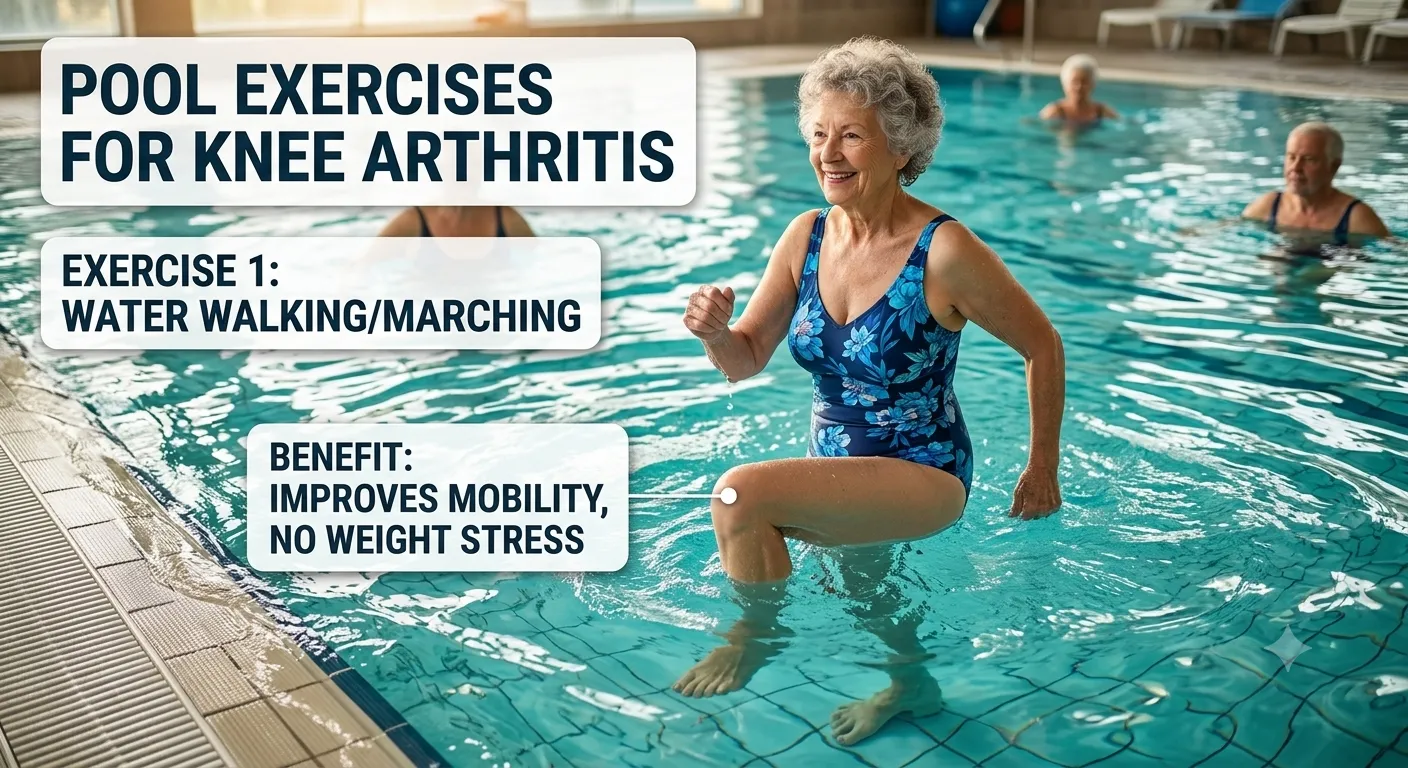
1. Water Walking/Marching
How to do it:
- Stand in waist-deep water
- March in place, lifting knees comfortably high
- Swing arms naturally for balance
- Keep core engaged
Benefits for knee arthritis:
- Improves knee mobility without weight-bearing stress
- Strengthens quadriceps muscles that support the knee
- Enhances walking mechanics
- Low impact on arthritic joints
Frequency: 3-5 minutes per session
2. Knee Lifts
How to do it:
- Stand holding pool edge for support
- Lift right knee toward chest
- Hold for 2-3 seconds
- Lower slowly
- Repeat on left side
Benefits for knee arthritis:
- Strengthens quadriceps muscles
- Supports knee stability
- Improves hip flexor flexibility
- Maintains knee range of motion
Frequency: 10-15 repetitions per leg
3. Leg Extensions
How to do it:
- Hold pool edge with both hands
- Extend right leg behind you
- Keep leg straight but not locked
- Hold for 2 seconds
- Return slowly
- Switch legs
Benefits for knee arthritis:
- Strengthens hamstrings and glutes
- Improves knee extension
- Reduces knee pain during walking
- Enhances balance
Frequency: 10-15 repetitions per leg
Best Water Exercises for Hip Arthritis
Hip arthritis often limits movement—these pool exercises improve mobility and reduce stiffness:
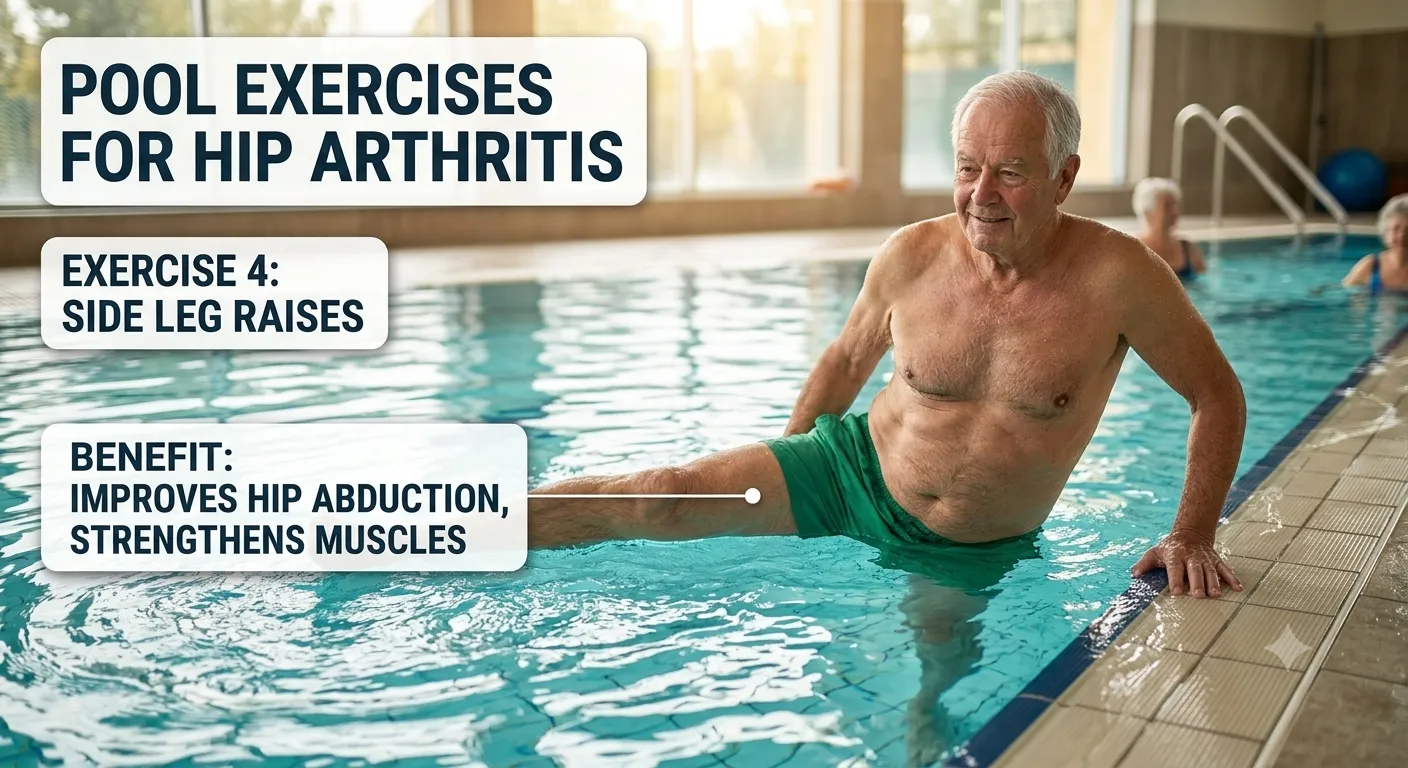
4. Side Leg Raises
How to do it:
- Stand sideways to pool wall
- Hold wall for balance
- Lift outside leg out to side
- Keep leg straight
- Lower slowly
- Switch sides
Benefits for hip arthritis:
- Improves hip abduction
- Strengthens hip muscles
- Reduces hip stiffness
- Enhances side-step ability
Frequency: 10-12 repetitions per leg
5. Hip Circles
How to do it:
- Hold pool edge for support
- Lift right knee to hip height
- Rotate hip in clockwise circles
- Complete 10 circles
- Reverse direction
- Switch legs
Benefits for hip arthritis:
- Increases hip range of motion
- Loosens tight hip flexors
- Improves walking mechanics
- Reduces hip pain
Frequency: 10 circles each direction per leg
6. Standing Marches
How to do it:
- Stand in chest-deep water
- March in place with high knees
- Swing arms for balance
- Keep back straight
Benefits for hip arthritis:
- Strengthens hips and legs
- Improves coordination
- Enhances cardiovascular health
- Low impact on joints
Frequency: 2-3 minutes
Best Water Exercises for Shoulder Arthritis
Shoulder arthritis can limit daily activities—these water exercises improve flexibility and strength:
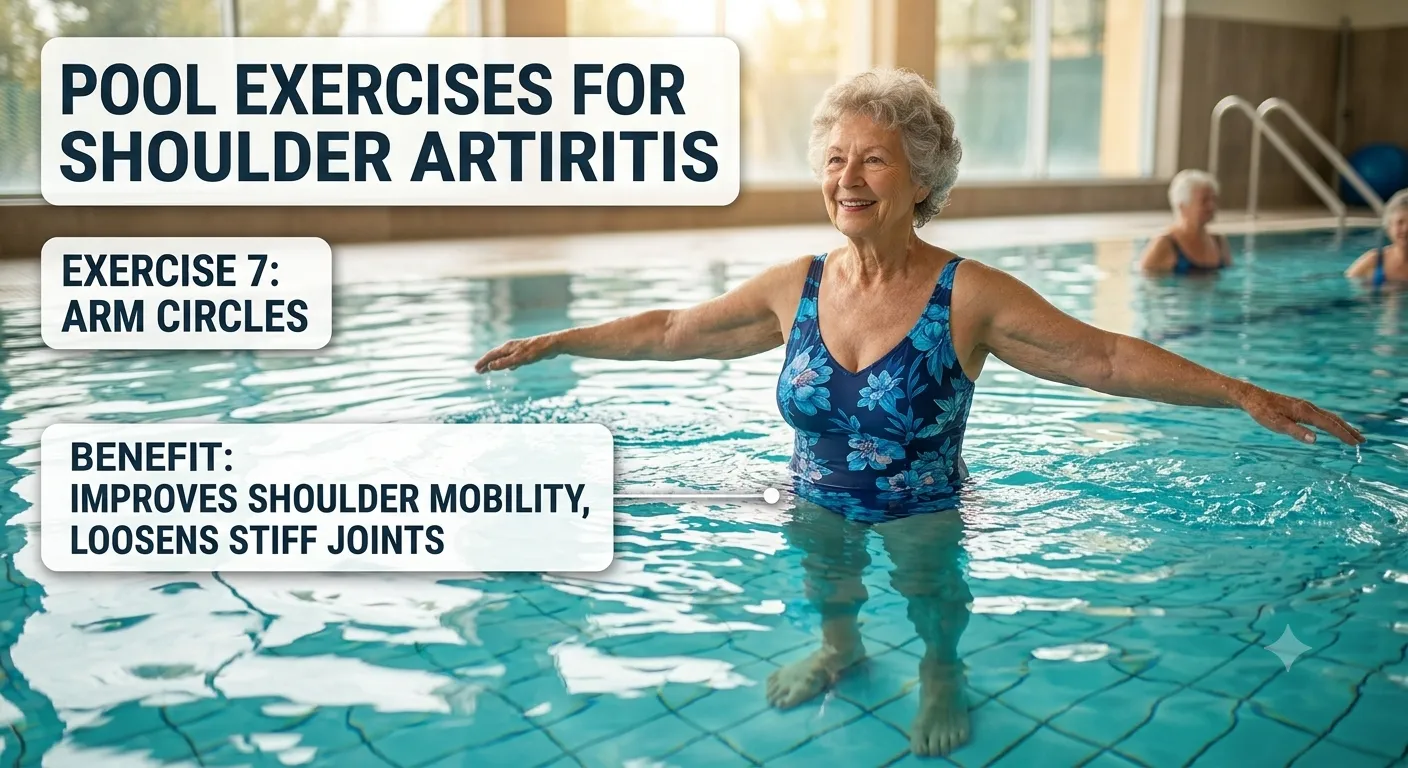
7. Arm Circles
How to do it:
- Stand with feet shoulder-width apart
- Extend arms to sides at shoulder height
- Make small circles forward
- Complete 10 circles
- Reverse direction
Benefits for shoulder arthritis:
- Improves shoulder mobility
- Loosens stiff joints
- Enhances blood flow
- Prevents frozen shoulder
Frequency: 10 circles each direction
8. Water Push-Pulls
How to do it:
- Stand with back to pool wall
- Place hands on wall at shoulder height
- Push against wall, then pull hands toward you
- Repeat with controlled movements
Benefits for shoulder arthritis:
- Strengthens chest and back muscles
- Improves shoulder stability
- Reduces shoulder pain
- Enhances posture
Frequency: 10-15 repetitions
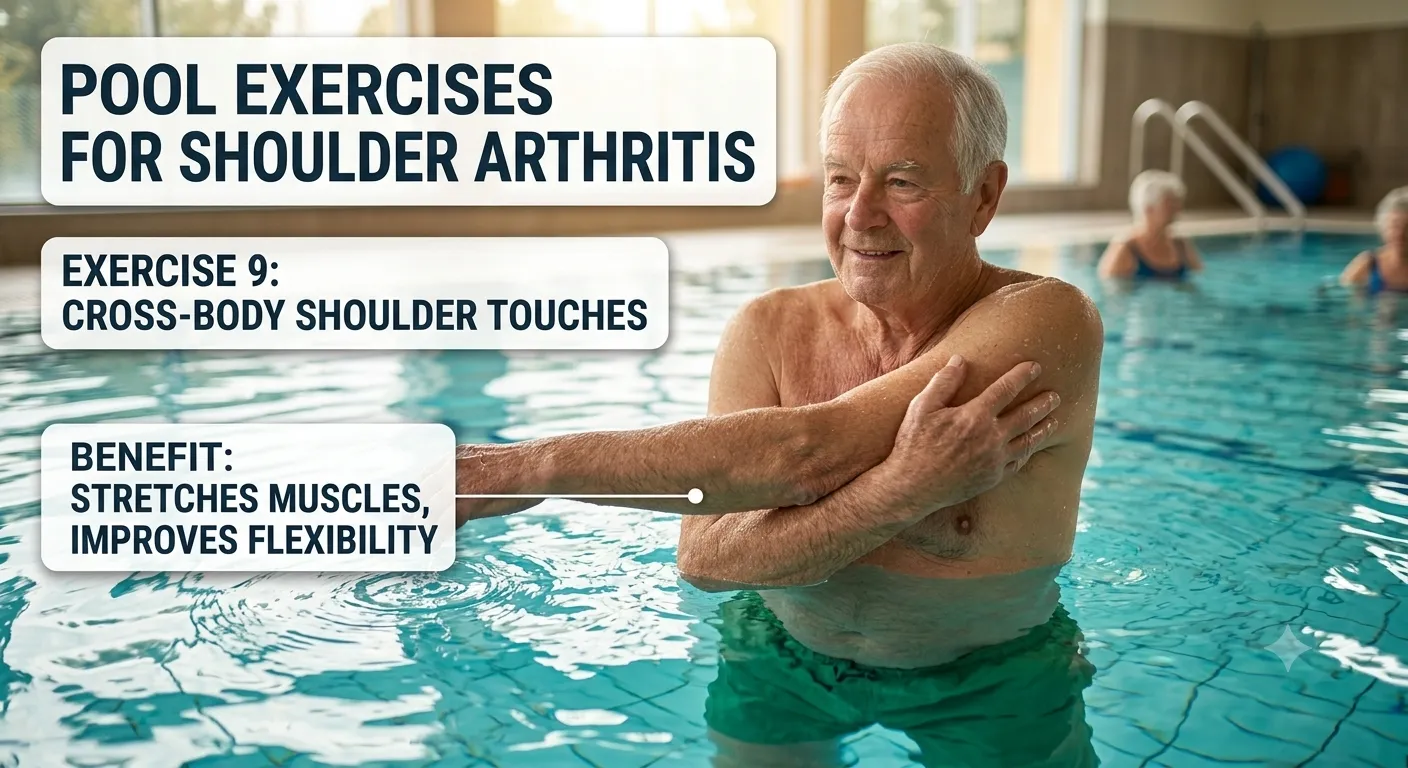
9. Cross-Body Shoulder Touches
How to do it:
- Stand in waist-deep water
- Reach right arm across body toward left shoulder
- Hold for 2 seconds
- Return to starting position
- Switch arms
Benefits for shoulder arthritis:
- Stretches shoulder muscles
- Improves cross-body reach
- Reduces shoulder tightness
- Enhances flexibility
Frequency: 10 repetitions per arm
Best Water Exercises for Hand and Wrist Arthritis
Hand arthritis affects daily tasks—these gentle water exercises improve grip and flexibility:
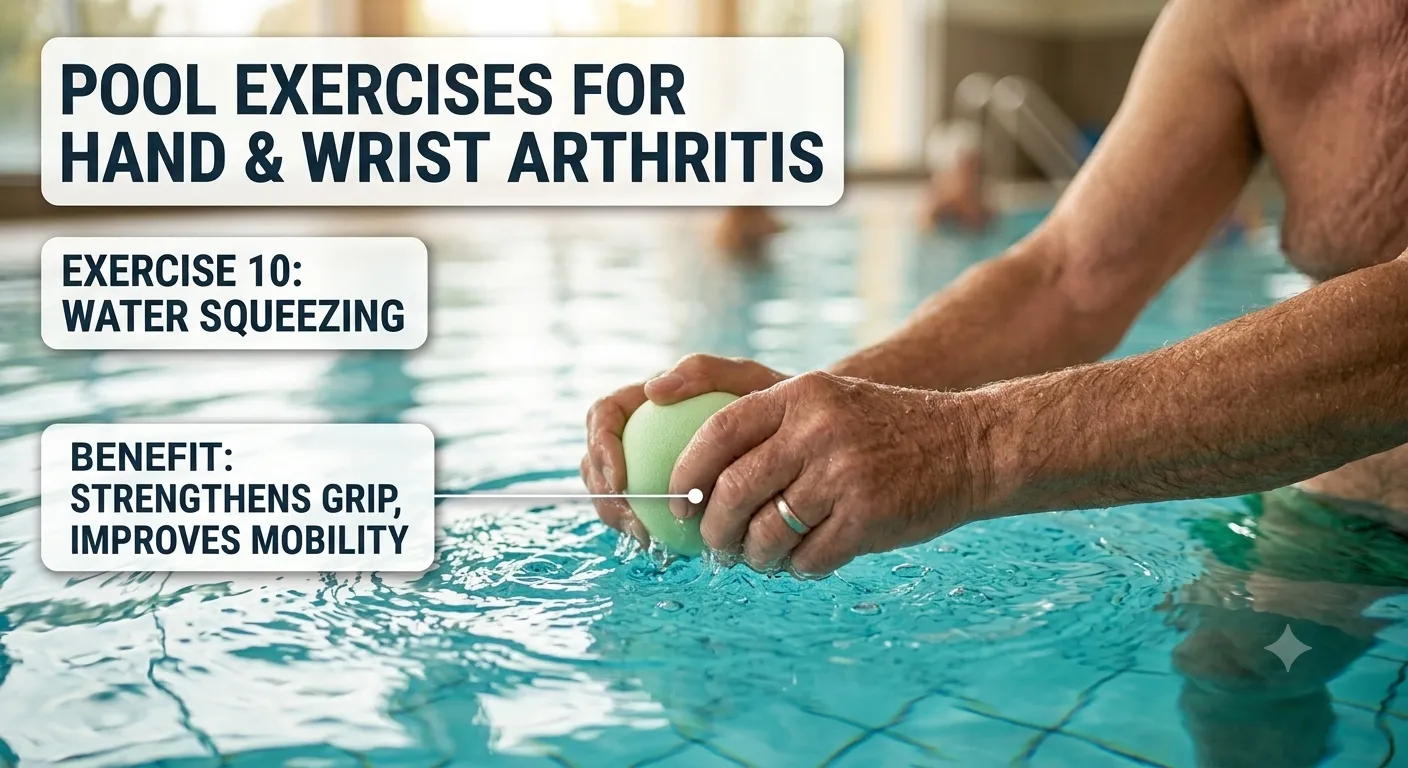
10. Water Squeezing
How to do it:
- Hold a soft ball or foam block
- Squeeze firmly in water
- Hold for 2 seconds
- Release slowly
Benefits for hand/wrist arthritis:
- Strengthens grip
- Improves hand mobility
- Reduces finger stiffness
- Enhances fine motor skills
Frequency: 10 squeezes per hand
11. Finger Opening Exercises
How to do it:
- Place hand flat in water
- Spread fingers wide
- Hold for 2 seconds
- Clench into fist
- Repeat
Benefits for hand/wrist arthritis:
- Improves finger flexibility
- Reduces joint stiffness
- Enhances hand function
- Maintains range of motion
Frequency: 10 repetitions per hand
12. Wrist Rotations
How to do it:
- Extend arm in front of you
- Rotate wrist in circular motion
- Complete 10 circles clockwise
- Reverse direction
Benefits for hand/wrist arthritis:
- Improves wrist mobility
- Reduces wrist pain
- Enhances forearm strength
- Supports daily activities
Frequency: 10 circles each direction per wrist
Exercise Order Tip
Always perform exercises from larger joints to smaller joints: hips → knees → shoulders → hands/wrists. This warms up the body systematically.
Intermediate Water Exercises for Arthritis
Once you're comfortable with the basic exercises, you can add these intermediate movements to challenge yourself:
Cross-Country Skiing Motion
This full-body exercise mimics skiing movement.
How to do it:
- Stand in chest-deep water
- Move opposite arm and leg forward together
- Continue alternating in skiing motion for 2-3 minutes
Benefits: Full-body cardio, improves coordination
Pool Noodle Exercises
Pool noodles add variety and flotation support:
- Noodle bicycling: Sit on noodle and pedal your legs
- Noodle resistance: Push noodle down into water
- Noodle pulling: Pull noodle ends apart for chest strengthening
Benefits: Versatile, adds resistance, improves balance
Water Jogging
For those who want more cardiovascular challenge:
- Stand in deep enough water that feet don't touch bottom (or use flotation belt)
- Jog in place with more vigorous movements
Benefits: High cardio, zero impact
Why Pool Exercises Help Arthritis
Buoyancy Benefits
Water buoyancy supports up to 90% of body weight, depending on depth. This dramatically reduces stress on arthritic joints:
| Pool Depth | Body Weight Supported | Best For |
|---|---|---|
| Waist-deep | 50% | Light exercise, beginners |
| Chest-deep | 70-80% | Moderate exercise |
| Neck-deep | 90% | Advanced exercise, minimal joint stress |
Resistance Benefits
Water provides natural resistance in all directions:
- Strengthens muscles without weights
- Gradual resistance—no jarring movements
- Works all muscle groups simultaneously
- Improves balance and coordination
- Creates warmth that soothes joints
Hydrostatic Pressure Benefits
The pressure of water against your body provides additional therapeutic benefits:
- Reduces swelling in joints
- Improves circulation
- Supports joints naturally
- Enhances proprioception (body awareness)
- Helps with fluid drainage
Research Insight
Studies suggest that aquatic exercise may help reduce arthritis pain by 30-40% and improve function by 20-30% in adults with osteoarthritis (Cochrane Review, 2021).
Water Aerobics vs Walking for Arthritis
Many people wonder whether water aerobics or walking is better for their arthritis. Here's how they compare:
| Factor | Water Aerobics | Walking |
|---|---|---|
| Joint stress | Very low | Moderate |
| Balance support | Excellent | Limited |
| Calorie burn | Moderate | Moderate |
| Fall risk | Low | Higher |
| Arthritis flare days | Easier to manage | Harder during flares |
| Muscle strengthening | Full-body | Lower body focused |
| Flexibility improvement | Excellent | Moderate |
| Accessibility | Requires pool | Can do anywhere |
When to choose water aerobics:
- Severe knee or hip arthritis
- Balance concerns
- Recent joint replacement
- Fear of falling
- Morning stiffness that improves with warmth
When walking may be better:
- No pool access
- Prefer outdoor activity
- Mild arthritis with good balance
The Physics Behind Water Exercise
Water provides buoyancy (reduces weight-bearing) and resistance (strengthens muscles) simultaneously. This combination is impossible to replicate on land without specialized equipment.
Which Type of Arthritis Benefits Most from Water Exercise?
Water exercise benefits most arthritis types, but some see greater advantages:
| Arthritis Type | Water Exercise Benefit | Key Advantage |
|---|---|---|
| Osteoarthritis | Reduces joint compression | Decreased pain during movement |
| Rheumatoid Arthritis | Improves mobility during remission | Maintains function between flares |
| Hip Arthritis | Allows movement without impact | Reduces fall risk |
| Knee Arthritis | Decreases weight-bearing load | Less pain than walking |
| Shoulder Arthritis | Warm water improves flexibility | Easier range of motion |
| Hand/wrist Arthritis | Gentle resistance training | Improves grip strength |
What Results Can You Expect from Water Aerobics?
Research Snapshot
A comprehensive review published in Arthritis Care & Research analyzed 17 studies on aquatic exercise for arthritis and found consistent improvements in:
| Outcome | Average Improvement | Evidence Level |
|---|---|---|
| Pain scores | 30-40% reduction | Strong |
| Walking ability | 20-30% improvement | Strong |
| Physical function | 15-25% improvement | Moderate |
| Quality of life | Significant improvement | Moderate |
| Balance | Reduced fall risk | Strong |
These improvements were seen in adults with both knee and hip osteoarthritis.
When Will You Notice Results?
| Timeline | Expected Improvements | What to Focus On |
|---|---|---|
| 1-2 Weeks | Less stiffness after exercise, easier movement | Consistency |
| 3-4 Weeks | Improved joint mobility, less morning stiffness | Form and technique |
| 6-8 Weeks | Reduced arthritis pain, better walking distance | Gradual progression |
| 12 Weeks | Better strength and endurance, maintained improvements | Advanced exercises |
Research Finding
A 12-week aquatic exercise program in adults with osteoarthritis showed sustained improvements in pain, function, and quality of life—even 6 months after the program ended.
Recommended Water Exercise Equipment for Arthritis
Simple equipment can enhance your pool exercise routine without adding stress to arthritic joints:
| Equipment | Purpose for Arthritis | Benefit |
|---|---|---|
| Pool Noodle | Flotation support, resistance | Inexpensive, improves balance |
| Foam Dumbbells | Upper body strengthening | Gentle resistance for weak muscles |
| Water Gloves | Increased resistance | Strengthens hand/wrist grip |
| Aqua Jogging Belt | Deep water exercise | Zero impact, ideal for severe arthritis |
Equipment Tip
Start with no equipment and add tools gradually. Focus on form before adding resistance. Begin with the exercises that target your most affected joint.
For detailed recommendations on the best water exercise equipment for seniors, check out our comprehensive guide: Best Water Exercise Equipment for Seniors
Effective Aqua Aerobics Exercises for Arthritis
📝Step-by-Step Guide
- 1Warm up with 5 minutes of gentle pool walking
- 2Perform ankle circles and arm swings
- 3March in place, lifting knees gradually
- 4Do side steps and leg swings
- 5Include arm circles and bicycle motion
- 6Cool down with gentle stretching
Warm-Up (5 minutes)
| Exercise | Duration | Target Joints |
|---|---|---|
| Pool Walking | 2 min | Hips, knees, ankles |
| Ankle Circles | 1 min | Ankles |
| Arm Swings | 2 min | Shoulders, elbows |
Main Workout (20 minutes)
| Exercise | Duration | Target Areas | Intensity |
|---|---|---|---|
| Marching | 3 min | Legs, core | Low-Medium |
| Leg Swings | 3 min | Hips, knees | Low |
| Standing Knee Lifts | 3 min | Hip flexors | Medium |
| Side Steps | 3 min | Outer thighs | Medium |
| Arm Circles | 3 min | Shoulders | Low |
| Bicycle Motion | 3 min | Quadriceps | Medium |
| Modified Jumping Jacks | 2 min | Full body | Low |
Cool Down (5 minutes)
- Gentle walking to lower heart rate
- Gentle stretching while holding pool edge
- Deep breathing exercises
Start Slowly
If you're new to water exercise, start with just 10-15 minutes and gradually increase duration as your strength and confidence improve.
Safety Tips for Arthritis Water Exercise
Before You Start
- Consult your doctor or physical therapist
- Check with pool staff about arthritis-friendly programs
- Arrive early to acclimate to pool temperature
- Bring a friend or caregiver if possible
During Exercise
- Stay hydrated even though you're in water
- Use pool edge for support when needed
- Avoid overexertion—pain is not gain
- Stop if you experience sharp pain or dizziness
- Use water shoes for better footing
After Exercise
- Take a warm shower to relax muscles
- Apply heat to sore joints if helpful
- Rest adequately between sessions
- Track your pain levels to monitor progress
Getting Started
Finding the Right Pool
| Factor | What to Look For |
|---|---|
| Temperature | 83-88°F (28-31°C) |
| Depth | Shallow area for standing exercises |
| Accessibility | Easy entry/exit (stairs, ramp, lift) |
| Programs | Arthritis-specific or senior water exercise classes |
| Timing | Classes when you're most energetic |
Equipment You'll Need
| Item | Purpose | Required? |
|---|---|---|
| Swimsuit | Comfortable, supportive | Yes |
| Water shoes | Grip, protection | Recommended |
| Goggles | Eye protection | Optional |
| Swim cap | Keep hair out of face | Optional |
| Water bottle | Stay hydrated | Yes |
| Towel | Dry off after | Yes |
Types of Arthritis Water Exercise Programs
| Program | Description | Best For |
|---|---|---|
| Arthritis Foundation Aquatic Program | Specially designed for arthritis pain relief | Arthritis beginners |
| Arthritis Water Aerobics | Pool exercises focused on joint health | All arthritis types |
| Deep Water Arthritis Exercise | Zero weight-bearing movements | Severe knee/hip arthritis |
| Aqua Therapy for Arthritis | Medical/therapeutic aquatic exercise | Specific arthritis conditions |
Arthritis Foundation Aquatic Program
This specialized program, approved by the Arthritis Foundation, includes water exercises specifically designed for people with arthritis. Many community pools offer these classes.
Tips for Your First Class
- Arrive 15 minutes early to change and acclimate
- Introduce yourself to the instructor—mention your arthritis
- Start at the back of the class if you're nervous
- Don't compare yourself to others
- Ask for modifications if an exercise hurts
- Celebrate small victories
Who Should Avoid Water Exercise?
While water exercise is generally safe, consult your doctor if you have:
- Open wounds or skin infections
- Uncontrolled heart conditions
- Severe respiratory problems
- Active joint inflammation (flare-up)
- Fever or acute illness
Medical Consultation
Always discuss new exercise programs with your healthcare provider, especially if you have other health conditions alongside arthritis.
Aquatic Therapy for Specific Conditions
In addition to arthritis, water exercise can benefit several other conditions common among seniors:
Hip Replacement Recovery
- When to Start: Typically 2-4 weeks after surgery, once incision is healed
- Water Walking - Walk forward slowly in waist-deep water
- Standing Hip Abduction - Lift one leg out to side, hold 2 seconds, repeat 10 times per leg
- Hip Extension - Move one leg straight backward, squeeze glutes, repeat 10 times per leg
Lower Back Pain
- Water Walking - Engages core muscles while water supports your spine
- Wall-Facing Leg Lifts - Lift one leg straight backward, hold 3 seconds, repeat 10 times per leg
- Knee-to-Chest - Lift knee toward chest, hold 3 seconds, repeat 10 times per leg
- Noodle-Assisted Floating Stretch - Hold noodle across chest, lean back, float for 2-3 minutes
Balance Problems
- Single Leg Stand - Lift one foot slightly, hold 10-30 seconds, switch legs
- Tandem Walking - Walk forward placing heel directly in front of toes
- Clock Reach - Imagine clock face around you, reach leg to 12, 3, 6 o'clock positions
- Noodle Balance Challenge - Hold noodle horizontally while walking forward
FAQ: Common Questions About Water Aerobics and Arthritis
Is water aerobics safe for all types of arthritis? Yes, water aerobics is generally safe for osteoarthritis, rheumatoid arthritis, psoriatic arthritis, and other forms of arthritis. The buoyancy reduces stress on all joints.
How warm should the pool water be for arthritis? Ideal pool temperature for arthritis exercise is 83-88°F (28-31°C). Warm water relaxes muscles and joints while allowing comfortable exercise.
How often should people with arthritis do water aerobics? 2-3 sessions per week of 30-45 minutes each provides optimal benefits. Consistency is more important than intensity for arthritis pain relief.
Can water aerobics replace medication for arthritis? Water aerobics complements but doesn't replace medical treatment. Many people with arthritis find they need less pain medication with regular water exercise.
What if I can't swim? Swimming ability isn't required for water aerobics. Most arthritis exercises are performed standing in waist-deep water with pool edge support available.
What are the best water exercises for knee arthritis? Walking in water, leg lifts, knee bends, and cycling motion in water are particularly effective for knee arthritis pain relief.
How long does it take to see results from water aerobics for arthritis? Many people notice reduced arthritis pain and improved mobility within 2-4 weeks. More significant improvements typically occur within 8-12 weeks of consistent exercise.
Is water aerobics better than swimming for arthritis? Swimming improves cardiovascular fitness and is excellent for arthritis. Water aerobics provides more controlled strengthening and balance training for arthritic joints. Both are beneficial—choose based on your comfort level and goals.
Can water aerobics help knee osteoarthritis? Yes, studies show water aerobics can reduce pain and improve function in people with knee osteoarthritis by reducing joint stress while strengthening supporting muscles.
What pool temperature is too cold for arthritis? Most arthritis specialists recommend avoiding pools below 82°F (28°C). Cold water can stiffen joints and make movement more uncomfortable for arthritis sufferers.
How deep should the water be for arthritis water exercises? Waist-deep water (3-4 feet) is ideal for most exercises. Chest-deep water provides more buoyancy and is better for those with severe arthritis joint pain.
Can people with rheumatoid arthritis do water aerobics? Yes, water aerobics is particularly beneficial for rheumatoid arthritis during remission periods. It helps maintain muscle strength and joint mobility without triggering inflammation.
Is water aerobics safe after knee replacement? Many people with knee or hip replacements benefit from aquatic exercise once cleared by their surgeon—typically 6-12 weeks post-surgery. Water exercise is often recommended for post-replacement rehabilitation.
Does water pressure hurt arthritic joints? No, water pressure (hydrostatic pressure) actually helps reduce swelling and supports joints. It should not cause pain for people with arthritis.
Can water aerobics make arthritis worse? Usually no. However, exercising during a severe arthritis flare with significant inflammation may increase discomfort. Start slowly and avoid high-intensity movements during flare-ups.
Where to Find Arthritis Water Exercise Classes
Many communities offer arthritis-friendly water exercise programs. Here's where to look:
Local Programs
| Program Type | Where to Find | Typical Cost |
|---|---|---|
| Arthritis Foundation Aquatic Program | Community pools, YMCA | $30-60/month |
| Arthritis Water Aerobics | Local recreation centers | $20-50/month |
| Aqua Therapy for Arthritis | Physical therapy clinics | Insurance may cover |
| Hospital Wellness Programs | Medical centers | $40-80/month |
| Arthritis Exercise Classes | City/county senior centers | Often free or low-cost |
How to Search Online
Try these searches to find programs near you:
- "water aerobics for arthritis near me"
- "arthritis pool classes [your city]"
- "aquatic therapy for arthritis near me"
- "YMCA water exercise for arthritis"
Questions to Ask When Calling
Before joining a class, ask:
- What is the pool temperature?
- Do you have arthritis-specific programs?
- What is the pool depth?
- Is there a chair lift or accessible entry?
- What are the class sizes?
- Is there an instructor trained in arthritis exercise?
Insurance Coverage
Aqua therapy—medically supervised aquatic physical therapy provided by a licensed therapist—may be covered by Medicare Part B or private insurance when a doctor documents it as medically necessary; coverage rules vary by plan, so ask the clinic to verify your benefits before the first session. Regular community water aerobics classes are typically self-pay (often $20-60 per month), though some Medicare Advantage plans include fitness benefits that may cover them.
If you want to pursue the therapy route, the conversation usually starts at a routine appointment: describe how joint pain is limiting your activity, ask whether aquatic physical therapy may help in your case, and request a referral if your doctor agrees. Bring the referral to a physical therapy clinic that has its own pool, then call your insurer with the clinic's details to confirm how many visits are covered and what portion you will owe. If coverage falls through, an Arthritis Foundation Aquatic Program class at a community pool is the budget-friendly fallback—less individualized than one-on-one therapy, but built on the same warm-water, low-impact principles.
Free Water Exercise Tracker for Arthritis
Tracking your progress helps you stay motivated and see real improvements over time.
What's Included in Our Free Tracker
- Weekly Exercise Log: Record pool sessions, duration, and exercises completed
- Pain Tracking Chart: Rate your pain before and after exercise on a 1-10 scale
- Mobility Progress Tracker: Measure improvements in daily activities
- Water Workout Checklist: Never wonder what to do—follow the guided workout
How to Use This Tracker
- Print the tracker at the beginning of each week
- Check off exercises as you complete them
- Rate your pain before entering the pool and after exiting
- Note any exercises that felt particularly good or uncomfortable
- Review monthly to see your progress
Download Your Free Water Exercise Tracker Get the PDF →
We'll also send you weekly workout reminders and new exercise ideas.
Related Articles
- Knee Pain Exercises for Arthritis Relief
- Low-Impact Exercises for Arthritis
- Exercise for Arthritis Seniors
- Best Walking Shoes for Arthritis
- Best Knee Braces for Arthritis
Arthritis Management Resources
Water Exercise Resources
References
- Arthritis Foundation. (2024). Water Exercise Benefits for Arthritis. https://www.arthritis.org/
- Journal of Rheumatology. (2024). Aquatic Therapy for Osteoarthritis.
- American College of Sports Medicine. (2024). Exercise Guidelines for Arthritis.
- National Institute on Aging. (2024). Exercise and Joint Health. https://www.nia.nih.gov/
- Arthritis Care & Research. (2024). Aquatic Exercise and Arthritis Pain.
- Mayo Clinic. (2024). Hydrotherapy Benefits. https://www.mayoclinic.org/
- Harvard Health Publishing. (2024). Water Exercise for Arthritis. https://www.health.harvard.edu/
- Journal of Aging and Physical Activity. (2024). Aquatic Exercise in Older Adults.