Educational information only. This article is not medical advice and does not replace care from a qualified healthcare professional. Talk to your doctor before changing medication, diet, or exercise.
📌Key Takeaways
- Grip strength declines 1-2% annually after age 50—exercise can slow this
- 5-10 minutes daily is enough to see improvements
- Finger dexterity exercises help with daily tasks like buttoning clothes
- Hand exercises reduce arthritis pain and stiffness
- No special equipment needed—use everyday items like rubber bands or rice
What are the best hand exercises for seniors? The most effective hand exercises for seniors include grip strengtheners (squeezing stress balls or rice), finger stretches (rubber band spreads), wrist curls, finger lifts, and dexterity drills like picking up small objects. These exercises target grip strength, finger flexibility, and overall hand mobility.
How often should seniors do hand exercises? Aim for 5-10 minutes daily, or 2-3 times per week with rest days. Consistency matters more than intensity.
Can hand exercises help with arthritis? Yes. Gentle hand exercises can reduce joint stiffness, improve range of motion, and decrease pain associated with arthritis in the hands.
You know the moment: the pickle jar lid refuses to budge, or the front-door key needs two tries and a shove from the heel of your hand before the lock turns. Grip and finger strength tend to leave quietly, one stubborn lid at a time. The good news is that a few minutes of targeted hand exercise most days can maintain—and in some cases improve—the grip, dexterity, and hand mobility those small daily moments demand.
Why Hand Health Matters
Strong hands are essential for maintaining independence. From daily tasks to emergency situations, hand strength and dexterity play a critical role in quality of life.
- •80% of daily activities require hand function
- •Weak grip increases fall risk by 30%
- •Hand exercises can slow age-related decline
- •Arthritis pain can be reduced with regular movement
The Science of Hand Aging
Why Hands Change with Age
As we grow older, several changes affect hand function:
| Change | What Happens | Impact |
|---|---|---|
| Muscle loss | Sarcopenia affects hand muscles | Weaker grip strength |
| Joint stiffness | Arthritis and reduced lubrication | Pain and limited movement |
| Nerve changes | Reduced sensation and coordination | Decreased dexterity |
| Skin changes | Thinning skin and reduced elasticity | Increased sensitivity |
Research Finding
Grip strength tends to decline gradually after age 50, with the change accelerating after age 70. Regular hand exercises can help slow this decline.
Benefits of Hand Exercises
Regular hand exercise provides multiple benefits:
- Improved grip strength - Better ability to hold objects
- Increased dexterity - Easier fine motor tasks like writing or using utensils
- Reduced arthritis pain - Gentle movement lubricates joints
- Improved circulation - Better blood flow to hands
- Enhanced independence - More confidence with daily activities
Best Hand Exercises for Seniors
📝Step-by-Step Guide
- 1Start with 5-minute warm-up
- 2Do 2-3 sets of each exercise
- 3Focus on controlled movements
- 4Breathe naturally throughout
- 5Finish with gentle stretches
Level 1: Beginner Exercises (No Equipment)
⚡Quick Facts
Adults 55+
Beginner
None required
5-10 min/day
Nothing to buy for this level. A thick rubber band and a few minutes at the kitchen table cover most of it:
1. Finger Stretches
- Hold your hand palm-up with fingers extended
- Gently pull each finger backward with your opposite hand
- Hold for 10-15 seconds per finger
- Repeat on the other hand
Benefits: Improves finger flexibility and reduces stiffness
2. Finger Spreads with Rubber Band
- Place a thick rubber band around all five fingers
- Spread fingers apart against the resistance
- Hold for 3 seconds
- Release slowly
- Repeat 10-15 times per hand
Benefits: Strengthens the muscles that spread fingers
3. Thumb Touches
- Touch your thumb to the tip of each finger (pinky to index)
- Make a smooth circle with your thumb
- Repeat 10 times clockwise, then 10 counterclockwise
- Switch hands
Benefits: Improves thumb mobility and coordination
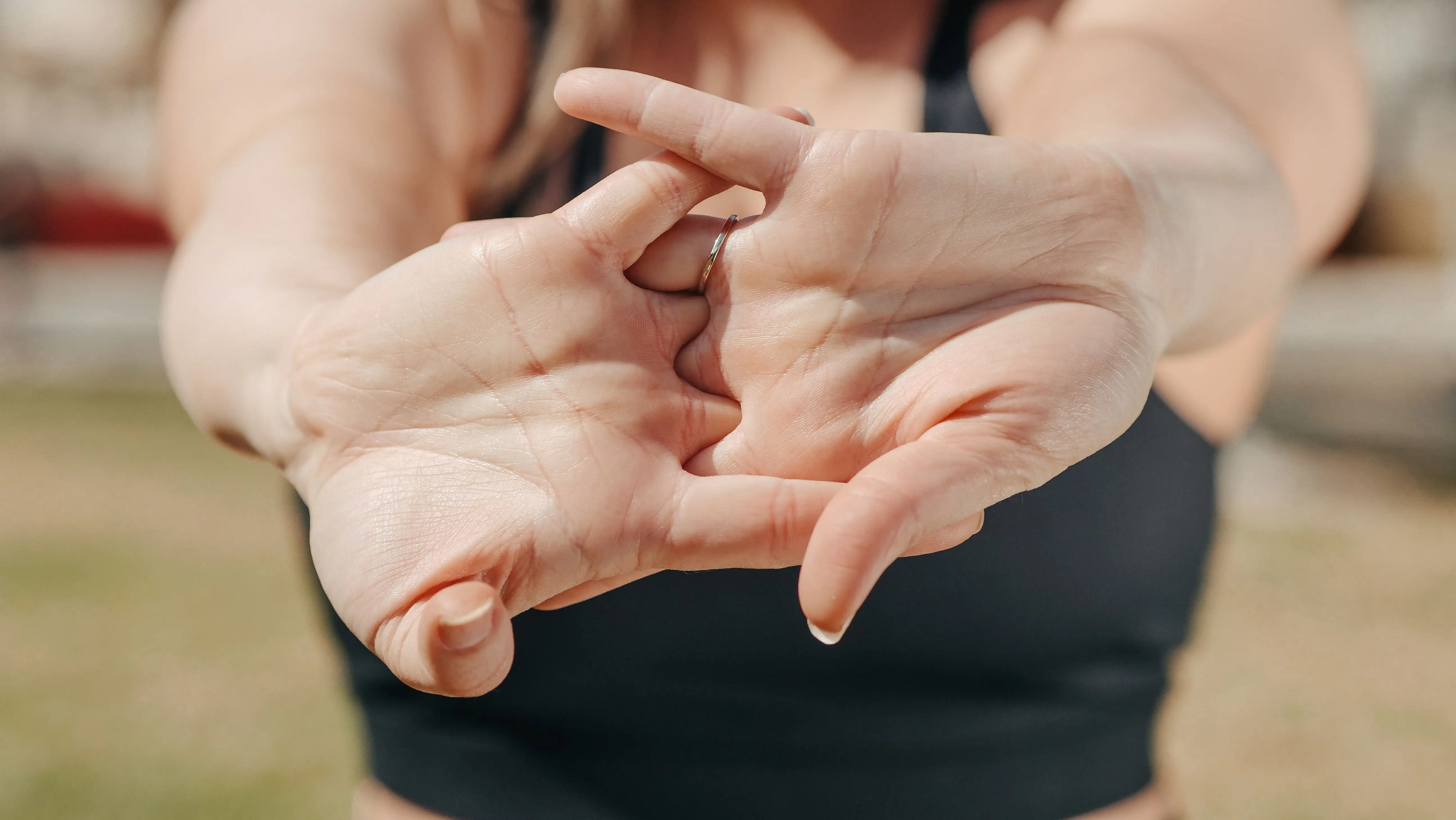
4. Wrist Flexor Stretch
- Extend arm forward with palm facing up
- Pull fingers back gently with opposite hand
- Keep elbow straight
- Hold for 15-30 seconds
- Repeat on the other arm
Benefits: Stretches the wrist and forearm muscles
Level 2: Grip Strength Exercises
For grip work, look no further than the kitchen drawer and the laundry pile:
5. Stress Ball Squeeze
- Hold a soft stress ball in your hand
- Squeeze as hard as comfortable
- Hold for 5 seconds
- Release slowly
- Repeat 10-15 times per hand
Progression: Use a firmer ball as strength improves
Benefits: Builds overall grip strength
6. Rice Bucket Squeeze
- Fill a small bucket or bowl with dry rice
- Submerge your hand and squeeze the rice firmly
- Open and close fingers fully
- Squeeze and hold for 5 seconds
- Repeat 10 times per hand
Benefits: Gentle, low-resistance grip training - excellent for beginners
7. Towel Wringing
- Wet a small towel and wring it out
- Hold opposite ends with both hands
- Twist the towel in opposite directions
- Squeeze tightly while twisting
- Repeat 5-10 times
Benefits: Builds grip endurance and forearm strength
8. Hand Gripper Squeezes
- Use a hand gripper set to light resistance (15-20 kg)
- Squeeze handles together
- Hold for 3 seconds
- Release slowly
- Repeat 10 times, 2 sets per hand
Progression: Increase resistance every 2-3 weeks
Benefits: Targeted grip strengthening
Level 3: Dexterity and Fine Motor Exercises
These drills train the small, precise movements behind buttoning a cuff or picking up a dropped coin:
9. Finger Lifts
- Place hand flat on a table, palm down
- Lift one finger at a time, keeping others pressed down
- Lower slowly
- Repeat with each finger, 5 times per finger
- Switch hands
Benefits: Improves individual finger control
10. Marble Pick-Up
- Place 10 marbles on a table
- Use one hand to pick up marbles one at a time
- Place them in a small container
- Time yourself and try to improve
- Switch hands
Benefits: Enhances fine motor skills and precision
11. Coin Stacking
- Gather 5-10 coins
- Stack them one on top of another
- Start with larger coins, progress to smaller ones
- Practice with both hands
Benefits: Improves hand-eye coordination and precision
12. Finger Tapping
- Tap each finger to your thumb rapidly
- Start slow, then increase speed
- Do 30 seconds per hand
- Try alternating hands
Benefits: Improves finger speed and coordination
Level 4: Wrist and Forearm Exercises
Grip starts upstream: tired wrists and forearms cap how hard the hand can squeeze, so give them their few minutes:
13. Wrist Curls
- Sit with forearm resting on thigh, wrist at knee
- Hold a light weight (1-3 kg) or water bottle
- Curl wrist upward
- Lower slowly
- Repeat 12 times, 2 sets per arm
Benefits: Strengthens wrist flexors
14. Reverse Wrist Curls
- Same position as wrist curls
- Palm facing down
- Curl wrist upward against gravity
- Lower slowly
- Repeat 12 times, 2 sets per arm
Benefits: Strengthens wrist extensors
15. Wrist Circles
- Extend arm forward with palm facing up
- Make small circles with your wrist
- Do 10 clockwise, then 10 counterclockwise
- Switch arms
Benefits: Improves wrist mobility and flexibility
Sample Hand Exercise Routine
📋5-Minute Daily Hand Workout
0/6 completed- Finger stretches (1 min)
- Rubber band finger spreads (1 min)
- Stress ball squeezes (1 min)
- Finger lifts (1 min)
- Wrist circles (30 sec)
- Wrist flexor stretches (30 sec)
Weekly Plan
| Day | Focus | Duration |
|---|---|---|
| Monday | Grip strength | 5-10 min |
| Tuesday | Finger dexterity | 5-10 min |
| Wednesday | Rest or light stretching | - |
| Thursday | Wrist and forearm | 5-10 min |
| Friday | Full routine | 10-15 min |
| Saturday | Fun activities (gardening, crafts) | - |
| Sunday | Rest | - |
Safety First
Stop exercising if you feel sharp pain. Mild discomfort is normal, but severe pain indicates you should stop and consult your doctor.
Hand Exercises for Arthritis
If you have arthritis, it helps to know the line between work and harm. A dull, warm ache while moving is usually the muscles working; sharp or catching pain—or pain that lingers for hours afterward or shows up as swelling the next morning—is the signal to ease back. Stay on the right side of that line with these gentle, pain-free movements:
Gentle Arthritis Exercises
- Finger Bends: Slowly bend and straighten each finger
- Palm Press: Press palms together at chest level, fingers pointing up
- Thumb Rolls: Roll thumb in circles, clockwise and counterclockwise
- Wrist Rocks: Gently rock wrist forward and backward
Arthritis Tip
Do hand exercises when joints are least stiff—often after a warm shower or in the morning after gentle stretching.
What to Avoid
- Forceful squeezing: Can irritate inflamed joints
- Repetitive movements: May increase pain
- Cold hands: Warm hands before exercising
- Ignoring pain: Stop if discomfort increases
Daily Activities That Strengthen Hands
Incorporate hand-strengthening activities into your routine:
| Activity | How It Helps | Frequency |
|---|---|---|
| Gardening | Digging, planting, pruning | 2-3x/week |
| Cooking | Kneading dough, chopping vegetables | Daily |
| Crafts | Knitting, crocheting, painting | 1-2x/week |
| Playing cards | Dealing, shuffling, holding cards | As desired |
| Playing piano/keyboard | Finger dexterity and coordination | Daily |
When to See a Doctor
👩⚕️ Hand Health Concerns
Consult a healthcare provider if you experience any of the following:
- •Severe pain preventing use of hand
- •Loss of sensation in fingers
- •Inability to move fingers
- Persistent pain or swelling in joints
- Sudden loss of grip strength
- Numbness or tingling in fingers
- Difficulty performing daily tasks
- Visible deformity of fingers or wrist
How to Progress Without Flaring Your Hands
The exercises above work best when the difficulty rises slowly. Give the beginner moves a week before you add resistance, then change one thing at a time: a few more repetitions, a slightly firmer band or ball, a slower lowering phase, or one extra set. Changing three things at once makes it impossible to tell which one irritated the joint.
Use your hands the next morning as the scorecard. Mild tiredness that fades by lunchtime is fine. Swelling, warmth, or pain that lasts into the next day means the last session was too much—drop back to the previous level for a week before trying again.
If you are recovering from a hand fracture, surgery, trigger finger, or a flare of rheumatoid arthritis, ask your doctor about a referral to a hand therapist. An occupational therapist can build a short program around the specific joints and tendons involved, which is more useful than a general routine when the problem is localized.
Common Mistakes That Slow Progress
Squeezing as hard as possible. A grip ball rewards control, not maximum force. White-knuckle squeezing tightens the forearm and often aggravates arthritic knuckles.
Death-gripping everyday objects. If jars, keys, and scissors already hurt, keep using them that way and the exercises fight against the rest of your day. A jar opener, larger handles, and loop scissors remove the strain while your hands get stronger.
Doing the whole routine in one sitting. Five minutes in the morning and five in the evening beats a single twenty-minute session that leaves the hands aching.
Skipping the thumb and wrist. Pinching and turning motions come from the thumb and wrist, not the fingers. A routine that only squeezes misses the movements behind opening a bottle or turning a doorknob.
Exercising cold hands. Cold fingers are stiff fingers. Wash your hands in warm water or exercise after a shower, and keep the rubber band loose enough that it does not leave marks or cut off circulation.
Ignoring numbness. Tingling that runs into the thumb and first two fingers, or that wakes you at night, is a reason to get evaluated rather than to push through the routine.
Fitting Hand Work Into an Ordinary Day
Hand exercises are short enough to attach to things you already do. Keep a rubber band and a soft ball in a bowl beside your usual chair, and use them during the kettle boiling, the evening news, or the wait for a pot of water. The five-minute routine fits between two cups of tea.
It also helps to name what you want back. Most people are not chasing a number—they want the pickle jar to open, the buttons to close, the key to turn on the first try. Pick one of those tasks and test it once a month rather than every day. Progress on a real task is easier to notice than a vague sense of improvement, and it tells you whether the routine is working. For a broader look at why grip matters beyond the kitchen, see our article on grip strength and longevity, and if sore joints are the bigger obstacle, the routines in our arthritis exercise guide keep the same principles while sparing the knuckles.
Frequently Asked Questions
How long does it take to see results?
Most people notice improved grip strength within 4-6 weeks of consistent exercise. Significant improvements typically develop over 8-12 weeks.
Can I do hand exercises if I have arthritis?
Yes, but focus on gentle, pain-free movements. Consult your doctor or physical therapist for personalized recommendations to avoid irritating inflamed joints.
What equipment do I need?
You can do most hand exercises with no equipment. Optional items include stress balls, hand grippers, rubber bands, and rice for gentle resistance training.
Is it better to do hand exercises daily or a few times a week?
Both approaches work. Daily short sessions (5-10 minutes) are often more sustainable than longer sessions 2-3 times per week. Consistency is key.
Can hand exercises prevent carpal tunnel syndrome?
While not a guarantee, exercises that strengthen wrist and forearm muscles can help reduce the risk of repetitive strain injuries like carpal tunnel.
Do hand exercises help with balance?
Indirectly—strong hands help with gripping supports like canes or walkers, which improves stability and confidence during movement.
Related Articles
- Grip Strength and Longevity: How Hand Strength Predicts Health
- Resistance Band Exercises for Seniors
- Arthritis Exercise Handbook: Safe Workouts for Joint Health
- Exercise Safety Tips for Seniors
- Strength Training for Seniors Over 65
Hand and Wrist Health
Strength and Mobility
References
- American Academy of Orthopaedic Surgeons. (2024). Hand Exercises for Arthritis. https://orthoinfo.aaos.org/
- Arthritis Foundation. (2024). Hand and Wrist Exercises. https://www.arthritis.org/
- National Institute on Aging. (2024). Keeping Muscles Strong as You Age. https://www.nia.nih.gov/
- Harvard Health Publishing. (2024). Grip Strength and Aging. https://www.health.harvard.edu/
- CDC. (2024). Arthritis and Physical Activity. https://www.cdc.gov/arthritis/
- Mayo Clinic. (2024). Hand Exercises. https://www.mayoclinic.org/