📌Key Takeaways
- Grip strength is a stronger mortality predictor than blood pressure or cholesterol
- Normal grip strength for men over 60: 30-40 kg; women: 15-25 kg
- Declines 1-2% per year after age 50, accelerating after 70
- Train 2-3 times per week with rest days between
- Combine grip training with total-body strength exercises
Quick Answer
Why is grip strength important for longevity? Research shows grip strength is a stronger predictor of all-cause mortality than blood pressure, cholesterol, or body weight. It reflects overall muscular health, neurological function, and nutritional status.
What is a normal grip strength for seniors? For men over 60, normal grip strength is approximately 30-40 kg (66-88 lbs). For women, it's approximately 15-25 kg (33-55 lbs). Lower values may indicate increased health risks.
How is grip strength measured? A hand dynamometer provides the most accurate measurement. Simple tests include the chair stand test, timed up-and-go, and squeeze tests with a tennis ball.
How often should seniors train grip strength? Train grip strength 2-3 times per week with at least one rest day between sessions. Consistency matters more than intensity.
Can grip strength be improved at any age? Yes. Research shows that seniors can significantly improve grip strength through regular training, even beginning in their 80s or 90s.
When thinking about longevity predictors, blood pressure, cholesterol, and weight often come to mind. However, research reveals that something as simple as hand grip strength may be one of the most powerful indicators of how long you'll live.
The Lancet Study Finding
A landmark study of nearly 140,000 adults across 17 countries found that grip strength was more strongly associated with all-cause mortality than blood pressure or cholesterol levels.
The Science Behind Grip Strength and Longevity
A landmark study published in The Lancet followed nearly 140,000 adults across 17 countries for four years. The findings were striking: grip strength was more strongly associated with all-cause mortality than blood pressure or cholesterol levels.
Why Grip Strength Predicts Mortality
Grip strength serves as a "canary in the coal mine" for overall health:
| Factor | How Grip Strength Reflects It | Health Implication |
|---|---|---|
| Muscle mass | Measures overall muscular strength | Adequate tissue for metabolism and mobility |
| Neurological function | Tests nerve-muscle connections | Healthy nervous system communication |
| Nutritional status | Indicates protein intake quality | Proper fuel for muscle maintenance |
| Systemic health | Chronic diseases affect strength | Early warning for health problems |
Grip Strength Decline with Age
| Age Range | Annual Decline | Cumulative Effect |
|---|---|---|
| 50-60 | 1% per year | 10-15% total loss |
| 60-70 | 1.5% per year | 15-20% total loss |
| 70-80 | 2-3% per year | 20-30% total loss |
| 80+ | 3-4% per year | Accelerated decline |
Research Finding
Every 5 kg (11 lbs) decrease in grip strength is associated with a 16% increase in mortality risk from all causes.
What Grip Strength Reflects About Overall Health
Studies show that grip strength correlates with:
- Cognitive function: Lower grip strength links to higher dementia risk
- Bone density: Weak grip often indicates osteoporosis
- Heart health: Strength predicts cardiovascular outcomes
- Immune function: Muscle mass supports immune system
- Recovery ability: Stronger patients recover faster from illness
Grip Strength Norms and Benchmarks
By Age and Sex (Dynamometer Measurement)
| Age | Men (kg) | Men (lbs) | Women (kg) | Women (lbs) |
|---|---|---|---|---|
| 50-59 | 35-45 | 77-99 | 20-30 | 44-66 |
| 60-69 | 30-40 | 66-88 | 15-25 | 33-55 |
| 70-79 | 25-35 | 55-77 | 12-20 | 26-44 |
| 80+ | 20-30 | 44-66 | 10-15 | 22-33 |
Grip Strength Categories
| Category | Men (kg) | Women (kg) | Health Implication |
|---|---|---|---|
| Excellent | > 45 | > 30 | Very low mortality risk |
| Good | 35-45 | 20-30 | Low mortality risk |
| Fair | 25-35 | 15-20 | Moderate risk |
| Weak | < 25 | < 15 | Higher mortality risk |
Measure Your Risk
If your grip strength falls below the "Fair" category for your age and sex, it may be worth discussing with your doctor and considering a strength training program.
How to Measure Your Grip Strength
Method 1: Hand Dynamometer (Most Accurate)
- Set the dynamometer to fit your hand size
- Stand with arms at sides
- Squeeze the handle as hard as possible
- Record the reading in kg or lbs
- Repeat 3 times per hand
- Use the average of your best scores
Method 2: Chair Stand Test (Functional Assessment)
How to perform:
- Sit in a sturdy chair with arms crossed over chest
- Stand completely upright without using arms
- Repeat 5 times as quickly as possible
- Time how long it takes
What your time means:
| Time | Interpretation |
|---|---|
| Under 11 seconds | Excellent strength |
| 11-13 seconds | Good strength |
| 13-16 seconds | Fair strength |
| Over 16 seconds | Weakness concern |
Method 3: Timed Up and Go (Mobility and Strength)
- Sit in a chair
- Rise, walk 10 feet, turn, return, sit
- Time the complete sequence
| Time | Interpretation |
|---|---|
| Under 10 seconds | Normal |
| 10-13 seconds | Slightly impaired |
| 13-20 seconds | Mild impairment |
| Over 20 seconds | Significant impairment |
Method 4: Simple Squeeze Test (Home Tracking)
- Use a standard tennis ball or stress ball
- Squeeze as hard as possible
- Rate the resistance: None / Some / Strong / Very Strong
- Track changes over time
When to See a Doctor
Significant decline in grip strength, especially if sudden, may indicate underlying health issues. Consult your healthcare provider if you notice rapid weakening.
Exercises to Improve Grip Strength
📝Step-by-Step Guide
- 1Start with 2-3 sessions per week with rest days
- 2Begin with light resistance (rice ball squeezes)
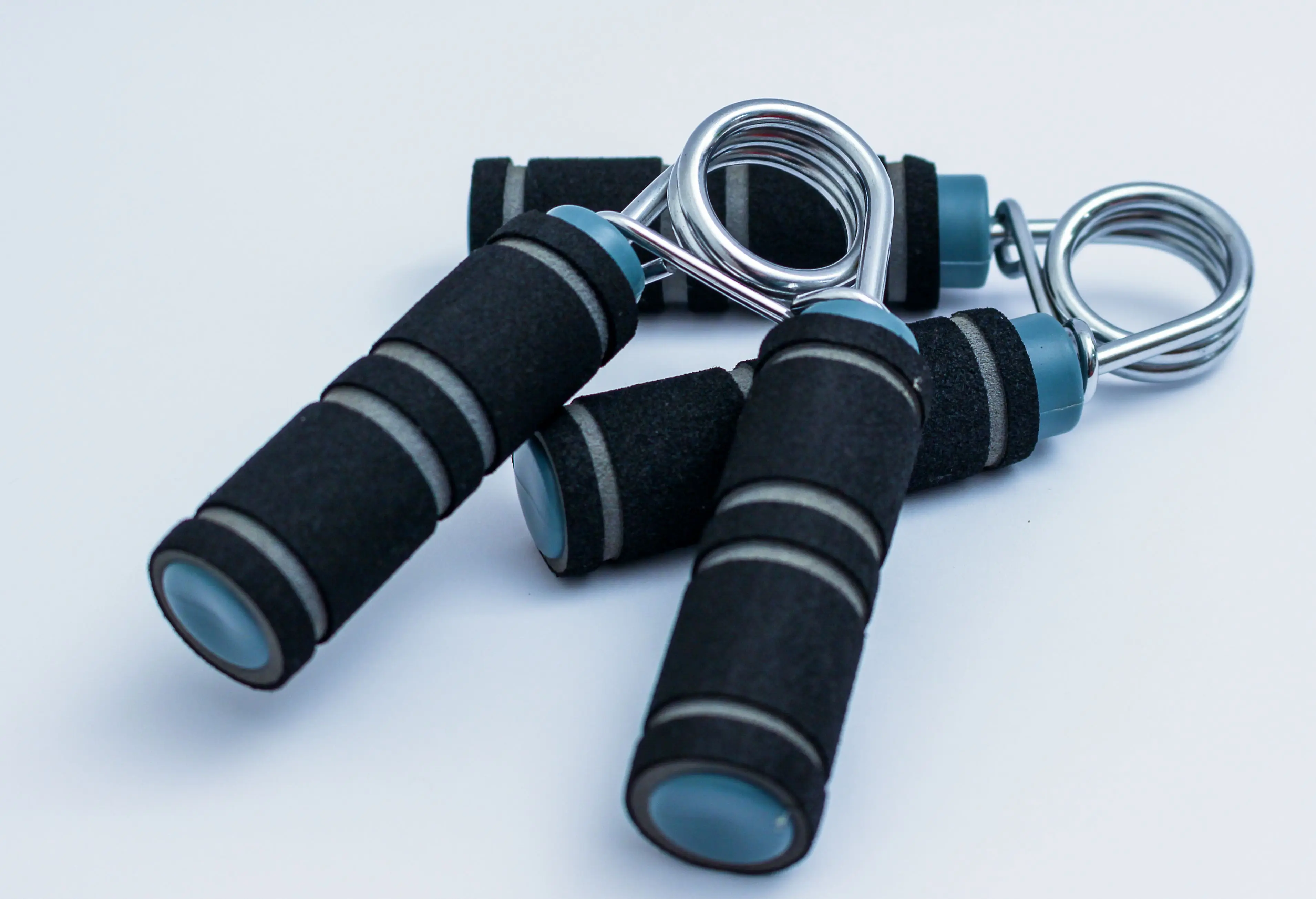
- 3Progress to hand grippers at comfortable resistance
- 4Add wrist curls with light weights
- 5Include total-body strength exercises
- 6Track progress weekly
Level 1: Beginner (First 4 Weeks)
Rice Ball Squeeze
- Fill a bowl with dry rice
- Insert hand and squeeze rice firmly
- Open and close fingers fully
- Squeeze and hold for 5 seconds
- Repeat 10 times per hand
Benefits: Safe, low-resistance, builds foundational strength
Finger Spreads with Rubber Band
- Place rubber band around all fingers
- Spread fingers apart against resistance
- Hold for 3 seconds
- Release slowly
- Repeat 10 times per hand
Benefits: Strengthens intrinsic hand muscles
Level 2: Intermediate (Weeks 5-12)
Hand Gripper Squeezes
- Set gripper to light resistance (15-20 kg)
- Squeeze handles together
- Hold for 3 seconds
- Release slowly
- Repeat 10 times, 2 sets per hand
Progression: Increase resistance by 5 kg every 2 weeks
Wrist Curls
- Sit with forearm resting on thigh, wrist at knee
- Hold light dumbbell (1-3 kg)
- Curl wrist upward
- Lower slowly
- Repeat 12 times, 2 sets per arm
Reverse Wrist Curls
- Same position as wrist curls
- Palm facing down
- Curl upward against gravity
- Lower slowly
- Repeat 12 times, 2 sets per arm
Level 3: Advanced (After 12 Weeks)
Dead Hangs
- Grip secure bar overhead (both hands)
- Allow body to hang
- Hold for 10-30 seconds
- Release and rest
- Repeat 3-5 times
Benefits: Builds grip endurance and shoulder stability
Towel Hangs
- Drape towel over pull-up bar
- Grip towel ends (overhand grip)
- Hang for 20-60 seconds
- Rest and repeat 3 times
Benefits: Superior to dead hangs for grip strength development
Farmer's Walk
- Hold heavy weights at sides
- Walk briskly for 30-60 seconds
- Keep shoulders back and core engaged
- Rest 1 minute
- Repeat 3-5 times
Benefits: Combines grip strength with overall stability
Grip Training Frequency and Recovery
| Training Level | Frequency | Rest Between Sessions | Sets per Exercise |
|---|---|---|---|
| Beginner | 3x per week | 1-2 days | 2 sets |
| Intermediate | 3x per week | 1 day | 2-3 sets |
| Advanced | 2-3x per week | 1-2 days | 3-4 sets |
Recovery Matters
Muscles need 24-48 hours between intense grip training sessions. This is when adaptation and growth occur.
Daily Activities That Strengthen Grip
Incorporate these functional grip exercises into your day:
| Activity | How It Helps | Frequency |
|---|---|---|
| Carrying groceries | Sustained grip under load | Shopping trips |
| Gardening | Varied grip positions | Daily |
| Kneading dough | Dynamic squeezing | Cooking |
| Opening jars | Grip endurance | As needed |
| Playing with putty | Intrinsic muscle strength | Daily |
| Using hand tools | Functional strength | Projects |
Nutrition for Grip Strength
Building and maintaining grip strength requires proper nutrition:
Protein Requirements for Seniors
| Body Weight | Daily Protein Need | Examples |
|---|---|---|
| 120 lbs (55 kg) | 55-65 g | 3 oz salmon, 1 cup beans |
| 150 lbs (68 kg) | 68-82 g | 4 oz chicken breast, Greek yogurt |
| 180 lbs (82 kg) | 82-98 g | 5 oz lean beef, lentils |
Nutrients That Support Muscle Health
| Nutrient | Food Sources | Why It Matters |
|---|---|---|
| Protein | Meat, fish, beans, dairy | Muscle repair and growth |
| Vitamin D | Sunlight, fatty fish, supplements | Muscle function |
| Omega-3s | Salmon, walnuts, flaxseed | Reduces inflammation |
| Magnesium | Nuts, leafy greens, whole grains | Muscle contraction |
| B12 | Meat, dairy, fortified foods | Nerve function |
Protein Timing
Distribute protein intake evenly across meals—about 25-30g per meal—to maximize muscle protein synthesis. This is especially important for seniors who may not absorb nutrients as efficiently.
Beyond Grip Strength: Total Body Strength
While improving grip strength is valuable, it reflects broader muscular health. A comprehensive approach provides the greatest longevity benefits:
Why Total Body Strength Matters
| Strength Type | Benefits | Grip Connection |
|---|---|---|
| Lower body | Walking, stairs, balance | Foundation of function |
| Core | Stability, posture | Supports everything |
| Upper body | Daily tasks, independence | Direct grip application |
Recommended Total-Body Exercises
| Exercise | Target | Grip Component |
|---|---|---|
| Chair stands | Legs, hips | Releasing chair |
| Wall push-ups | Chest, shoulders | Wall grip |
| Rows (bands) | Back | Gripping handles |
| Bicep curls | Arms | Wrist flexion |
| Shoulder press | Shoulders | Overhead stability |
How to Preserve Grip Strength Long-Term
Maintaining grip strength is a lifelong endeavor:
Prevention Strategies
- Stay physically active: Regular exercise of any kind supports muscle health
- Maintain protein intake: Even during illness or recovery
- Use your hands daily: Manual tasks preserve function
- Monitor changes: Track grip to catch decline early
- Address weakness early: Don't accept "just aging" explanations
It's Never Too Late
Research shows that even very elderly individuals (90+) can improve grip strength with regular training. The body retains the ability to adapt and grow muscle throughout life.
FAQ: Common Questions About Grip Strength and Longevity
What is a normal grip strength for seniors? For men over 60, normal grip strength is approximately 30-40 kg (66-88 lbs). For women, it's approximately 15-25 kg (33-55 lbs). Below these ranges may indicate increased mortality risk.
Can grip strength predict dementia? Research indicates that declining grip strength correlates with cognitive decline and increased dementia risk. Maintaining strength may support brain health.
How often should I train grip strength? Training grip strength 2-3 times per week with rest days between sessions allows for recovery and adaptation. Consistency matters more than intensity.
Does grip strength decline with age? Yes, grip strength typically declines 1-2% per year after age 50, accelerating after 70. This decline is associated with increased mortality risk.
What foods support muscle and grip strength? Adequate protein intake (1.0-1.2 g per kg body weight), vitamin D, omega-3 fatty acids, and overall balanced nutrition support muscular health.
Can grip strength be improved at any age? Yes. Research shows that seniors can significantly improve grip strength through regular training, even beginning in their 80s or 90s.
Is grip strength more important than other health markers? Studies show grip strength is a stronger predictor of all-cause mortality than blood pressure or cholesterol. However, it should complement—not replace—regular health checkups.
What is the best grip strength exercise for beginners? Rice ball squeezes are excellent for beginners. Fill a bowl with dry rice and squeeze firmly, opening and closing fingers fully. It's safe, low-resistance, and builds foundational strength.
Can poor grip strength increase fall risk? Yes. Grip strength reflects overall muscular health and coordination. Weakness in hands and forearms can affect balance, posture, and the ability to catch yourself during a fall.
Related Articles
- Exercises for Seniors with Weak Ankles: Strengthen and Stabilize
- how can seniors rebuild leg strength safely
- how can seniors regain strength after illness
- Strength Training for Seniors Over 65: Build Bone & Muscle
- strength training for seniors
- VO2 Max and Longevity: How Cardiovascular Fitness Predicts Lifespan
Strength and Muscle Health
- Strength Training for Seniors Over 65
- Sarcopenia Prevention and Treatment
- Protein Foods for Senior Citizens
- Resistance Band Exercises for Seniors
Functional Fitness
- Daily Exercise Routine for Seniors
- Chair Exercises for Seniors
- Low-Impact Exercises for Seniors
- Balance Exercises for Seniors
Nutrition for Seniors
References
- The Lancet. (2024). Grip Strength and Mortality: A Large-Scale Study. https://www.thelancet.com/
- Journal of Cachexia, Sarcopenia and Muscle. (2024). Sarcopenia and Longevity. https://www.ncbi.nlm.nih.gov/
- Harvard Health Publishing. (2024). Grip Strength as a Health Marker. https://www.health.harvard.edu/
- National Institute on Aging. (2024). Keeping Muscles Strong as You Age. https://www.nia.nih.gov/
- Mayo Clinic. (2024). Hand Grip Strength and Mortality in Older Adults. https://www.mayoclinic.org/
- CDC. (2024). Physical Activity and Health for Seniors. https://www.cdc.gov/
- Arthritis Foundation. (2024). Hand and Wrist Exercises. https://www.arthritis.org/
- NIH Osteoporosis and Related Bone Diseases. (2024). Bone Health and Muscle Strength. https://www.bones.nih.gov/