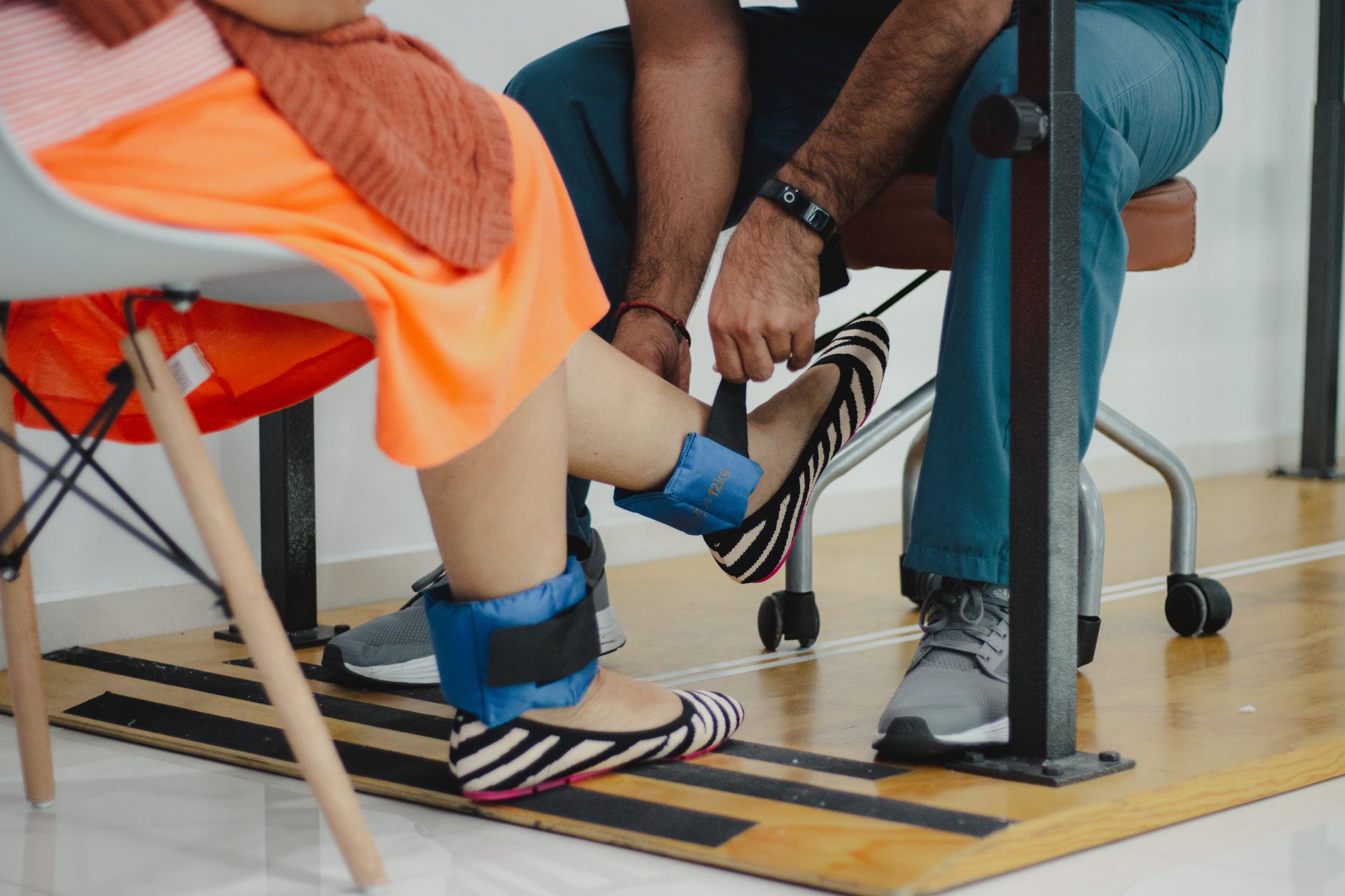
Understanding Weak Ankles in Older Adults
You know the moment: your foot catches the edge of a curb or sinks into thick pile carpet, and the ankle wobbles before you catch yourself. A lot of older adults know it well. Unsteady ankles can follow an old sprain that never quite healed, creep in gradually with age and less activity, or arrive alongside arthritis.
The real trouble is the cycle that follows. Wobbles make walking feel risky, so trips get shorter; less walking leaves the ankles weaker still. Specific, repeated strengthening breaks that loop and brings steadiness—and confidence—back.
Every step loads the ankle first. When it can't hold its position, the knee twists to compensate, the hip hikes, and the stride shortens. Weakness doesn't stay at the ankle—it travels up the leg.
Common Experience:
Many seniors describe similar patterns: previous ankle injuries that never fully recovered, gradual weakness as they age, and a growing fear of walking without support. The good news is that research shows targeted ankle strengthening exercises can improve stability within 3 months for most older adults.
Note: This reflects typical experiences shared by seniors in physical therapy programs, based on clinical observations.
Research-Backed Evidence:
According to the American Orthopaedic Foot & Ankle Society, ankle instability affects approximately 20% of seniors, with previous injuries being the leading cause. A study published in Foot & Ankle International found that:
- Ankle weakness increases fall risk by 2.5 times in community-dwelling seniors
- Targeted ankle strengthening exercises reduce instability by 40% within 12 weeks
- Calf raises and resistance band exercises are among the most effective movements
The National Institute on Aging emphasizes that ankle strength is critical for maintaining balance, as the ankle acts as the body's primary shock absorber and stabilizer during walking.
The Anatomy of Ankle Stability
Your ankle is a complex joint where several structures work together:
- Bones: The tibia and fibula connect to the talus bone in the foot
- Muscles: The calf muscles (gastrocnemius and soleus) and muscles in the front of your lower leg work together to move your ankle
- Ligaments: Bands of tissue connect bones and provide stability
- Tendons: Connect muscles to bones and help transmit force
When any one of them weakens, the joint wobbles. Stronger muscles and better-conditioned tendons can take up the slack left by ligaments that have stretched over the years.
Safe Ankle Exercises for Seniors
1. Ankle Alphabet
This exercise improves ankle mobility and strengthens surrounding muscles in a safe, seated position.
How to do it:
- Sit in a sturdy chair with your feet hanging freely
- Using your big toe as a "pencil," trace the letters of the alphabet in the air
- Make the letters as large as comfortably possible
- Complete the entire alphabet
- Rest and repeat with the other foot
- Do 2-3 sets on each foot
This gentle movement helps maintain ankle range of motion while engaging the muscles that control movement.
2. Resistance Band Dorsiflexion
This exercise strengthens the muscles on the front of your shin that help lift your foot.
How to do it:
- Sit in a chair and extend your right leg forward, foot off the ground
- Anchor a resistance band to a heavy object or have someone hold it
- Loop the band around the top of your right foot
- Pull your toes toward your shin against the band's resistance
- Hold for 2-3 seconds
- Slowly release
- Repeat 10-15 times
- Switch legs and repeat
- Do 2-3 sets on each leg
Start with a light resistance band and increase as you build strength.
3. Seated Calf Presses
This exercise strengthens your calf muscles, which support ankle movement.
How to do it:
- Sit in a sturdy chair with your feet flat on the floor
- Place your hands on your thighs for support
- Slowly lift your heels off the ground as high as possible
- Hold for 2-3 seconds
- Lower your heels back down
- Repeat 10-15 times
- Rest and do 2-3 sets
As you get stronger, try lifting one leg at a time for more challenge.
4. Towel Scrunches
This exercise strengthens the muscles on the bottom of your feet while also engaging ankle stabilizers.
How to do it:
- Sit in a chair with your feet flat on a small towel
- Keeping your heel on the ground, scrunch the towel toward you using your toes
- Continue until you have pulled the towel completely toward you
- Spread the towel back out and repeat
- Do 3-5 repetitions with each foot
This simple activity engages multiple foot and ankle muscles at once.
5. Standing Heel Raises (With Support)
Standing heel raises build functional strength for daily activities.
How to do it:
- Stand behind a sturdy chair, holding it with both hands
- Keep your feet hip-width apart
- Slowly rise up onto your toes
- Hold for 1-2 seconds at the top
- Lower your heels slowly back down
- Repeat 10-15 times
- Rest and do 2-3 sets
Keep your movements controlled. The chair is right there if your balance slips.
6. Single-Leg Stance (With Support)
Walking is really a series of one-leg stands—each step has a moment when only one foot is on the ground. This move rehearses that instant, the one that happens on a curb edge or a rumpled rug.
How to do it:
- Stand beside a sturdy chair, holding it with both hands
- Slowly shift your weight onto your right foot
- Lift your left foot off the ground
- Hold for 10-20 seconds
- Lower your foot and switch legs
- Repeat 5-8 times on each leg
As you improve, reduce your reliance on the chair until you can balance with just fingertips, then without support.
7. Lateral Step-Ups
Curbs and uneven ground catch the ankle sideways, not just head-on. This move trains that direction.
How to do it:
- Stand beside a low step or stair
- Hold onto a railing for balance
- Step up with your right foot
- Bring your left foot up to meet it
- Step down with your left foot
- Bring your right foot down
- Repeat 8-10 times
- Lead with the opposite foot in the next set
Use a very low step (2-4 inches) until your ankles feel more stable.
Building Your Ankle Exercise Routine
None of this requires a gym. The alphabet and towel work happen sitting down—propped at the foot of the bed in the morning works, with the bedroom wall right there if you need it.
Suggested weekly schedule:
- Monday: Ankle Alphabet + Seated Calf Presses + Towel Scrunches
- Tuesday: Rest or gentle walking
- Wednesday: Resistance Band Work + Standing Heel Raises
- Thursday: Rest or gentle walking
- Friday: Single-Leg Stances + Lateral Step-Ups
- Saturday: Light walking or activity
- Sunday: Rest
Tips for Ankle Safety
- Keep support within arm's reach: Every standing move happens next to a wall, counter, or sturdy chair you can grab
- Progress slowly: Increase repetitions and duration gradually
- Check for swelling: Some mild soreness is normal, but significant swelling is not
- Wear supportive shoes: Proper footwear helps stabilize ankles
- Be patient: Ankle strengthening takes time, often 6-8 weeks to notice significant changes
Ankle Strengthening Progress Checklist
Use this checklist to track your ankle strengthening journey:
Before Starting
- Consult healthcare provider if you have recent injury or severe pain
- Gather necessary equipment (resistance band, towel, sturdy chair)
- Find a safe exercise space with support nearby
- Set realistic goals (e.g., "stand on one leg for 20 seconds")
Weekly Exercise Checklist
- Ankle Alphabet (daily, 5 minutes)
- Seated Calf Presses (3x/week, 10-15 reps)
- Towel Scrunches (3x/week, 10-15 reps)
- Resistance Band Ankle Dorsiflexion (3x/week, 10-15 reps)
- Standing Heel Raises (2x/week, 10-15 reps)
- Single-Leg Stances (5x/week, 10-30 seconds/leg)
- Lateral Step-Ups (2x/week, 8-10 reps/leg)
Progress Tracking
- Week 2: Can do single-leg stance for 15 seconds
- Week 4: Notice less ankle instability during walking
- Week 6: Can do standing heel raises without support
- Week 8: Can walk on uneven surfaces with confidence
- Month 3: Reduced fear of falling
Footwear & Safety
- Wear supportive shoes with good arch support
- Check shoes for wear regularly
- Use ankle brace if recommended by provider
- Warm up before exercising (5 minutes)
- Cool down after exercising (5 minutes)
When to Pay Attention
While weakness alone is not concerning, certain symptoms warrant a visit to your healthcare provider:
- Significant ankle swelling
- Pain that does not go away with rest
- Recent ankle injury
- Sudden increase in instability
- Ankle that gives way frequently
FAQ: Strengthening Weak Ankles
How long does it take to strengthen weak ankles?
Most seniors see improvement in ankle stability within 4-6 weeks of consistent exercise. More significant changes typically appear at 8-12 weeks.
I rolled my ankle recently. Is it safe to exercise?
If you have a recent injury, consult your healthcare provider before doing ankle exercises. They can advise on safe movements during recovery.
Should I ice my ankles after exercising?
If you experience mild soreness after exercise, ice can help. Apply ice for 15-20 minutes. If you have significant pain or swelling, stop exercising and consult your provider.
Are there braces that can help while I exercise?
Ankle braces or compression sleeves can provide support during exercise. However, they should not replace strengthening. Use them as a temporary aid while you build strength.
Can weak ankles cause knee problems?
Possibly. When ankles are unstable, the knee often absorbs extra stress to compensate. Strengthening your ankles may help reduce knee strain.
I have arthritis in my ankle. Will these exercises help?
Gentle ankle exercises can help maintain range of motion and strengthen surrounding muscles, which may reduce arthritis symptoms. Check with your provider to ensure the exercises are appropriate for your condition.
Related Articles
- Foot Strengthening Exercises for Older Adults
- Balance Exercises for Seniors with Neuropathy
- Exercises to Improve Walking Speed After 70
- Daily Stretching Routine for Seniors
- Best Walking Shoes for Seniors with Arthritis