15 Best Resistance Band Exercises for Seniors to Improve Strength, Balance & Mobility
After age 60, many adults naturally lose muscle mass (sarcopenia), making everyday activities harder:
- Standing up from a chair becomes slower and more effortful
- Carrying groceries or walking upstairs can feel tiring
- Maintaining balance while walking or getting dressed becomes challenging
- Preventing falls becomes a growing concern
Resistance bands help train the muscles used in daily life—without requiring heavy weights, expensive equipment, or a gym membership. They're especially valuable for seniors managing arthritis, recovering from surgery, or looking to maintain independence.
This guide walks you through 15 safe, effective resistance band exercises specifically designed for older adults. You'll learn which exercises to start with, how to progress, and how to build a simple weekly routine that takes just 20-30 minutes.
Why Resistance Band Training Matters After 60
Sarcopenia—the age-related loss of muscle mass and strength—begins around age 30 and accelerates after 60. By age 75, adults may have lost up to 40% of their muscle mass. This directly impacts:
- Mobility: Walking, climbing stairs, and getting up from a chair
- Independence: Performing daily activities like dressing, cooking, and bathing
- Fall risk: Weak muscles and poor balance increase the chance of falls
- Bone health: Strength training stimulates bone density, reducing osteoporosis risk
- Metabolism: Muscle mass helps maintain a healthy weight and blood sugar levels
The good news: resistance training can slow or even reverse this decline at any age. Studies show that seniors who start strength training in their 70s and 80s can build significant muscle strength within 8-12 weeks.
Resistance bands are particularly well-suited for older adults because they provide variable resistance—the resistance increases as you stretch the band, matching your natural strength curve and reducing joint stress compared to traditional weights.
Who Should Use Resistance Bands After 60
Resistance band training is appropriate for:
- Healthy seniors looking to maintain strength and prevent age-related muscle loss
- Seniors with arthritis who need gentle, joint-friendly exercise
- Post-surgery patients recovering from hip or knee replacement
- Beginners who find weights intimidating or want a low-cost start
- Those with limited space who can't accommodate home gym equipment
- Travelers who want a portable exercise solution
Safety Note: Always consult your doctor before starting a new exercise program, especially if you have heart conditions, joint issues, or chronic health concerns.
Benefits of Resistance Band Training
Resistance bands offer several advantages that make them particularly suitable for older adults:
- Joint-friendly: Unlike weights that create constant resistance, bands provide variable resistance that peaks at the end of each movement, reducing stress on knees, hips, and shoulders
- Portable and lightweight: Bands can be used anywhere—at home, while traveling, or even in a small apartment
- Affordable: Quality bands cost significantly less than gym memberships or weight equipment
- Versatile: One set of bands can target every major muscle group
- Safe: There's no risk of dropping heavy weights, and bands are easier to control than barbells or dumbbells
- Adjustable: Simply changing grip position or band thickness modifies resistance level
Research from the American College of Sports Medicine shows that resistance band training can produce strength gains comparable to traditional weight training for older adults. A study published in the Journal of Strength and Conditioning Research found that seniors using resistance bands showed significant improvements in muscle strength and functional performance after just 8 weeks.
Choosing the Right Resistance Band
Resistance Band Type Comparison
| Type | Resistance Level | Best For | Difficulty |
|---|---|---|---|
| Thin / Therapy Bands (5-15lb) | Light | Rehabilitation, beginners, arthritis | Beginner |
| Medium Tube Bands (15-30lb) | Medium | Most exercises, lower body, strength building | Intermediate |
| Thick Tube Bands (30-50lb) | Heavy | Advanced strength, leg work | Advanced |
| Loop Bands | Variable | Leg exercises, glute work, lateral walks | All levels |
| Flat Bands | Variable | Lower body, gripped exercises | All levels |
How to Choose the Right Band for You
Step 1: Determine Your Fitness Level Start with a resistance level that allows you to complete 10-12 repetitions with good form:
- Beginner: Start with thin (light) bands. You should feel some effort but be able to maintain proper technique throughout
- Intermediate: Progress to medium bands when you can comfortably complete 15 repetitions with light resistance
- Advanced: Move to thick bands when 15 reps with medium resistance feel easy
Step 2: Choose Resistance Level Most sets include color-coded bands for different levels:
- Yellow/Tan (light): 5-15 lbs — ideal for beginners and rehabilitation
- Red/Green (medium): 15-30 lbs — suitable for most seniors starting a program
- Blue/Purple (heavy): 30-50 lbs — for those with established strength
Step 3: Decide on Style Different band styles work better for different exercises:
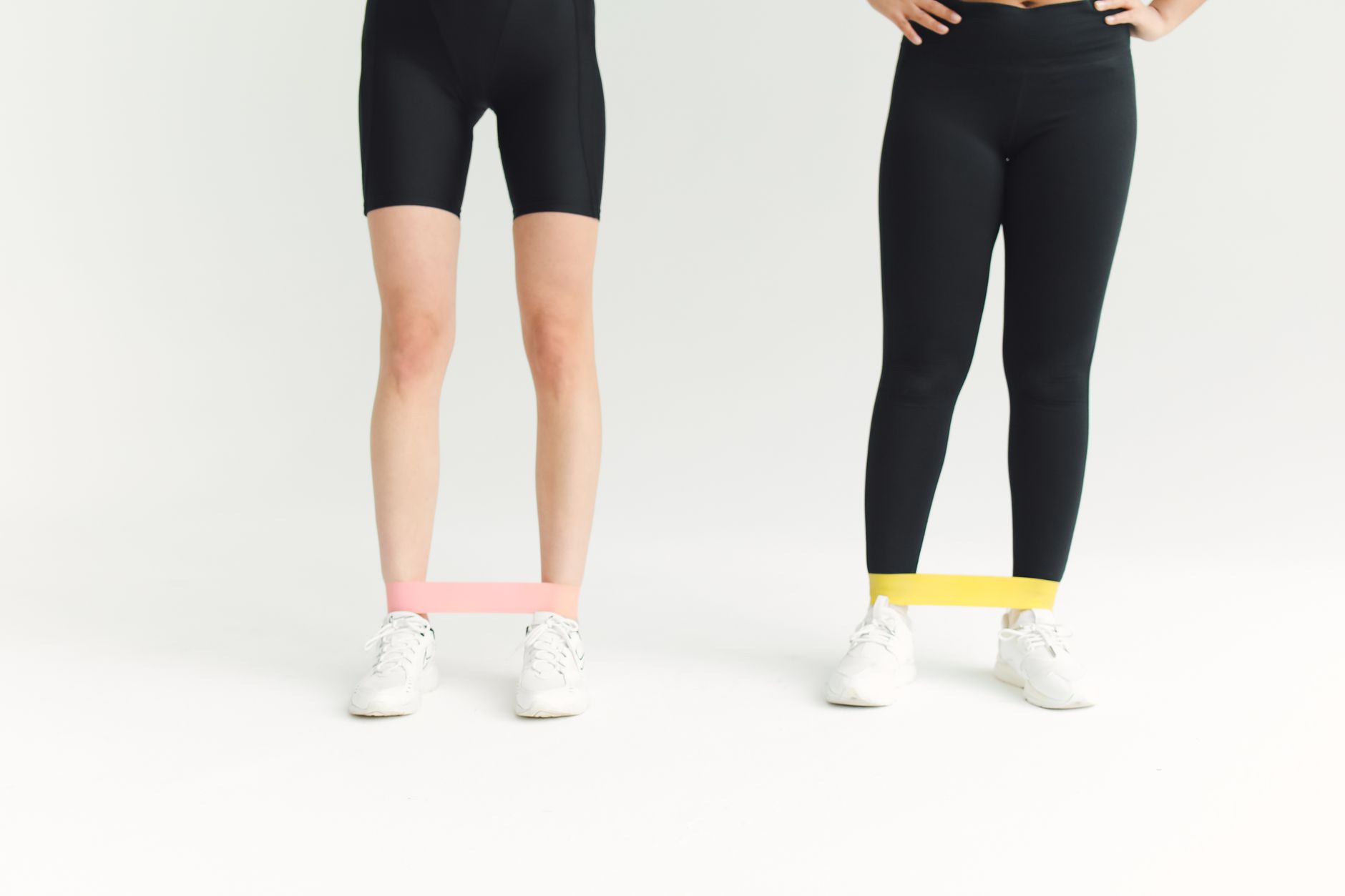
- Loop bands: Continuous circles, perfect for leg exercises (glute bridges, lateral walks) and lower body work
- Tube bands: Often come with handles, offering a secure grip for upper body movements (bicep curls, shoulder press)
- Flat bands: Wider than tube bands, comfortable for gripped exercises and lower body work
Step 4: Check Safety Features Ensure your bands are safe and durable:
- Inspect bands for tears, cracks, or wear before each use
- Look for high-quality latex or synthetic rubber construction
- Check that handles (if included) are securely attached
- Start with controlled movements and light resistance to test bands
Recommended Resistance Bands for Seniors
Choosing the right equipment helps you exercise safely and effectively. Here's a guide to selecting bands based on your needs:
| Product Type | Best For | Features |
|---|---|---|
| Light therapy bands (5-15lb) | Arthritis & beginners | Gentle resistance, color-coded, latex-free options available |
| Tube bands with handles (15-30lb) | Upper body exercises | Secure grip, easy to anchor, multiple resistance levels |
| Loop bands (variable) | Legs & balance training | Non-slip surface, different sizes, portable |
| Door anchor attachments | Versatile workouts | Secure attachment point for band exercises |
Learn more: See our full guide to best resistance bands for seniors with arthritis for detailed product recommendations and buyer's tips.
Beginner Resistance Band Exercises (Easy)
These exercises are gentle on joints, can be performed seated or standing, and use light to medium resistance. Start here if you're new to resistance training.
Beginner Exercise Quick Reference
| Exercise | Muscle Group | Difficulty | Can be Seated? |
|---|---|---|---|
| Seated Bicep Curl | Arms | Easy | ✅ Yes |
| Seated Row | Back | Easy | ✅ Yes |
| Leg Extension | Legs / Quads | Easy | ✅ Yes |
| Glute Bridge | Glutes / Hips | Easy | ❌ No (lying down) |
| Lateral Band Walks | Hips / Balance | Easy | ❌ No (standing) |
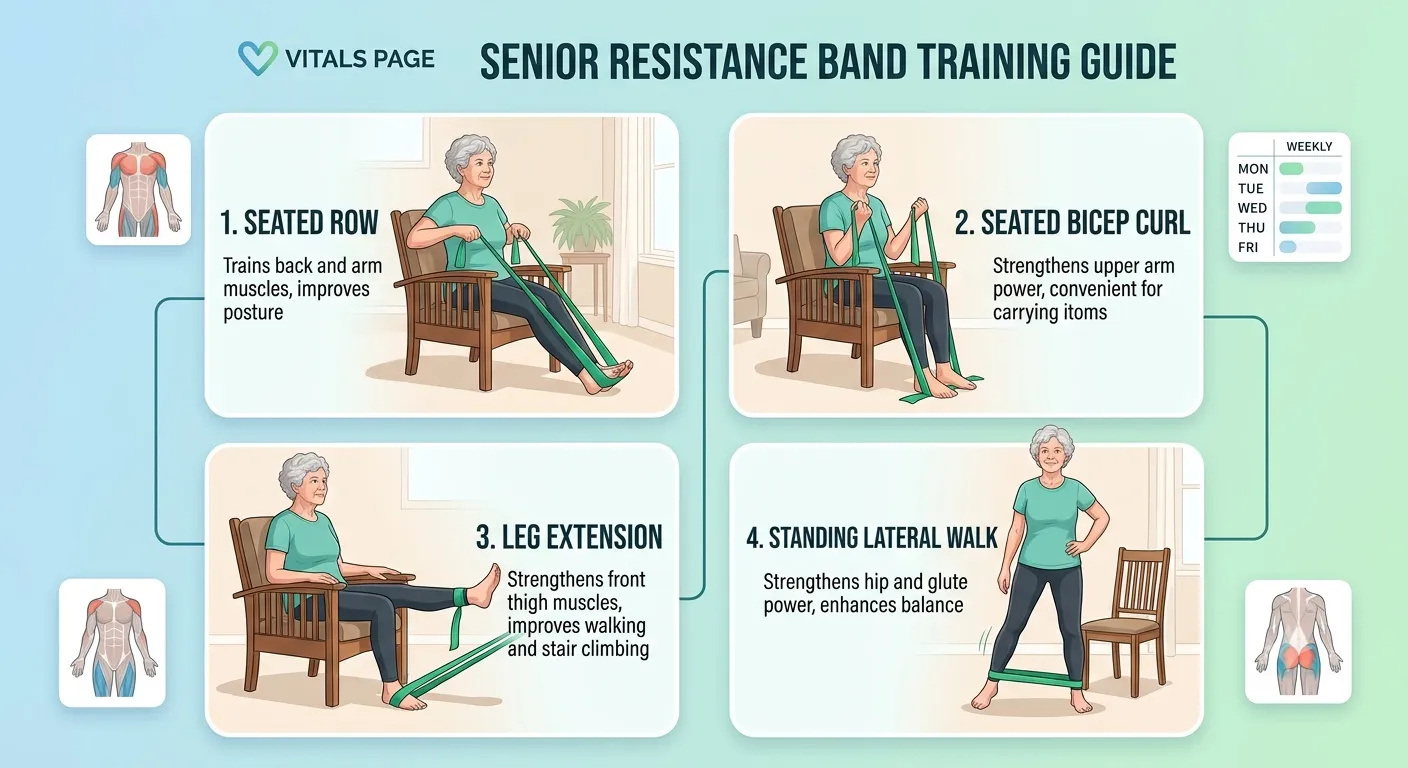
1. Seated Bicep Curl
Strengthens the front of the upper arms (biceps), making it easier to lift groceries, open jars, and carry items.
- Sit with feet flat on the floor, back supported
- Hold one end of the band in each hand, stepping on the middle of the band with both feet
- Start with arms extended down, palms facing forward
- Slowly bend elbows, bringing hands toward shoulders
- Keep elbows close to your body throughout the movement
- Slowly lower back to starting position
- Perform 10-15 repetitions, 2 sets
2. Seated Row
Strengthens the back muscles, improving posture and making it easier to pull yourself up from a chair.
- Sit with legs extended, band looped around both feet
- Hold band ends in each hand, arms extended forward
- Pull hands toward your chest, squeezing shoulder blades together
- Keep your back straight and tall
- Hold briefly, then slowly release
- Perform 10-15 repetitions, 2 sets
3. Leg Extension
Strengthens the quadriceps (front of thighs), the muscles used for standing, walking, and climbing stairs.
- Sit in a sturdy chair with back supported
- Loop one end of the band around your right ankle
- Hold the other end securely or anchor it to the chair leg
- Start with knee bent at 90 degrees
- Slowly extend your leg straight
- Hold briefly, then return to starting position
- Perform 10-15 repetitions per leg, 2 sets
4. Glute Bridge with Band
Strengthens the glutes and hips—critical for walking stability and fall prevention.
- Lie on your back with knees bent, feet flat on the floor
- Place a loop band around your thighs, just above the knees
- Tighten your abdominal muscles
- Slowly lift your hips toward the ceiling
- Push knees outward slightly against the band's resistance
- Hold at the top for 2-3 seconds
- Lower back down and repeat
- Perform 10-15 repetitions, 2 sets
5. Lateral Band Walks
Strengthens hip muscles important for balance and stability when walking.
- Place a loop band around both ankles or just above knees
- Stand with feet hip-width apart, knees slightly bent
- Step sideways with one foot, then bring the other foot toward it
- Continue stepping sideways for 8-10 steps
- Reverse direction and repeat
- Hold onto a wall or chair if balance is uncertain
- Perform 2 sets of 8-10 steps per direction
Intermediate Resistance Band Exercises
These exercises add more challenge and target additional muscle groups. Move here when beginner exercises feel easy.
6. Tricep Extensions
Targets the back of the upper arms (triceps), important for pushing motions like opening doors.
- Hold one end of the band behind your back with one hand
- Grasp the other end with your opposite hand, reaching overhead
- Start with the working arm bent at the elbow
- Slowly extend the arm straight up
- Hold briefly, then return to starting position
- Perform 10-15 repetitions per side, 2 sets
7. Shoulder Press
Builds shoulder and arm strength for lifting and reaching overhead.
- Stand or sit with feet flat, holding one end of the band in each hand
- Step on the band's center with both feet
- Start with hands at shoulder height, elbows bent
- Slowly press hands upward until arms are fully extended
- Hold briefly, then lower back to shoulder height
- Perform 10-15 repetitions, 2 sets
8. Chest Press
Strengthens the chest and front shoulders for pushing movements.
- Loop the band around a sturdy post, door handle, or have a partner hold it
- Stand with back to the anchor point, holding band ends in each hand
- Start with elbows bent at shoulder height, hands near chest
- Slowly press hands forward until arms are extended
- Hold briefly, then return to starting position
- Perform 10-15 repetitions, 2 sets
9. Hamstring Curls
Targets the back of the thighs (hamstrings), important for walking and bending.
- Stand holding onto a chair or wall for balance
- Loop the band around your right ankle
- Anchor the other end to a sturdy object at ankle height
- Start with leg extended
- Slowly bend knee, bringing heel toward your buttocks
- Hold briefly, then lower back down
- Perform 10-15 repetitions per leg, 2 sets
10. Standing Oblique Crunch
Targets the sides of the abdominal muscles for core stability and posture.
- Stand on one end of the band with right foot
- Hold the other end in your right hand at shoulder height
- Bend sideways to the right, pulling the band down
- Return to center
- Perform 10-12 repetitions per side, 2 sets
11. Band Woodchop
Diagonal movement that strengthens the core and improves rotational stability.
- Anchor the band at shoulder height to a sturdy post
- Stand sideways to the anchor point
- Hold the band with both hands at shoulder height
- Pull the band diagonally downward across your body
- Rotate your torso slightly as you pull
- Slowly return to starting position
- Perform 8-12 repetitions per side, 2 sets
Exercises for Arthritis
If you have arthritis, these exercises are specifically designed to be gentle on joints while still building strength. Always use light resistance and prioritize proper form.
12. Ankle Dorsiflexion and Plantarflexion
Strengthens ankles and improves foot mobility, reducing foot pain and improving walking.
Ankle flexion (pulling foot up):
- Sit with one leg extended
- Loop band around your foot and hold ends securely
- Pull your foot upward toward your shin against the band's resistance
- Return to starting position
- Repeat 10-15 times per foot, 2 sets
Ankle extension (pointing foot down):
- Anchor one end of the band to a sturdy object
- Loop the other end around your foot
- Point your foot downward against resistance
- Return to starting position
- Repeat 10-15 times per foot, 2 sets
13. Seated Band Twist
A gentle core exercise that avoids straining the spine.
- Sit in a sturdy chair, feet flat on the floor
- Hold a band with both hands, arms extended in front of you
- Slowly rotate your torso to one side
- Return to center, then rotate to the other side
- Perform 8-10 repetitions per side, 2 sets
Resistance Bands and Fall Prevention
Strong legs and better balance are your body's best defense against falls. According to the Centers for Disease Control and Prevention (CDC), one in four adults over 65 falls each year, and falls are the leading cause of injury-related deaths among seniors.
Resistance band exercises help strengthen the muscles most critical for fall prevention:
- Hip muscles: Glute bridges and lateral walks improve hip stability
- Quadriceps: Leg extensions build strength for standing and walking
- Glutes: These are the body's largest muscle group and essential for balance
- Core muscles: A strong core supports posture and prevents falls
- Ankles: Strengthened ankles improve foot control and balance
Regular resistance band training 2-3 times per week can significantly improve walking stability and reduce fall risk. Combined with balance exercises for seniors and a fall prevention routine, this creates a powerful protection plan.
Beginner 10-Minute Routine
Get started with this simple workout. Aim for 2-3 sessions per week, with at least one rest day between sessions.
Warm-Up (2 minutes)
- Gentle arm circles (forward and backward)
- Marching in place
- Ankle circles
Workout (8 minutes)
| Exercise | Duration | Sets × Reps |
|---|---|---|
| Seated Bicep Curl | 2 min | 2 × 10-12 |
| Seated Row | 2 min | 2 × 10-12 |
| Leg Extension | 2 min | 2 × 10-12 (each leg) |
| Glute Bridge | 2 min | 2 × 10-12 |
Cool-Down (2 minutes)
- Gentle stretching for worked muscles
- Slow breathing
Weekly Training Schedule
2-3 sessions per week:
- Upper body exercises: 8-10 minutes
- Lower body exercises: 10-12 minutes
- Core and balance work: 5 minutes
Sample weekly plan:
| Day | Activity | Duration |
|---|---|---|
| Monday | Resistance band session (full body) | 20-25 min |
| Tuesday | Walking or light activity | 20-30 min |
| Wednesday | Rest or gentle stretching | - |
| Thursday | Resistance band session (focus on legs) | 20 min |
| Friday | Balance exercises | 10-15 min |
| Saturday | Walking, swimming, or leisure activity | 30+ min |
| Sunday | Rest | - |
Allow at least one day between strength training sessions for muscle recovery.
Common Mistakes to Avoid
Mistake 1: Starting Too Heavy
Resistance that's too heavy causes poor form and increases injury risk. If you can't complete 10 reps with good form, the band is too thick.
Mistake 2: Rushing Through Movements
Resistance training works best with slow, controlled movements. Count 2 seconds for the effort phase and 2 seconds for the release phase.
Mistake 3: Neglecting Your Legs and Glutes
The largest muscle gains come from training the biggest muscle groups: glutes, quads, and hamstrings. Don't focus only on arm exercises.
Mistake 4: Skipping Rest Days
Muscles grow during rest, not during exercise. Allow 48 hours between strength sessions for optimal recovery.
Mistake 5: Forgetting to Breathe
Exhale during the effort phase (when pulling or pushing against resistance) and inhale during the release. Proper breathing helps maintain blood pressure and stamina.
Mistake 6: Poor Anchor Points
Never anchor bands to unstable objects like furniture. Use door anchors or sturdy posts only.
Exercises for Balance and Fall Prevention
For seniors specifically concerned about balance and fall risk, these exercises target the stabilizing muscles:
14. Single-Leg Glute Bridge
An advanced variation that challenges balance while strengthening glutes.
- Lie on your back with one knee bent, foot flat on the floor
- Extend the other leg straight up
- Place a loop band around the thigh of the bent leg
- Slowly lift your hips, squeezing the glute of the bent leg
- Hold for 2 seconds at the top
- Lower and repeat
- Perform 8-10 repetitions per leg, 2 sets
15. Resisted Step-Up
Builds functional leg strength for climbing stairs and stepping up.
- Stand in front of a low step or sturdy box (4-6 inches high)
- Loop a band around both ankles
- Step up onto the step, leading with one leg
- Push through the heel to stand fully on the step
- Step down slowly
- Perform 8-10 repetitions per leg, 2 sets
More balance training: For a complete balance and fall prevention program, see our fall prevention master guide.
Combining with Other Exercise
Resistance band training complements other forms of exercise:
- Balance exercises: Improves stability and reduces fall risk — balance exercises for seniors
- Walking: Provides cardiovascular health benefits — complete walking guide
- Chair exercises: Offers seated alternatives for all fitness levels — chair exercise guide
- Low-impact cardio: Boosts endurance without joint stress — low-impact exercises
- Strength training: Free weights and machines for progressive overload — strength training after 60
Setting Realistic Expectations
Most seniors notice improved strength within 4-8 weeks of consistent training. Functional benefits—like easier lifting, better posture, and improved mobility—often become apparent within 6-12 weeks.
What to expect at each stage:
- Week 1-2: Learn proper form, use light resistance, focus on mastering 5-6 basic exercises
- Week 3-4: Build consistency, increase to 8-10 exercises, add a second session per week
- Week 5-8: Notice improved strength in daily activities (easier chair stands, better stair climbing)
- Week 9-12: Measurable strength gains, improved balance, reduced fall risk
- Long-term: Sustained muscle strength, better bone density, maintained independence
Individual results vary based on starting fitness level, consistency, and overall health. The goal is gradual, sustainable progress rather than rapid gains.
FAQ
Can a 70 year old build muscle with resistance bands?
Absolutely. Research consistently shows that adults well into their 70s, 80s, and 90s can build meaningful muscle strength through resistance training. A study in the Archives of Gerontology and Geriatrics found that seniors who performed elastic band training showed significant improvements in muscle strength and physical function. The key is starting with appropriate resistance levels, using proper form, and being consistent.
How many times a week should seniors use resistance bands?
Most research recommends 2-3 strength training sessions per week with at least one rest day between sessions. This allows muscles time to repair and grow. Light daily activity such as walking or stretching is fine on rest days. The American College of Sports Medicine confirms that twice-weekly sessions produce meaningful strength gains in older adults.
Are resistance bands better than weights for seniors?
Resistance bands offer unique advantages for seniors:
- They are joint-friendly due to variable resistance
- They are portable and require no setup
- They are affordable and don't require a gym
- There's no risk of dropping weights or needing a spotter
- They can be used seated for those with mobility limitations
For most older adults, bands provide excellent strength gains. However, some seniors may progress to light weights if they desire greater resistance or want to add variety.
Are resistance bands safe for seniors with arthritis?
Yes. Resistance bands are generally gentler on joints than weights because resistance increases gradually through each movement. Many seniors with arthritis find bands comfortable to use. If you have arthritis, start with very light resistance and focus on controlled movements. Consult your doctor or physical therapist before beginning.
What resistance level should I start with?
Begin with the lightest band that provides some challenge but allows you to complete 10-12 repetitions with good form. The exercise should feel workable but not overwhelming. If you can't maintain proper form by the last repetition, the band is too heavy. Progress to thicker bands only when you can comfortably complete 15 repetitions with the current band.
Can I do resistance band exercises sitting down?
Yes. Many exercises can be performed seated or modified for seated performance. Seated options are especially useful for seniors with balance concerns, mobility limitations, or who prefer the stability of a chair. The chair exercise guide provides additional seated band exercise variations.
How long do resistance bands last?
Quality bands typically last 6-12 months with regular use. Inspect bands regularly for signs of wear—cracks, tears, or thin spots—and replace them promptly when damage appears. Store bands away from sunlight and extreme temperatures to extend their life.
References
-
National Institute on Aging (NIA). (2023). Exercise & Physical Activity: Your Everyday Guide. U.S. Department of Health and Human Services.
-
American College of Sports Medicine (ACSM). (2024). Resistance Training for Older Adults. ACSM Position Stand.
-
Centers for Disease Control and Prevention (CDC). (2024). Preventing Falls Among Older Adults.
-
Colado, J.C., et al. (2012). Effects of a short-term elastic band training program on physical fitness in elderly women. Journal of Strength and Conditioning Research.
-
Martins, W.R., et al. (2013). Elastic resistance training to increase muscle strength in elderly: A systematic review with meta-analysis. Archives of Gerontology and Geriatrics.
-
Mayo Clinic. (2024). Strength training: Get stronger, leaner, healthier.
-
Harvard Health Publishing. (2023). Strength training builds more than muscles. Harvard Medical School.
Disclaimer: This information is for educational purposes only and should not replace professional medical advice. Consult healthcare providers for personalized guidance.