📌Key Takeaways
- Muscle loss (sarcopenia) begins after 30 and accelerates after 50—1-2% per year after 65
- Strength training may rebuild muscle at any age, even after 65
- Building strength may protect bones and reduce fall risk
- Start light and focus on proper form
- Seniors may increase muscle mass by 10-15% over several months
- Leg strength is the foundation of senior independence
- Consistency matters more than intensity for long-term results
Yes, strength training is safe and highly beneficial for seniors—and it may be the single most important thing you can do to maintain independence after 65. Focus on compound movements like chair squats, step-ups, and glute bridges that work multiple muscle groups at once. Aim for 2-3 sessions weekly, 20-30 minutes each. Start with light weights or bodyweight, focus on proper form, and progress gradually. Always consult your healthcare provider before beginning a new program, especially if you have heart disease, arthritis, diabetes, or other chronic conditions.
The Muscle Loss Nobody Talks About
Here's something nobody tells you about aging: starting around age 30, you begin losing muscle mass—at a rate of 3-5% per decade. After 50, this accelerates to 1-2% per year. After 65, the decline speeds up even more.
By the time you're 70, you could have lost 30-40% of your muscle mass. This isn't just about being weaker. It's about becoming dependent. Muscle loss means difficulty getting out of chairs, climbing stairs, carrying groceries, and maintaining balance. It means falls, hospitalizations, and loss of independence.
But here's what I find most disturbing: most seniors don't know this is happening until it's too late.
"I didn't realize how much muscle I'd lost until I couldn't get up from my grandson's small chair," said Margaret, 74. "I used to carry my own groceries. Now I needed help. That's when my doctor told me about sarcopenia."
The Statistics Are Staggering
After age 50, the average adult loses 1-2% of muscle mass annually. By 80, most people have lost 30-50% of their muscle strength. But research shows this decline is largely preventable—even reversible—with strength training.
Why Leg Strength Declines With Age
The process behind muscle loss involves several biological changes that occur as we age:
Sarcopenia (Age-Related Muscle Loss): The primary driver is sarcopenia, a progressive loss of muscle mass, strength, and quality. It begins around age 30 and accelerates after 60. Reduced protein synthesis, hormonal changes (declining testosterone and growth hormone), decreased physical activity, and changes in muscle fiber composition all contribute. Fast-twitch muscle fibers—responsible for power and quick movements—decline first, which is why balance and reaction time suffer.
Hormonal Shifts: Changes in estrogen, progesterone, thyroid function, and insulin sensitivity all affect muscle maintenance. Reduced muscle building and increased muscle breakdown create a net loss over time.
Lifestyle Factors: Sedentary behavior accelerates muscle loss dramatically. The "use it or lose it" principle applies strongly to muscle tissue—without regular stimulation, muscles atrophy and become harder to rebuild. Poor nutrition, especially inadequate protein intake, compounds the problem.
Medical Conditions: Arthritis, peripheral neuropathy, diabetes, and circulation issues can all contribute to leg weakness. Some medications—including statins, corticosteroids, and certain antidepressants—may cause muscle weakness as a side effect.
Understanding these causes is empowering because many of them can be addressed with the right approach.
Why Strength Training Is Non-Negotiable for Seniors
It Reverses Muscle Loss
Unlike other age-related declines, muscle loss isn't inevitable. Strength training signals your muscles to grow, even in older adults. Studies published by Harvard Medical School demonstrate that seniors who engage in regular strength training may increase muscle mass by up to 15% over several months, regardless of starting fitness level.
It Protects Your Bones
Weight-bearing exercise stimulates bone formation. Strength training increases bone density, reducing fracture risk—the leading cause of death in elderly fall victims. Learn more about how strength training compares to cardio for bone density.
It Improves Balance and Prevents Falls
Stronger legs and core mean better stability. This directly translates to reduced fall risk, the biggest threat to senior independence. For more on fall prevention, see our complete guide to fall prevention strategies.
It Makes Daily Life Easier
From carrying laundry to lifting grandchildren, strength makes everything easier. Independence isn't about age—it's about strength. The ability to rise from a chair, climb stairs, and walk without fatigue are foundational skills that determine quality of life.
It Boosts Metabolism
Muscle burns more calories than fat, even at rest. Building muscle helps manage weight and reduces strain on heart and joints.
It Enhances Mental Health
Studies link strength training to reduced anxiety, depression, and cognitive decline. Feeling strong translates to feeling capable and confident.
At-a-Glance: Benefits of Strength Training for Seniors
| Benefit | How It Helps | Timeline |
|---|---|---|
| Muscle Growth | May increase muscle mass by 10-15% | 8-12 weeks |
| Bone Density | Stimulates bone formation, reduces fracture risk | 6-12 months |
| Balance | Stronger legs and core improve stability | 4-8 weeks |
| Metabolism | Muscle burns more calories at rest | Ongoing |
| Mood | Reduces symptoms of anxiety and depression | 2-4 weeks |
| Independence | Easier chair rises, stair climbing, and daily tasks | 4-8 weeks |
| Fall Prevention | Better reaction time and stability | 4-8 weeks |
Who Should Strength Train?
Short answer: everyone. Long answer:
- •Even frail seniors in their 90s may benefit
- •Those with arthritis - stronger muscles may protect joints
- •People with osteoporosis - weight-bearing may build bone
- •Those recovering from illness or surgery
- •Anyone who wants to maintain independence
- •Sedentary adults starting from scratch
Before You Start: Important Safety Considerations
Medical Clearance
- Consult your doctor before starting, especially with heart disease, diabetes, arthritis, or joint problems
- Discuss any limitations or modifications needed for your specific conditions
- Review medications that might affect exercise tolerance
- Get clearance after any recent surgeries or injuries
Starting With an Honest Assessment
Before you begin, take a simple inventory of your current abilities:
- Time how long you can stand comfortably
- Count how many times you can sit and stand from a chair without assistance
- Measure how far you can walk before fatigue sets in
- Note any discomfort or pain during daily movements
This baseline helps you set realistic goals and track progress. Start with achievable objectives: climb stairs more easily, get up from chairs without using hands, or walk longer distances. Long-term goals like maintaining independence and staying active with grandchildren provide lasting motivation.
Starting Principles
- Begin with very light weights or no weights at all
- Focus on proper form before adding resistance
- Work with a physical therapist or certified trainer if possible (especially initially)
- Never hold your breath during strength training—breathe steadily
- Stop immediately if you feel pain (not normal muscle fatigue)
- Progress slowly—strength builds over weeks and months, not days
Understanding Muscle Fatigue vs. Pain
- Muscle fatigue: Mild tiredness in muscles, slight burning sensation, muscles feeling worked—this is normal and expected
- Pain: Sharp, sudden, or persistent discomfort, joint pain, pain that doesn't subside—this is NOT normal and requires stopping
Safety First
Never exercise through sharp pain. "No pain, no gain" does NOT apply to senior strength training. Stop immediately if something hurts, and consult your healthcare provider before continuing.
Special Modifications for Common Conditions
Arthritis: Focus on pain-free range of motion. Use controlled, slow movements and consider water-based training if land-based exercise causes joint stress. Strengthening the muscles around arthritic joints may help reduce pain and improve function. For more, see our arthritis exercise handbook.
Balance Issues: Use seated exercises exclusively at first. Hold onto a sturdy chair or wall for support during standing exercises. Focus on stability before adding strength. Consider working with a physical therapist for a personalized program.
Diabetes: Check blood sugar before and after exercise. Stay hydrated and have glucose tablets or fruit handy. Check your feet regularly, as nerve damage can mask injuries. Avoid exercising when blood sugar is too high or too low.
Heart Conditions: Monitor your intensity—you should be able to hold a conversation while lifting. Never hold your breath, as this can raise blood pressure. Use lighter weights and allow longer rest periods between sets.
Understanding Strength Training Basics
Types of Strength Training
Bodyweight Training: Uses your body as resistance. Effective and requires no equipment.
Resistance Bands: Elastic bands provide resistance. Great for beginners and travel.
Dumbbells/Weights: Traditional strength training. Allows progressive overload.
Water Bottles/Cans: Perfect for beginners. Light enough to learn form safely.
Key Principles
Progressive Overload: Gradually increase weight, reps, or difficulty over time. This is how muscles grow stronger. Increase one variable at a time—add reps first, then weight, then sets.
Specificity: Train all major muscle groups—legs, hips, back, chest, arms, shoulders, core.
Recovery: Muscles grow during rest, not during exercise. Allow 48 hours between training the same muscle group. Aim for 7-8 hours of sleep per night, when muscle repair happens.
Consistency: Regular training matters more than perfect training. Even 20-30 minutes, 2-3 times a week, produces meaningful results over time.
Essential Exercises for Seniors
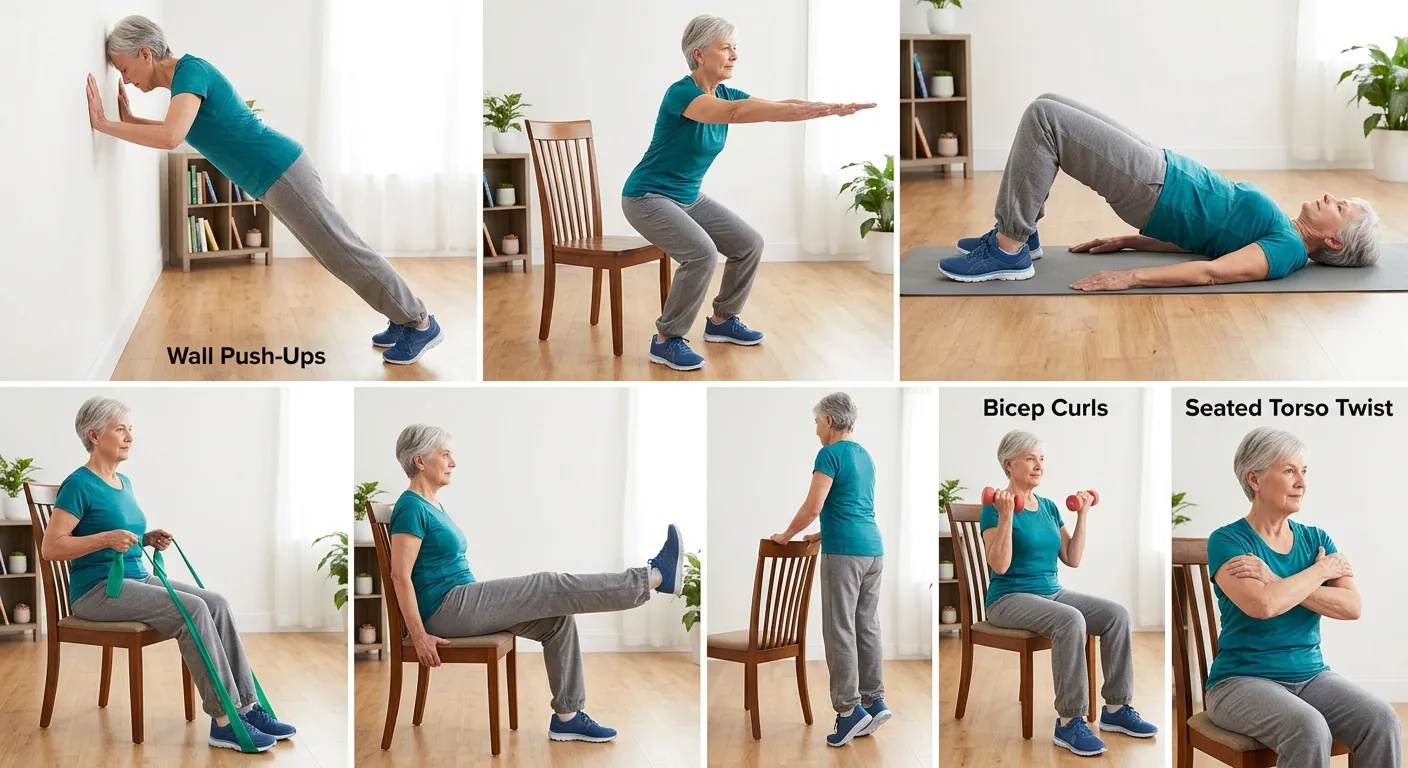
Lower Body (Critical for Mobility)
1. Chair Squats
Muscles worked: Quadriceps, glutes, hamstrings
Instructions:
- Stand in front of a sturdy chair, feet hip-width apart
- Slowly lower body toward chair seat as if sitting down
- Lightly touch seat with buttocks, then immediately stand back up
- Don't sit fully down—just hover above seat
- Keep weight in heels, chest lifted
- Arms can extend forward for balance or stay at sides
Reps: 10-15 | Sets: 2-3
Modification: Start by actually sitting and standing (no hovering) if strength is limited. Use chair with armrests for support initially.
2. Step-Ups
Muscles worked: Legs, glutes
Instructions:
- Using a sturdy step or bottom stair, step up with one foot
- Bring the other foot up to meet it
- Step back down
- Alternate leading leg
Reps: 10-15 each leg | Sets: 2
3. Glute Bridges
Muscles worked: Glutes, core
Instructions:
- Lie on your back with knees bent, feet flat on floor
- Tighten abdominals and lift hips off the floor until body forms a straight line
- Hold 3 seconds, lower slowly
Reps: 10-15 | Sets: 2-3
4. Seated Leg Lifts
Muscles worked: Quadriceps
Instructions:
- Sit tall in a sturdy chair
- Extend one leg straight out, hold 3 seconds, lower
- Repeat with other leg
Reps: 10-15 each leg | Sets: 2
5. Heel Raises (Standing Calf Raises)
Muscles worked: Calves, ankle stabilizers
Instructions:
- Stand behind sturdy chair, hands on backrest for balance
- Feet flat on floor, hip-width apart
- Rise up onto toes, lifting heels off ground
- Hold for 2-3 seconds at top
- Lower heels slowly with control
Reps: 10-15 | Sets: 2
Modification: Sit and perform heel raises if standing balance is limited.
6. Hip Abduction (Outer Leg Lifts)
Muscles worked: Outer hip muscles (hip abductors)
Instructions:
- Stand behind chair holding backrest for balance
- Keeping standing leg slightly bent for stability
- Lift other leg out to side (about 45 degrees)
- Keep leg straight throughout movement
- Hold for 2-3 seconds
- Lower slowly with control
Reps: 10 each leg | Sets: 2
Modification: Perform seated by lifting knee to side if standing is difficult.
Additional Seated Leg Exercises
For seniors who need to sit during exercise, these provide effective strengthening without balance demands:
Seated Knee Raises: Sit tall in a chair, lift one knee toward your chest, hold for 2-3 seconds, lower slowly. Repeat 10-15 times per leg.
Seated Calf Raises: Sit with feet flat on the floor, lift heels off the ground while keeping toes on the floor, hold for 2-3 seconds, lower slowly. Repeat 10-15 times.
Seated Ankle Circles: Sit with feet flat on the floor, lift one foot slightly and make slow circles with the ankle—10 circles in each direction. Repeat on the other foot.
Upper Body
7. Wall Push-Ups
Muscles worked: Chest, shoulders, triceps
Instructions:
- Stand arm's length from a wall
- Place hands on wall at shoulder height, slightly wider than shoulders
- Slowly bend elbows, leaning body toward wall
- Stop when face is 2-3 inches from wall
- Push back to starting position with control
- Keep body straight throughout—don't sag at hips
Reps: 10-15 | Sets: 2
Modification: Stand further from wall for easier version; closer for more challenge.
8. Seated Rows (with Resistance Band)
Muscles worked: Upper back, biceps, rear shoulders
Instructions:
- Sit in a sturdy chair with good posture
- Loop resistance band around feet, holding ends in each hand
- Start with arms extended forward, palms facing each other
- Pull hands toward waist, squeezing shoulder blades together
- Keep elbows close to body throughout movement
- Slowly release back to starting position with control
Reps: 10-15 | Sets: 2
9. Bicep Curls (Dumbbells or Water Bottles)
Muscles worked: Biceps
Instructions:
- Stand or sit with arms at sides
- Hold light weights (1-3 lbs to start) or water bottles, palms facing forward
- Slowly bend elbows, curling weights toward shoulders
- Keep elbows stationary at sides—only forearms move
- Lower with control back to starting position
Reps: 10-15 | Sets: 2
10. Overhead Press
Muscles worked: Shoulders, triceps, upper chest
Instructions:
- Sit or stand with weights in hands at shoulder height
- Elbows bent, palms facing forward
- Push weights upward until arms are fully extended overhead
- Lower slowly with control back to shoulder height
Reps: 10-15 | Sets: 2
Caution: Skip this exercise if shoulder problems or rotator cuff issues exist.
Core
11. Seated Torso Twist
Muscles worked: Obliques, core
Instructions:
- Sit tall, arms crossed over chest
- Slowly twist torso to right, then left
- Keep hips facing forward
Reps: 10-15 each direction | Sets: 2
12. Pelvic Tilts
Muscles worked: Lower abs, glutes
Instructions:
- Lie on back with knees bent
- Tighten abdominals and flatten lower back against the floor
- Hold 3 seconds, release
Reps: 10-15 | Sets: 2
Special: Pelvic Floor Exercises (Kegels)
Muscles worked: Pelvic floor muscles
Instructions:
- Sit or lie comfortably
- Contract muscles as if stopping urination (identify the correct muscles)
- Hold contraction for 3-5 seconds
- Relax for 3-5 seconds
- Repeat 10 times, complete 2-3 sets daily
Benefits: May improve bladder control; may reduce urinary incontinence; supports pelvic organ health
Exercise Summary Table
| Exercise | Muscle Group | Equipment | Difficulty |
|---|---|---|---|
| Chair Squats | Legs, glutes | Chair | Easy-Moderate |
| Step-Ups | Legs, glutes | Step/stair | Moderate |
| Glute Bridges | Glutes, core | Bodyweight | Easy |
| Seated Leg Lifts | Quadriceps | Chair | Easy |
| Heel Raises | Calves, ankles | Chair | Easy |
| Hip Abduction | Outer hips | Chair | Easy |
| Seated Knee Raises | Quadriceps | Chair | Easy |
| Wall Push-Ups | Chest, arms | Wall | Easy |
| Seated Rows | Back | Resistance Band | Easy-Moderate |
| Bicep Curls | Biceps | Weights | Easy |
| Overhead Press | Shoulders | Weights | Moderate |
| Seated Torso Twist | Core | Chair | Easy |
Equipment Options for Senior Strength Training
| Equipment Type | Pros | Cons | Best For |
|---|---|---|---|
| Bodyweight | Free, accessible anywhere, no learning curve | Limited resistance, harder to progress | Complete beginners, those starting at home |
| Resistance Bands | Affordable ($5-15 for set), versatile, gentle on joints | Limited max resistance, may snap if damaged | Beginners, those with joint pain, home workouts |
| Light Dumbbells (1-5 lbs) | Progressive overload possible, familiar to most | Requires storage, risk of dropping | Beginners ready to add light resistance |
| Ankle Weights | Targets legs specifically, adds challenge to seated work | Can strain ankles if too heavy | Leg strengthening, seated exercises |
| Weight Machines | Guided movement, stable, easy to adjust | Less functional, gym-only, limited range | Seniors new to strength training, balance issues |
Inspect Your Equipment
Always inspect resistance bands for tears or damage before each use. Secure bands around stable surfaces—never use door handles. Start with the lightest resistance level and progress only when 15 repetitions feel easy with good form.
No Equipment (Bodyweight)
- Wall push-ups, squats, leg lifts, heel raises
- Completely free and accessible
- Good starting point for beginners
Resistance Bands
- Affordable ($5-15 for set)
- Versatile for many exercises
- Available in different resistance levels
- Safe alternative to weights
- Learn more in our resistance bands guide for seniors with arthritis
Light Dumbbells
- 1-5 pound weights for beginners
- Good for bicep curls, overhead press
- Can progress to heavier weights gradually
Ankle Weights
- For leg exercises (start very light: 0.5-2 lbs)
- Don't use for walking exercises
If you're setting up a home gym, check out our senior fitness equipment guide for recommendations.
Creating Your Strength Training Routine
Train each muscle group 2-3 times per week with at least one rest day between sessions.
Sample Weekly Schedule
Option A (3-Day Split):
- Monday: Upper body (wall push-ups, bicep curls, overhead press, seated rows)
- Wednesday: Lower body (squats, leg lifts, heel raises, hip abduction)
- Friday: Full body (combination of upper and lower, plus core)
Option B (2-Day Full Body):
- Tuesday: Full body workout (all major muscle groups)
- Friday: Full body workout (all major muscle groups)
Rest days: Light walking, stretching, or low-impact exercises for seniors
Sample Session Structure
| Phase | Duration | Activities |
|---|---|---|
| Warm-Up | 5-10 min | Light cardio (walking, marching in place), arm circles, joint rotations |
| Main Workout | 20-30 min | 8-10 exercises, 2-3 sets of 10-15 reps each |
| Cool-Down | 5-10 min | Static stretches (hold 20-30 seconds), deep breathing, light walking |
| Total | 30-50 min |
Progression Strategy
The principle of progressive overload is how muscles grow stronger. Follow this safe progression:
- Weeks 1-2: Learn form, light resistance, 8-10 reps
- Weeks 3-4: Add second set, maintain proper form
- Weeks 5-8: Increase resistance slightly, add reps to 12
- Weeks 9+: Progress to heavier weights or more challenging variations
Always increase one variable at a time—reps first, then sets, then weight. If your form breaks, you've progressed too quickly.
Starting Point
If you've never strength trained:
- •Start with bodyweight only for 2-4 weeks
- •Add light resistance (bands or 1-2 lb weights)
- •Progress to 5-10 lb weights over 2-3 months
- •Focus on perfect form before adding weight
- •Listen to your body—if it hurts, stop
Nutrition for Strength Building
What you eat fuels your workouts and supports recovery. While you don't need a special diet, paying attention to key nutrients helps your body build and maintain muscle.
Protein for Muscle Repair
Seniors have higher protein needs than younger adults because of reduced muscle protein synthesis. Aim for 1.2-1.5 grams of protein per kilogram of body weight, spread throughout the day.
Good protein sources:
- Lean meats, fish, eggs
- Greek yogurt, milk, cheese
- Beans, lentils, legumes
- Nuts and seeds
Timing matters: Include protein at every meal to support muscle repair consistently throughout the day. A small snack with protein after your workout may also help with recovery.
Hydration
Staying hydrated is crucial for performance and recovery. Drink water throughout the day, not just during workouts. Monitor your urine color—pale yellow is a good sign you're adequately hydrated. Adjust for weather and activity level.
Other Important Nutrients
- Vitamin D: Supports muscle function and bone health. Get sunlight exposure or consider a supplement.
- Calcium: Essential for bone density. Found in dairy products, leafy greens, and fortified foods.
- Omega-3 fatty acids: May help reduce inflammation and support muscle recovery. Found in fish, flaxseeds, and walnuts.
- B vitamins: Important for energy metabolism. Found in whole grains, meat, and leafy greens.
For more detailed nutrition advice, check out our senior nutrition guide.
Tips for Success
Start Small: If 10 reps feel impossible, start with 5. It's better to do fewer reps correctly than more reps with poor form.
Breathe Properly: Exhale during exertion (lifting), inhale during relaxation (lowering). Never hold your breath during strength training.
Track Your Progress: Write down exercises, weights, and reps. Seeing improvement motivates continued training.
Warm Up First: 5-10 minutes of light activity (walking, marching in place) before strength training may help prevent injury.
Cool Down After: Gentle stretching after training maintains flexibility and reduces soreness.
The Best Weight to Start With
The best starting weight is one that feels challenging by the last few reps but doesn't compromise your form. If you can easily do 15 or more reps, you're ready for more weight.
Safety Tips for Senior Strength Training
- Always warm up for 5-10 minutes before strength training
- Use proper breathing—never hold breath during exertion
- Maintain control—no jerky, fast, or uncontrolled movements
- Keep exercise area clear of tripping hazards
- Use sturdy furniture for support when needed
- Stay hydrated before, during, and after exercise
- Wear proper shoes with good support and non-slip soles
- Have phone nearby for emergencies
- Exercise in good lighting to see your movements clearly
- Stop immediately if you feel sharp pain—discomfort is normal, pain is not
- Listen to your body—fatigue is a signal to rest, not push through
- Seek professional guidance if you're unsure about form or have complex health needs
Warning Signs to Stop Immediately
End your workout and contact your healthcare provider if you experience:
- Sharp or sudden pain in joints or muscles
- Dizziness or nausea
- Significant shortness of breath beyond normal exertion
- Chest pain or irregular heartbeat
- Extreme muscle weakness or inability to control movements
- Pain that persists more than 24 hours after exercise
- Excessive fatigue after light activity
- Irregular heartbeat or heart racing
- Swelling or redness in joints
Key Takeaways
- Muscle loss with age is common but may be preventable and reversible with strength training
- Leg strength is the foundation of independence—it affects walking, climbing stairs, and daily activities
- Strength training may build muscle at any age, even after 70
- Start gently and progress gradually—consistency matters more than intensity
- Focus on proper form over heavy weights
- Listen to your body and stop if pain occurs
- Modify exercises for arthritis, balance issues, or other conditions as needed
- Proper nutrition, especially protein intake, supports strength building
- Warm up before and cool down after every session
- Consult your healthcare provider before starting a new program
References
-
National Institute on Aging. (2024). "Exercise & Physical Activity: Your Everyday Guide." https://www.nia.nih.gov/health/exercise-and-physical-activity
-
Centers for Disease Control and Prevention. (2024). "Physical Activity Guidelines: Strength Training for Older Adults." https://www.cdc.gov/physicalactivity/basics/older_adults/
-
Harvard Medical School. (2023). "Strength Training for Seniors: Benefits and Guidelines." Harvard Health Publishing. https://www.health.harvard.edu/staying-healthy
-
Mayo Clinic. (2024). "Strength Training: Get Stronger, Leaner, Healthier." https://www.mayoclinic.org/healthy-lifestyle/fitness
-
American Heart Association. (2024). "Strength Training and Older Adults." https://www.heart.org/en/healthy-living/fitness
-
National Institutes of Health. (2023). "Sarcopenia: Age-Related Muscle Loss and Prevention." https://medlineplus.gov/ency/article/003285.htm
-
American College of Sports Medicine. (2024). "Strength Training for Older Adults." https://www.acsm.org/
Strength training after 65 isn't just possible—it's essential for maintaining independence, protecting your bones, and improving your quality of life. Start gradually, focus on form, and celebrate every improvement.
Always consult your healthcare provider before beginning any strength training program, especially if you have heart disease, arthritis, diabetes, or other chronic conditions.
Related Articles
Exercise & Fitness
- The Ultimate Senior Exercise Guide — Back to main guide
- Strength Training vs Cardio for Bone Density — Which is better for your bones?
- Balance Exercises for Seniors — Strength plus balance equals fall prevention
- Core Exercises for Seniors — Stability training
- Stretching Exercises for Seniors — Flexibility for recovery
- Arthritis Exercise Handbook — Safe movement with joint pain
- Fall Prevention Strategies for Seniors — Protect yourself at home
Equipment & Tools
- Best Resistance Bands for Seniors with Arthritis — Resistance band guide
- Exercise Equipment for Seniors — Home equipment
- Senior Fitness Equipment — Complete buying guide
- Home Exercises for Seniors — No-gym workouts