📌Key Takeaways
- VO2 max is a stronger predictor of longevity than smoking, hypertension, or cholesterol
- Each 5 mL/kg/min increase in VO2 max reduces mortality risk by 21%
- VO2 max can be improved at any age with consistent training
- Testing options range from clinical labs to field tests and wearables
- Zone 2 and interval training are the most effective improvement strategies
The Short Answer
Is VO2 max the strongest predictor of longevity? Yes, research shows VO2 max is one of the strongest predictors of lifespan—often stronger than traditional risk factors like smoking, hypertension, or cholesterol levels.
What VO2 max should seniors aim for? For optimal longevity:
- Ages 60-69: Aim for 30+ mL/kg/min (men), 25+ mL/kg/min (women)
- Ages 70-79: Aim for 25+ mL/kg/min (men), 20+ mL/kg/min (women)
- Ages 80+: Aim for 20+ mL/kg/min (men), 16+ mL/kg/min (women)
Can walking increase VO2 max? Brisk walking improves fitness but may not maximally challenge VO2 max. Adding hills, intervals, or more vigorous exercise produces greater improvements.
How much VO2 max is lost each decade? VO2 max naturally declines about 10% per decade after age 30, but regular exercise can slow this decline by 50% or more.
Quick Answer
What is a good VO2 max for a 70-year-old? For a 70-year-old, VO2 max of 24-28 mL/kg/min is average for men, 18-22 for women. Higher values indicate better fitness and longevity.
Can VO2 max be improved at any age? Yes! Studies show seniors can improve VO2 max through consistent training, though improvement may be slower than in younger individuals.
How often should VO2 max training be done? Two to three interval sessions per week, combined with regular Zone 2 training, effectively improves VO2 max.
Is walking enough to improve VO2 max? Brisk walking improves fitness but may not maximally challenge VO2 max. Adding hills, intervals, or more vigorous exercise produces greater improvements.
How long does it take to improve VO2 max? Noticeable improvements typically occur within 8-12 weeks of consistent training. Significant changes may take 6-12 months.
Among all fitness measurements, VO2 max consistently emerges as one of the strongest predictors of longevity. Research shows that cardiovascular fitness is a more significant indicator of lifespan than many traditional health markers.
VO2 Max and Mortality Risk
Research consistently finds that moving from the lowest fitness category to even moderate fitness dramatically lowers mortality risk. Here's what the science shows:
| Fitness Category | Relative Mortality Risk | Average VO2 Max Range |
|---|---|---|
| Low | 100% (baseline) | Men: <21, Women: <15 |
| Below Average | 75% | Men: 21-26, Women: 15-20 |
| Above Average | 55% | Men: 27-31, Women: 21-25 |
| Good | 40% | Men: 32-37, Women: 26-30 |
| Excellent | 20-30% | Men: 38+, Women: 31+ |
HUNT Study Finding
The Norwegian University of Science and Technology HUNT Study, which followed over 50,000 adults for decades, found that individuals in the highest fitness category had a 70-80% lower mortality risk compared to those in the lowest category.
Key Research Sources
This data comes from landmark studies including:
- HUNT Study (Norwegian University of Science and Technology)
- JAMA Network Open - Cardiorespiratory Fitness and Mortality (2024)
- American College of Sports Medicine Exercise Guidelines
- European Journal of Preventive Cardiology
Landmark Research Finding
A Norwegian study following over 50,000 adults for decades found that low fitness was a stronger predictor of early death than smoking, hypertension, or high cholesterol. Each 5 mL/kg/min increase in VO2 max was associated with 21% lower mortality risk.
What Is VO2 Max?
Definition
VO2 max represents the maximum rate at which your body can consume oxygen during intense exercise. It's measured in milliliters of oxygen per kilogram of body weight per minute (mL/kg/min).
| Component | Meaning |
|---|---|
| VO | Volume of oxygen |
| Max | Maximum capacity |
| mL/kg/min | Measurement unit |
Why VO2 Max Matters for Longevity
VO2 max reflects:
| System | What It Indicates |
|---|---|
| Heart | Cardiac output and efficiency |
| Lungs | Oxygen uptake and diffusion |
| Blood | Oxygen-carrying capacity |
| Muscles | Mitochondrial density and efficiency |
| Metabolism | Energy production capacity |
VO2 Max Norms by Age and Gender
| Age Group | Men - Poor | Men - Average | Men - Good | Men - Excellent | Women - Poor | Women - Average | Women - Good | Women - Excellent |
|---|---|---|---|---|---|---|---|---|
| 50-59 | <24 | 24-30 | 31-37 | 38+ | <18 | 18-23 | 24-28 | 29+ |
| 60-69 | <21 | 21-26 | 27-31 | 32+ | <15 | 15-20 | 21-25 | 26+ |
| 70-79 | <18 | 18-23 | 24-28 | 29+ | <13 | 13-17 | 18-22 | 23+ |
| 80+ | <15 | 15-19 | 20-24 | 25+ | <11 | 11-15 | 16-20 | 21+ |
Age-Related Decline
VO2 max naturally declines about 10% per decade after age 30. However, regular exercise can slow this decline by 50% or more.
Estimate Your VO2 Max
Simple Walking Estimate
6-Minute Walk Test:
- Measure a flat 100-foot course
- Walk as far as possible in 6 minutes
- Record total distance covered
VO2 Max ≈ (Distance in feet × 0.1) + 10
| Distance Walked | Estimated VO2 Max | Fitness Level |
|---|---|---|
| <1000 ft | <20 | Low |
| 1000-1300 ft | 20-30 | Average |
| 1300-1600 ft | 30-40 | Good |
| >1600 ft | >40 | Excellent |
Quick Heart Rate Estimate
VO2 Max ≈ 15 × (Max Heart Rate ÷ Resting Heart Rate)
Max Heart Rate = 220 - your age
Example for a 70-year-old with resting heart rate of 65:
- Max HR = 220 - 70 = 150
- VO2 Max ≈ 15 × (150 ÷ 65) ≈ 35
Accuracy Note
These are estimates only. For precise measurement, consider clinical testing or advanced wearables.
The Longevity Zone
What VO2 max is associated with the longest lifespan?
| Age Group | Minimum for Longevity | Target for Optimal Longevity |
|---|---|---|
| 60-69 | 27+ (men), 21+ (women) | 30+ (men), 25+ (women) |
| 70-79 | 24+ (men), 18+ (women) | 25+ (men), 20+ (women) |
| 80+ | 20+ (men), 16+ (women) | 22+ (men), 18+ (women) |
Maintaining a VO2 max above average for your age appears to provide the greatest longevity benefit.
The Science: Why VO2 Max Predicts Longevity
Key Research Findings
A landmark Norwegian study followed over 50,000 adults for decades and found:
| Finding | Impact |
|---|---|
| Each 5 mL/kg/min increase in VO2 max | 21% lower mortality risk |
| Low fitness vs. smoking | Low fitness was stronger predictor of death |
| Low fitness vs. hypertension | Low fitness was stronger predictor of death |
| Low fitness vs. high cholesterol | Low fitness was stronger predictor of death |
| Benefits held regardless of age | Even older adults benefit |
Why Higher VO2 Max Extends Lifespan
| Mechanism | How It Works |
|---|---|
| Cardiovascular efficiency | Stronger heart pumps more blood per beat |
| Mitochondrial health | More energy production at cellular level |
| Inflammation reduction | Lower chronic inflammation markers |
| Blood pressure control | Better vascular function |
| Body composition | Lower fat mass, more muscle |
| Insulin sensitivity | Better blood sugar regulation |
The Bottom Line
VO2 max is considered the single best marker of cardiovascular fitness and one of the strongest predictors of how long you'll live—stronger than many traditional medical risk factors.
Testing Your VO2 Max
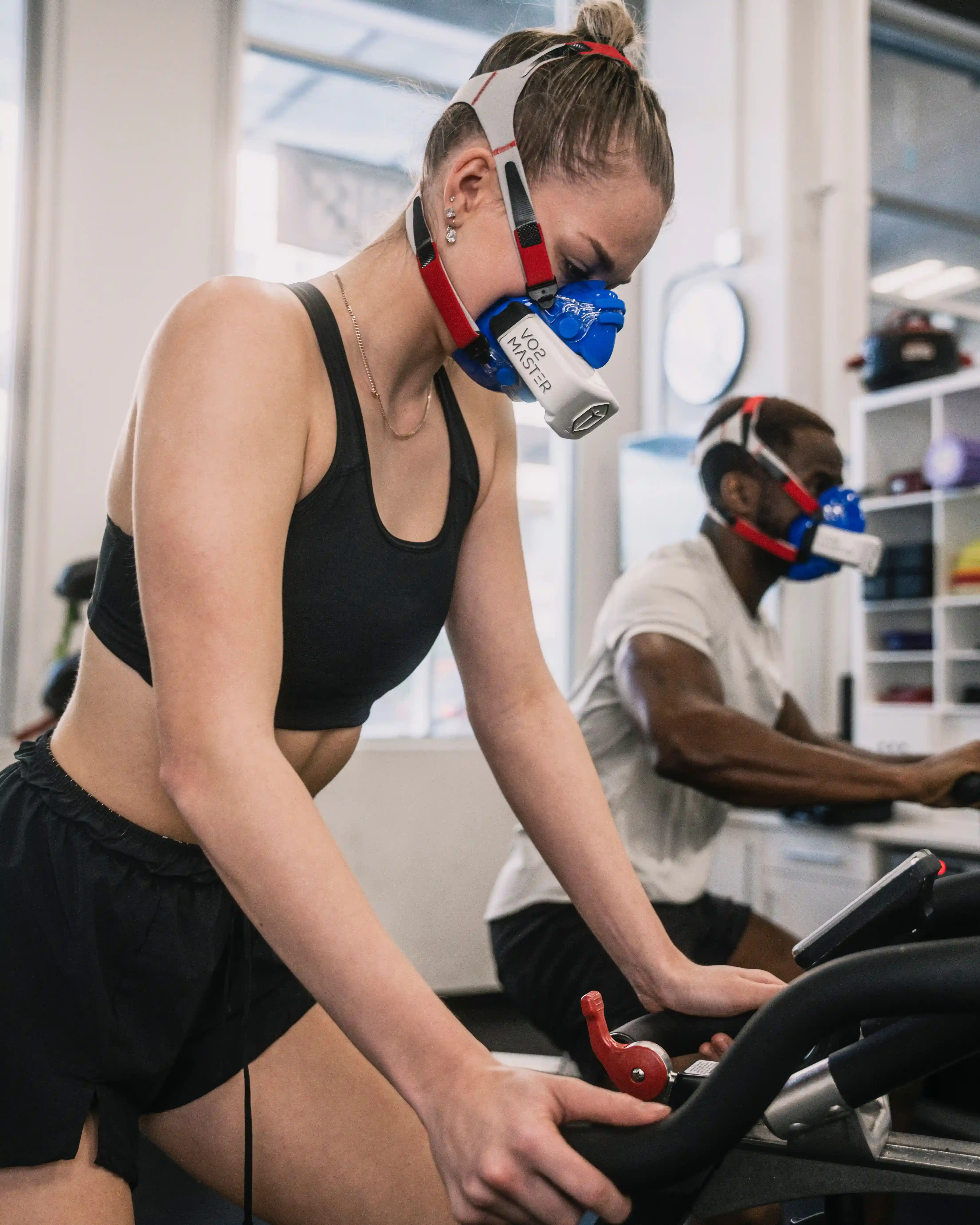
Clinical Testing (Gold Standard)
| Component | Details |
|---|---|
| Equipment | Treadmill or cycle ergometer |
| Measurement | Expired gas analysis |
| Protocol | Progressive intensity until exhaustion |
| Location | Medical or fitness facility |
| Duration | 10-20 minutes |
| Cost | $150-400 |
Field Tests (Estimates Without Lab Equipment)
6-Minute Walk Test
How to perform:
- Measure a flat 100-foot course
- Walk as far as possible in 6 minutes
- Record total distance covered
Estimated VO2 max:
| Distance | Estimated VO2 Max |
|---|---|
| <1000 ft | <20 mL/kg/min |
| 1000-1300 ft | 20-30 mL/kg/min |
| 1300-1600 ft | 30-40 mL/kg/min |
| >1600 ft | >40 mL/kg/min |
Rockport Walk Test
- Walk 1 mile (1609 meters) as fast as possible
- Record time and heart rate immediately after
- Use formula to estimate VO2 max
Step Tests
| Test Type | Duration | Measurement |
|---|---|---|
| 3-Minute Step | 3 min | Heart rate recovery |
| Queen's College Step | 3 min | Heart rate immediately after |
Wearable Fitness Trackers
Modern devices estimate VO2 max:
| Device Type | Accuracy | Features |
|---|---|---|
| Smartwatches | Good | Continuous tracking |
| Heart rate monitors | Moderate | Exercise-specific |
| Pulse oximeters | Limited | Basic only |
Accuracy Note
Wearable estimates are less accurate than clinical testing but useful for tracking changes over time. A 10-15% margin of error is typical.
How to Improve Your VO2 Max
How Much Can Seniors Improve VO2 Max?
The good news is that VO2 max can be improved at any age. Here's what research shows:
| Starting Fitness Level | Typical Improvement (6-12 months) | Example |
|---|---|---|
| Sedentary | 15-30% | 20 → 23-26 mL/kg/min |
| Recreational | 10-20% | 28 → 31-34 mL/kg/min |
| Already Fit | 5-10% | 35 → 37-39 mL/kg/min |
A 70-year-old with a VO2 max of 20 mL/kg/min may realistically improve to 24–26 after several months of structured training.
The Two-Training Approach
Research shows the combination of Zone 2 and interval training produces optimal results:
| Training Type | Purpose | Frequency |
|---|---|---|
| Zone 2 training | Build mitochondrial base | 3-5x/week |
| Interval training | Push aerobic ceiling | 2-3x/week |
Best Exercises to Improve VO2 Max After 60
| Exercise | Type | Benefits |
|---|---|---|
| Walking Hills | Weight-bearing cardio | Builds endurance, accessible |
| Zone 2 Cardio | Steady-state | Mitochondrial health |
| Interval Walking | High-intensity intervals | Rapid VO2 improvement |
| Cycling | Low-impact cardio | Joint-friendly, scalable |
| Swimming | Non-weight-bearing | Full-body, gentle on joints |
| Rowing | Full-body cardio | Builds endurance and strength |
Learn more:
Zone 2 Training
What it is: Long, steady efforts at 60-70% max heart rate
How to find your Zone 2:
- Talk test: Can speak in complete sentences but not sing
- Heart rate: 60-70% of maximum (220 - age)
- Example for 65-year-old: 93-109 bpm
| Session Details | Recommendation |
|---|---|
| Duration | 45-60 minutes |
| Frequency | 3-5 times per week |
| Intensity | 60-70% max HR |
| Benefits | Mitochondrial density, fat metabolism |
Activities for Zone 2:
- Brisk walking
- Light jogging
- Cycling at low resistance
- Swimming at comfortable pace
- Elliptical at low resistance
Interval Training
What it is: Short, intense efforts with recovery periods
Protocol:
| Interval Component | Duration | Intensity |
|---|---|---|
| Warm-up | 5 minutes | Easy pace |
| Work interval | 1-2 minutes | 85-95% max HR |
| Recovery | 2-3 minutes | Easy pace |
| Repeat | 4-8 times | - |
| Cool-down | 5 minutes | Easy pace |
📝Step-by-Step Guide
- 1Consult healthcare provider before starting intense exercise
- 2Build base fitness with 4-6 weeks of Zone 2 training first
- 3Add intervals gradually: start with 1-2 intervals per session
- 4Allow adequate recovery between sessions (48 hours)
- 5Track progress with wearable or simple logging
- 6Progress slowly: add one interval or 1 minute per week
Sample Weekly Training Schedule
| Day | Workout Type | Duration | Intensity |
|---|---|---|---|
| Monday | Zone 2 | 45 min | 60-70% max HR |
| Tuesday | Rest | - | - |
| Wednesday | Intervals | 30 min | 85-95% max HR |
| Thursday | Zone 2 | 45 min | 60-70% max HR |
| Friday | Rest | - | - |
| Saturday | Zone 2 | 45 min | 60-70% max HR |
| Sunday | Intervals | 30 min | 85-95% max HR |
Expected Timeline
Noticeable improvements in VO2 max typically occur within 8-12 weeks of consistent training. More significant changes may take 6-12 months. The key is consistency—regular training beats occasional intense sessions.
Who Should Focus on VO2 Max Training?
Ideal Candidates
| Profile | Why It Helps |
|---|---|
| Sedentary adults | Prevents age-related decline |
| Those with metabolic syndrome | Improves insulin sensitivity |
| Heart disease patients | Cardiac rehabilitation |
| Diabetics | Blood sugar regulation |
| Overweight individuals | Calorie expenditure |
| Anyone over 50 | Maintains independence |
Precautions
Medical Consultation Recommended
Consult your healthcare provider before starting VO2 max training if you have:
- Heart disease
- Uncontrolled hypertension
- Diabetes
- Lung disease
- Any chronic health condition
VO2 Max for Women Over 60
Understanding VO2 max norms for women requires recognizing important biological differences:
Key Considerations for Women
| Factor | Explanation |
|---|---|
| Natural Differences | Women typically have 15-20% lower VO2 max than men due to smaller body size and different muscle composition |
| Direct Comparison Not Valid | Comparing women's VO2 max directly to men's is misleading |
| Age-Adjusted Percentiles | Using age-specific percentiles is more meaningful |
VO2 Max Norms for Women by Age
| Age Group | Poor | Average | Good | Excellent |
|---|---|---|---|---|
| 50-59 | <18 | 18-23 | 24-28 | 29+ |
| 60-69 | <15 | 15-20 | 21-25 | 26+ |
| 70-79 | <13 | 13-17 | 18-22 | 23+ |
| 80+ | <11 | 11-15 | 16-20 | 21+ |
What's a good VO2 max for a woman age 70? For a 70-year-old woman, a VO2 max of 18-22 mL/kg/min is considered good, with values above 23 being excellent.
FAQ: Common Questions About VO2 Max and Longevity
Is VO2 max the strongest predictor of longevity? Yes, research consistently shows VO2 max is one of the strongest predictors of lifespan—often stronger than traditional risk factors like smoking, hypertension, or cholesterol.
What VO2 max should a 70-year-old aim for? For optimal longevity:
- Men: Aim for 25+ mL/kg/min (good), 29+ mL/kg/min (excellent)
- Women: Aim for 18+ mL/kg/min (good), 23+ mL/kg/min (excellent)
Can walking increase VO2 max? Brisk walking improves fitness but may not maximally challenge VO2 max. Adding hills, intervals, or more vigorous exercise produces greater improvements.
How much VO2 max is lost each decade? VO2 max naturally declines about 10% per decade after age 30, but regular exercise can slow this decline by 50% or more.
Is VO2 max more important than cholesterol? According to the HUNT Study and JAMA research, VO2 max is a stronger predictor of mortality than cholesterol levels.
Can VO2 max predict dementia risk? Yes, higher VO2 max is associated with lower dementia risk. Regular aerobic exercise supports brain health through improved blood flow and BDNF production.
What is a good VO2 max for a 70-year-old? For a 70-year-old, VO2 max of 24-28 mL/kg/min is average for men, 18-22 for women. Higher values indicate better fitness and longevity.
Can VO2 max be improved at any age? Yes! Studies show seniors can improve VO2 max through consistent training, though improvement may be slower than in younger individuals. Even very old adults show benefits from regular aerobic exercise.
How often should VO2 max training be done? Two to three interval sessions per week, combined with regular Zone 2 training, effectively improves VO2 max. Most days should include some form of aerobic exercise.
How long does it take to improve VO2 max? Noticeable improvements typically occur within 8-12 weeks of consistent training. Significant changes may take 6-12 months. Individual results vary based on starting fitness and training consistency.
What's the difference between VO2 max and VO2 reserve? VO2 max is your absolute maximum oxygen uptake. VO2 reserve (VO2R) is the difference between your VO2 max and resting VO2. Training programs often use VO2 reserve percentages for precision.
Can heart medications affect VO2 max testing? Yes, beta-blockers and other heart medications can affect heart rate response. Your doctor may recommend different testing protocols or interpretation guidelines.
The Most Important Takeaway
If you remember only one thing from this article: VO2 max is the single strongest predictor of longevity that you can actively improve.
Even small improvements in cardiovascular fitness can have significant impacts on your lifespan. The key is consistency—regular Zone 2 training combined with occasional intervals is the most effective approach for seniors.
Start today with a simple walk, and gradually build from there. Your future self will thank you.
Explore the VO2 Max Hub
This article is part of our comprehensive VO2 Max Hub. Discover more helpful guides:
VO2 Max Fundamentals
Training Programs
- Zone 2 Cardio for Longevity
- Interval Training for Seniors
- Low-Impact Cardio for Seniors
- Walking for Seniors Benefits
Longevity Topics
- Grip Strength and Longevity
- Heart Health for Seniors
- Protein for Seniors
- Mediterranean Diet Longevity
References
- Journal of the American Medical Association. (2024). Cardiorespiratory Fitness and Mortality. https://jamanetwork.com/
- Medicine & Science in Sports & Exercise. (2024). VO2 Max and Aging.
- Harvard Health Publishing. (2024). Why VO2 Max Matters. https://www.health.harvard.edu/
- American College of Sports Medicine. (2024). Exercise Testing Guidelines.
- Mayo Clinic. (2024). VO2 Max Testing and Interpretation. https://www.mayoclinic.org/
- British Journal of Sports Medicine. (2024). Cardiorespiratory Fitness and Longevity.
- NIH National Heart, Lung, and Blood Institute. (2024). Physical Activity and Heart Health. https://www.nhlbi.nih.gov/
- European Journal of Preventive Cardiology. (2024). Aerobic Fitness and Lifespan.