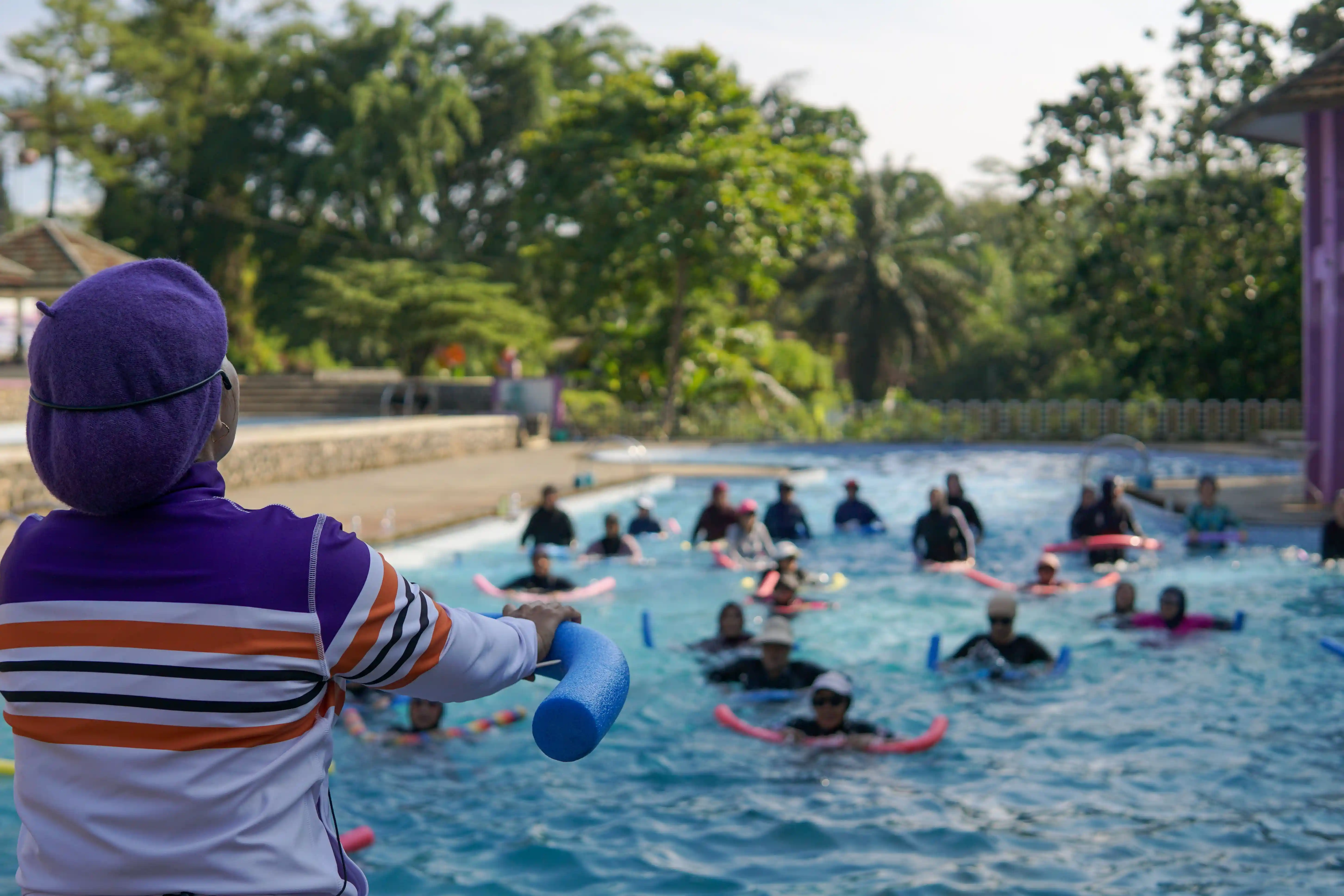
If you're new to water exercise, a pool noodle can provide flotation support and make some exercises feel more comfortable. If your goal is resistance training, foam aqua dumbbells are more useful. Water shoes can make walking on wet pool surfaces easier, while an aqua jogging belt is designed for a very different workout in deep water.
The best choice depends on what you want to do in the pool, how comfortable you are in the water, and whether you need support for balance or joints.
Here are our main picks:
- Best overall: Pool Noodle — inexpensive and versatile
- Best for resistance training: Foam Aqua Dumbbells — simple upper-body resistance
- Best for pool-area footing: Water Shoes — useful around wet surfaces
- Best for deep-water exercise: Aqua Jogging Belt — helps support the body during deep-water workouts
- Best for added hand resistance: Water Gloves — useful for selected upper-body exercises
- Best for swimmers: Swim Goggles — more comfortable vision underwater
- Best for upper-body-focused swimming: Aqua Exercise Buoy — supports the legs during swimming drills
A note about safety
Water exercise is often comfortable for people with joint pain, but it is not automatically appropriate for every condition. If you have significant balance problems, recent surgery, severe pain, heart or lung conditions, or another medical concern, ask your healthcare professional whether aquatic exercise is appropriate for you.
| Equipment | Best For | Typical Price | Main Benefit |
|---|---|---|---|
| Pool Noodle | Beginners & support | $5-15 | Flotation and versatility |
| Foam Aqua Dumbbells | Resistance exercise | $10-25 | Water-based upper-body resistance |
| Water Shoes | Pool-area footing | $15-30 | Traction and foot protection |
| Aqua Jogging Belt | Deep-water exercise | $20-40 | Buoyancy support |
| Water Gloves | Hand & arm resistance | $10-20 | Increased resistance |
| Swim Goggles | Swimming & underwater exercise | $10-25 | Clearer underwater vision |
| Aqua Exercise Buoy | Upper-body swimming | $15-30 | Leg flotation |
Top Picks by Category
1. Best Overall: Pool Noodle
A pool noodle is one of the simplest pieces of aquatic exercise equipment, and it can be useful for beginners who want some flotation support without buying a large amount of gear.
It is particularly handy for exercises performed in shallow water, although it should not be treated as a substitute for a properly fitted flotation device.
Good choice for: Beginners, water walking, balance practice, and exercises that use light flotation support.
Why it stands out:
- Inexpensive and easy to replace
- Lightweight and simple to carry
- Can be used for several different exercises
- Provides flotation for selected movements
- Doesn't require batteries, straps, or complicated setup
When choosing one, look for firm, high-density foam and a size that feels comfortable in your hands. A noodle that bends excessively may be less useful for exercises where you need to push it through the water.
Try it for:
- Holding across your body during shallow-water walking
- Gentle push-and-pull movements
- Supported leg exercises
- Flotation-assisted movements
One important point: don't rely on a pool noodle to prevent drowning or keep you safe if you cannot swim. For anyone who is not comfortable in the water, supervised exercise in an appropriate shallow area is a better starting point.
Our Recommended Pick: View priceamazon
2. Best for Resistance Training: Foam Aqua Dumbbells
Foam aqua dumbbells look more like small pieces of foam than traditional weights. That's intentional.
Instead of adding conventional weight, they create resistance as you move them through the water. Moving them slowly can make relatively simple arm movements surprisingly challenging.
For older adults who want to add some strength work to a water workout, this is often a more useful purchase than buying several different pieces of equipment.
Good choice for: Upper-body resistance, water aerobics, and people who want to make arm exercises more challenging.
Look for:
- Comfortable handles
- Foam that keeps its shape
- A size appropriate for your hand
- A pair rather than a single dumbbell
- A design intended specifically for aquatic exercise
Start with slow movements rather than trying to move the dumbbells as quickly as possible. The water itself provides resistance, and faster movements are not necessarily better.
Useful exercises include:
- Biceps curls
- Chest presses
- Shoulder presses
- Arm pushes and pulls
- Controlled arm circles
If gripping objects is difficult because of hand or wrist pain, check the handle design carefully before buying.
Our Recommended Pick: View priceamazon
3. Best for Pool-Area Footing: Water Shoes
Water shoes are easy to overlook because they aren't really a workout tool. For many older adults, however, the most useful part of the shoe is what happens between the changing room and the pool.
Wet tile and pool decks can be slippery. A water shoe with a properly designed rubber outsole can provide additional traction and protect the feet from rough surfaces.
It cannot eliminate the risk of slipping, so walk slowly and use available handrails when entering or leaving the pool.
Good choice for: Water walking, aquatic classes, public pools, and people who want additional foot protection.
Look for:
- A rubber or similarly grippy outsole
- Secure fit around the heel
- Drainage that allows water to escape
- Flexible upper material
- Enough room for your toes
- A sole that feels stable rather than overly soft
Avoid shoes that are loose enough to move around on your foot. A secure fit matters more than having the thickest sole.
Water shoes may be particularly useful if you regularly walk through wet locker rooms, pool decks, or shallow-water exercise areas.
Our Recommended Pick: View priceamazon
4. Best for Deep-Water Exercise: Aqua Jogging Belt
An aqua jogging belt serves a completely different purpose from a pool noodle.
It is designed to provide buoyancy around the torso during deep-water exercise, allowing you to perform jogging or other movements without placing your feet on the pool floor.
This can be useful for people who want to exercise in deep water, but it also requires more confidence in the water than ordinary shallow-water exercises.
Good choice for: Deep-water jogging, water-based cardio, and people who prefer not to repeatedly load their feet during exercise.
Look for:
- Adjustable waist strap
- Secure buckle
- Comfortable foam
- A fit that stays in place while moving
- Buoyancy appropriate for your body and the intended activity
The belt should feel secure without being uncomfortably tight. If it constantly rides up or rotates around your waist, the fit may not be right.
Common deep-water movements include:
- Water jogging
- High-knee movements
- Forward and backward jogging
- Cross-country skiing motions
- Controlled leg movements
If you are not comfortable in deep water, this is not the equipment to start with. A shallow-water class or water-walking program may be a better introduction.
Our Recommended Pick: View priceamazon
5. Best for Added Hand Resistance: Water Gloves
Webbed water gloves increase the surface area of your hands, making movements through the water more resistant.
They can be useful for people who already have a basic water exercise routine and want to make certain arm movements more challenging without adding conventional weights.
However, they aren't essential equipment. If you have painful or stiff fingers, wearing them may actually make some exercises less comfortable.
Good choice for: Upper-body water exercise and people who want additional resistance from hand movements.
Look for:
- Comfortable finger openings
- Flexible material
- Adjustable wrist closure
- A fit that doesn't restrict circulation
- Webbing designed for aquatic exercise
Try them with simple arm pushes and pulls before using them for longer workouts.
Our Recommended Pick: View priceamazon
6. Best for Swimming: Swim Goggles
If your water workout includes swimming, goggles can make the experience considerably more comfortable.
They keep chlorinated water away from the eyes and make it easier to see underwater. For older swimmers, fit may matter more than having the most advanced lens technology.
Look for a comfortable seal without excessive pressure around the eyes.
Useful features include:
- Adjustable straps
- Comfortable eye seals
- Anti-fog treatment
- UV protection for outdoor swimming
- Lenses that provide adequate visibility
If you only perform standing water exercises, goggles may not be necessary. They're more useful when your face regularly goes underwater.
Our Recommended Pick: View priceamazon
7. Best for Upper-Body-Focused Swimming: Aqua Exercise Buoy
An aqua exercise buoy, often used between the legs, provides flotation so you can concentrate more on your upper body while swimming.
This makes it more relevant to swimmers than to someone doing basic water aerobics.
It can also help beginners experiment with different body positions in the water, although it isn't necessary for a typical shallow-water workout.
Good choice for: Swimming drills, upper-body-focused sessions, and swimmers who want temporary leg flotation.
Look for:
- Comfortable foam
- A shape that stays securely in place
- Enough buoyancy for the intended use
- A size that doesn't cause discomfort between the legs
Try it for:
- Freestyle drills
- Upper-body swimming practice
- Controlled arm-resistance movements
Our Recommended Pick: View priceamazon
How We Evaluate Water Exercise Equipment
For this guide, the most useful question isn't simply "Which product has the highest rating?"
It's what problem does the equipment solve for an older adult at the pool?
We look at:
- Ease of use — Can someone unfamiliar with aquatic equipment understand how it works?
- Fit and handling — Are straps, handles, and openings reasonably easy to manage?
- Pool safety considerations — Does the equipment make sense for the environment in which it is used?
- Versatility — Can it be used for more than one exercise?
- Value — Is the benefit worth adding another item to your pool bag?
- Appropriate use — Is the product being used for the purpose it was designed for?
We also distinguish between exercise equipment and safety equipment. A pool noodle, for example, may provide flotation support during an exercise, but it is not a certified personal flotation device.
Water Exercise Equipment Comparison
| Equipment | Joint-Friendly Exercise | Balance/Support | Resistance | Cardio | Typical Cost |
|---|---|---|---|---|---|
| Pool Noodle | ★★★★☆ | ★★★★★ | ★★★☆☆ | ★★★☆☆ | $ |
| Foam Aqua Dumbbells | ★★★★★ | ★★☆☆☆ | ★★★★★ | ★★★☆☆ | $$ |
| Water Shoes | ★★★★☆ | ★★★★☆ | ★☆☆☆☆ | ★☆☆☆☆ | $$ |
| Aqua Jogging Belt | ★★★★★ | ★★★★☆ | ★★★★☆ | ★★★★★ | $$$ |
| Water Gloves | ★★★★☆ | ★★☆☆☆ | ★★★★☆ | ★★★☆☆ | $$ |
| Swim Goggles | ★★★☆☆ | ★★☆☆☆ | ★☆☆☆☆ | ★★☆☆☆ | $$ |
| Aqua Exercise Buoy | ★★★★☆ | ★★★☆☆ | ★★★☆☆ | ★★★☆☆ | $$ |
These ratings are intended as a quick comparison of how each type of equipment is generally used, not as clinical ratings or guarantees of benefit.
What Else Might Be Useful?
You don't need to buy everything on this list.
In fact, most beginners can get plenty from water shoes plus one piece of exercise equipment. Add other items only when they solve a specific problem.
Waterproof Fitness Tracker
A waterproof fitness tracker can be useful if you enjoy monitoring your activity over time.
Before buying one, check:
- Water-resistance rating appropriate for swimming
- Swim or water-workout tracking
- Easy-to-read display
- Battery life
- Comfortable wristband
For water exercise, don't assume that every "water-resistant" wearable is designed for swimming. Check the manufacturer's stated rating and permitted activities.
Our Recommended Pick: View priceamazon
Pool Handrails and Steps
For people with mobility or balance concerns, getting into and out of the pool can be more important than what happens during the workout.
If you're considering a permanent handrail or pool-access system, installation and compatibility with the specific pool matter. These products should be selected and installed according to the manufacturer's requirements.
Our Recommended Pick: View optionsamazon
Resistance Bands for Water Exercise
Aquatic resistance bands can add another type of resistance to a workout, but they're a more specialized purchase.
Look for products specifically designed for water exposure rather than assuming an ordinary resistance band will hold up well in a pool.
Our Recommended Pick: View optionsamazon
Waterproof Phone Pouch
This isn't exercise equipment, but it can be convenient if you want to keep your phone nearby at the pool.
Look for:
- Secure closure
- Clear touchscreen window
- Appropriate waterproof rating
- Comfortable lanyard or carrying method
Don't rely on a phone pouch as a substitute for following the pool's rules about phones and electronic devices.
Our Recommended Pick: View optionsamazon
How to Choose the Right Water Exercise Equipment
Start With the Exercise, Not the Product
Before buying anything, ask yourself what you actually want to do.
Want to walk in the shallow end? Water shoes may be the most useful purchase.
Want more upper-body resistance? Try foam aqua dumbbells.
Want to exercise in deep water? An aqua jogging belt makes more sense.
Want additional support during selected exercises? A pool noodle may be useful.
This approach can prevent a common mistake: buying a large collection of pool gear that ends up sitting in a locker or garage.
Start With One or Two Items
For a beginner, there is no need to build a complete $150 pool kit immediately.
A simple starting combination might be:
- Water shoes
- Pool noodle
After you've established a routine, consider adding foam aqua dumbbells if you want more resistance.
Pay Attention to Fit
For older adults, small design details can make equipment easier or harder to use.
Look for:
- Easy-to-grip handles
- Secure straps
- Comfortable materials
- Lightweight construction
- Good visibility
- A fit that doesn't require excessive hand strength
If an item is difficult to put on, adjust, or carry, it is less likely to become part of a regular routine.
How Much Water Exercise Equipment Do You Actually Need?
You don't need all seven products.
Basic Setup
Approximately $20-50
- Water shoes
- Pool noodle
This is enough for many beginners doing shallow-water walking or basic aquatic exercise.
Resistance-Focused Setup
Approximately $30-70
- Water shoes
- Pool noodle
- Foam aqua dumbbells
This gives you options for walking, support, and upper-body resistance.
Deep-Water Setup
Approximately $40-80
- Water shoes
- Aqua jogging belt
- Optional goggles
This makes more sense for someone who already feels comfortable exercising in deep water.
Complete Setup
A larger kit can include gloves, goggles, a buoy, fitness tracker, and other accessories, but more equipment doesn't automatically mean a better workout.
Buy the item that solves your next problem rather than trying to own every piece of pool gear.
A Simple 30-Minute Water Workout
If your healthcare professional has cleared you for exercise, a simple session can be built around walking and controlled movements.
Warm-Up — 5 Minutes
- Easy water walking
- Gentle arm swings
- Ankle movements
- Slow shoulder movements
Main Workout — 20 Minutes
Water walking — 5 minutes
Walk at a comfortable pace in shallow water. Use the pool edge or another appropriate support if needed.
Aqua dumbbell presses — 3 minutes
Push the dumbbells slowly through the water and return to the starting position.
Side steps — 3 minutes
Take controlled steps sideways while maintaining an upright posture.
Arm circles — 2 minutes
Use water gloves if they feel comfortable, or simply use your hands.
Leg movements — 3 minutes
Perform controlled leg lifts or knee movements while maintaining stable footing.
Water walking — 4 minutes
Finish the main portion with comfortable forward or backward walking.
Cool Down — 5 Minutes
- Slow walking
- Gentle range-of-motion movements
- Relaxed breathing
- Light stretching if comfortable
The goal isn't to finish exhausted. For many older adults, a workout that feels manageable enough to repeat two or three times a week is more useful than one extremely difficult session.
Water Exercise Safety for Seniors
Water reduces some of the loading associated with land-based exercise, but a pool still has hazards.
Keep these points in mind:
- Enter and exit slowly. Wet surfaces can be slippery.
- Use available handrails. Especially when getting into or out of the pool.
- Start with shallow-water exercise if you're new to the pool.
- Don't use exercise equipment as a substitute for a flotation device.
- Check straps, foam, and handles for damage.
- Drink water before and after exercise.
- Increase exercise intensity gradually.
- Stop if you develop unusual pain, dizziness, chest discomfort, or significant shortness of breath.
- Follow the pool's rules and use appropriate supervision when necessary.
If joint pain, balance problems, or another medical condition affects your ability to exercise safely, a physical therapist or other healthcare professional can help you determine which type of aquatic exercise is appropriate.
FAQ: Water Exercise Equipment for Seniors
Do I need equipment to do water exercises?
No. Many water exercises can be performed without equipment. The water itself provides resistance, while equipment can add flotation support or make certain movements more challenging.
What water exercise equipment is best for beginners?
For many beginners, water shoes and a pool noodle are practical starting points. If strength training is your goal, foam aqua dumbbells are another useful option.
Is water exercise equipment expensive?
Basic equipment is usually affordable. Pool noodles and foam dumbbells generally cost less than specialized products such as aqua jogging belts or waterproof fitness trackers.
Prices vary by brand, materials, and retailer, so check current pricing before buying.
Where can I buy water exercise equipment?
Sporting-goods stores, swim shops, specialty aquatic-equipment retailers, and online marketplaces such as Amazon carry many of these products.
Can I use regular dumbbells in the water?
It is better to use dumbbells specifically designed for aquatic exercise. Foam aqua dumbbells are designed to create resistance in water and are easier to handle than conventional weights.
Do I need to know how to swim?
Not necessarily. Many aquatic exercises take place in shallow water where you can stand. Deep-water exercise is different, however, and requires comfort in deep water and appropriate safety precautions.
How often should I use water exercise equipment?
A common starting point is two or three sessions per week, with the duration and intensity adjusted to your fitness level and healthcare guidance.
Consistency matters more than trying to make every workout difficult.
What is a comfortable pool temperature for water exercise?
Many aquatic exercise programs use comfortably warm water, often around the mid-80s Fahrenheit. The appropriate temperature depends on the activity, pool setting, and individual comfort.
Related Articles
If you're building a joint-friendly exercise routine, these guides may also help:
- 12 Best Pool Exercises for Arthritis Pain Relief
- Aqua Aerobics for Arthritis
- Best Exercise Equipment for Seniors
- Low-Impact Exercises for Arthritis
References
- Arthritis Foundation — Water Exercise and Arthritis
- National Institute on Aging — Exercise and Physical Activity
- Mayo Clinic — Exercise and Arthritis
- American College of Sports Medicine — Exercise and Physical Activity Guidance