Introduction
Many older adults want to stay in their own homes as they age, and most of the changes that keep them there are small. Try this first: walk the house at 3 a.m., the way your parent does—bed to light switch, light switch to bathroom, bare feet on a cold floor. The real to-do list writes itself. A throw-rug corner that catches a toe, a threshold lip in the dark, a bathroom door that swings the wrong way for a walker, a faucet knob that demands a hard twist. None of these is a renovation; all of them are home modifications, and fixing the ones on that midnight route is where the work below starts.
Falls are common among older adults. The CDC reports that more than 1 in 4 adults age 65 and older report falling each year. Falls can lead to serious injuries, loss of confidence, and reduced independence. Making the home safer is one important part of fall prevention, along with staying physically active, reviewing medications, and addressing vision and balance problems.
The goal is not to make a home look like a medical facility. It is to make everyday activities—getting out of bed, using the bathroom, walking down the stairs, preparing a meal, or answering the front door—easier and more predictable.
You also do not need to change everything at once. Start with the hazards that are easiest to remove, then add equipment or larger modifications when the person's mobility, balance, vision, or other needs make them necessary.
📌Key Takeaways
- Start with simple hazards such as loose rugs, clutter, poor lighting, and unsecured cords before considering expensive remodeling
- Bathrooms, stairs, bedrooms, and nighttime walking routes deserve particular attention because they combine movement, transfers, wet surfaces, or low lighting
- Choose modifications that support independence rather than making the person feel that their home is being taken away from them
- DIY is reasonable for simple changes such as furniture rearrangement and plug-in lighting; structural, electrical, plumbing, and complex accessibility work should be evaluated by qualified professionals
- People with osteoporosis or dementia may need additional safety measures based on their individual risks and abilities
Three Tiers of Home Modification
Before buying a grab bar or planning a bathroom remodel, walk through the home and identify what actually creates a problem.
A useful approach is to divide modifications into three practical tiers.
Zero-cost tier. Start with changes that require no equipment. Remove loose or unnecessary rugs, clear walking paths, move frequently used items to easier-to-reach locations, secure or reroute electrical cords, and remove objects from stairs and hallways.
These changes are easy to overlook because they seem too simple. But removing an obvious trip hazard is usually a better first step than buying expensive equipment.
Low-cost tier. Next, consider equipment that addresses a specific problem. Depending on the person's needs, this might include nonslip bathroom surfaces, grab bars, plug-in or motion-activated night lights, a shower chair, a raised toilet seat, stair treads, or improved lighting.
Do not buy every safety product available. Choose equipment based on how the person actually moves around the home. A shower chair may be helpful for someone who becomes unsteady while standing, while a grab bar may be more useful for someone who needs support during a transfer.
Higher-cost tier. Larger modifications may become appropriate when simple changes are no longer enough. Examples include ramps, stair lifts, walk-in shower conversions, doorway widening, bathroom remodeling, or other accessibility changes.
These projects should be based on an actual mobility need rather than simply making the home look more accessible. A home modification assessment can help determine which changes are worthwhile before you spend thousands of dollars.
Start Small Before Remodeling
Many important home-safety improvements are simple: removing loose rugs, improving lighting, clearing walkways, securing cords, and making frequently used items easier to reach. The National Institute on Aging recommends correcting immediate hazards first and then reassessing what additional changes may be needed as the person's abilities and needs change.
📝Step-by-Step Guide
- 1Step 1 — Zero-cost pass: Walk through the home with a notepad. Remove loose rugs and obstacles, clear stairs and hallways, secure electrical cords, improve furniture spacing, and move everyday items to comfortable heights. Pay particular attention to the route between the bedroom and bathroom.
- 2Step 2 — Low-cost pass: Address the highest-priority problem areas. Depending on the person's needs, this may include bathroom grab bars, nonslip surfaces, shower seating, raised toilet seating, stair treads, and plug-in or motion-activated night lights.
- 3Step 3 — Larger modifications: If stairs, bathing, entering the home, or wheelchair or walker access remains difficult, consider a ramp, stair lift, walk-in shower, threshold modification, doorway widening, or another accessibility project. Get professional advice and written estimates before starting major work.
- 4Step 4 — Professional assessment when needed: If the person has fallen, has significant mobility or balance problems, or has changing cognitive or physical abilities, ask a doctor or other health professional whether an occupational or physical therapy home-safety evaluation would be appropriate.
Room-by-Room Modification Checklist
Walk through the home room by room rather than trying to fix everything at once. The National Institute on Aging recommends this approach because the right modification depends on the person's mobility, vision, balance, and daily routines.
For more guidance on fall reduction, pair this walkthrough with How Can Caregivers Reduce Fall Risk.
Entryways and exterior walkways. Make the route to the front door easy to see and walk across. Remove loose mats and replace damaged or uneven surfaces. Keep hoses, tools, decorations, and other objects away from the walking path. Make sure exterior steps are in good condition and have secure handrails where needed. Good porch lighting can also make nighttime entry safer.
If there is a threshold or small step that is difficult to see, a contrasting edge can make the change in height easier to notice, and a properly designed threshold ramp can remove the lip entirely—inexpensively and without construction. A stable bench near the entrance provides a place to sit while putting on or removing shoes. And notice which way the door swings: a door that opens into the entry and blocks someone with a walker can sometimes be reversed on its hinges for the cost of a handyman's hour, a cheap alternative to widening the frame.
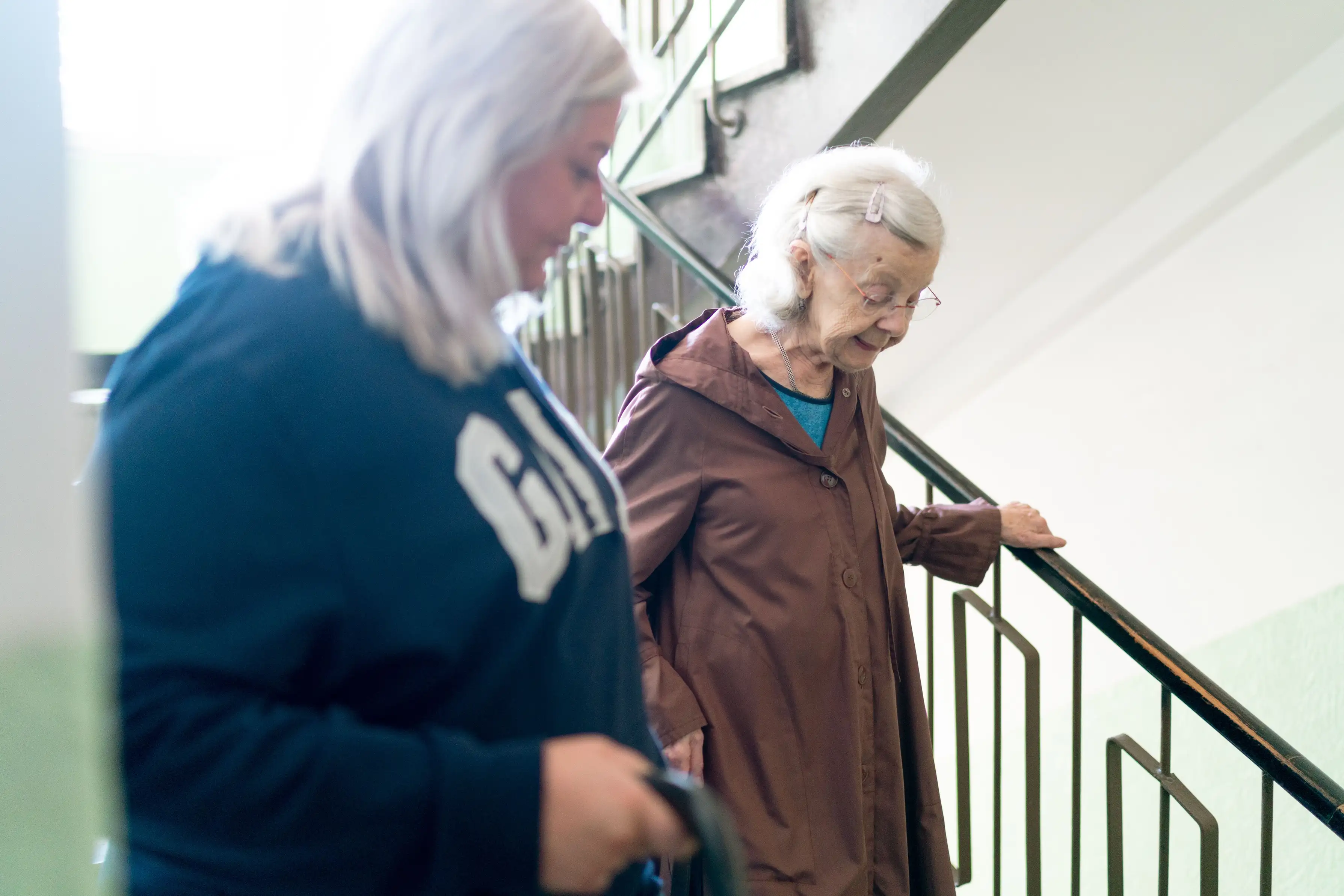
Staircases. Secure handrails can provide important support on stairs. Keep every step clear of shoes, boxes, pet toys, and other objects. Make sure the staircase is well lit, with switches that are easy to reach. Motion-activated lighting can be useful in areas where people regularly walk at night.
If the person has difficulty seeing the edges of steps, high-contrast stair nosing or tape may improve visibility. For someone who is becoming uncomfortable using stairs, adding a secure second handrail may be a useful first step. If stairs are no longer safe even with support, discuss a stair lift or another accessibility solution with a qualified professional.
Bathroom. Bathrooms deserve special attention because wet surfaces and transfers can make movement more difficult.
Install appropriately mounted grab bars near the toilet and in the tub or shower area when support is needed. The National Institute on Aging recommends grab bars near toilets and on the inside and outside of tubs and showers. Add nonslip strips, mats, or other suitable surfaces where floors become wet.
A handheld showerhead can make seated bathing easier, while a shower chair may help someone who becomes tired or unsteady when standing. A raised toilet seat may also make getting up easier for some people. If twisting the faucet knobs has become hard on arthritic hands, swap them for lever handles, which operate with a flat hand or a forearm—another small change that removes a daily annoyance.
For nighttime trips, use a night light or other lighting that clearly illuminates the route from the bedroom to the bathroom.
The products in Best Non-Slip Mats for Seniors, Best Night Lights to Prevent Falls, and Best Grab Bars for Elderly Bathrooms can help you compare specific options.
Kitchen. Kitchen safety is not only about falls. Burns, cuts, spills, and difficulty reaching objects can also create problems.
Keep frequently used pots, pans, dishes, and utensils where they can be reached without climbing or stretching. Clean spills promptly. Avoid storing everyday items in very high cabinets if the person has difficulty reaching them safely.
For someone with cognitive changes, consider additional precautions around the stove, knives, cleaning products, and other potentially dangerous items. Depending on the person's needs, stove safety devices or automatic shut-off features may be appropriate.
Replace difficult-to-grip cabinet hardware with handles that are easier to use if hand strength or dexterity is limited. Keep a stable work surface available so the person does not need to carry heavy objects across the kitchen.
Bedroom. Make getting in and out of bed as predictable as possible. The bed should allow the person to sit comfortably and place their feet securely on the floor before standing.
Keep a clear path between the bed and the bathroom. Remove small rugs, pet beds, baskets, and furniture that could become obstacles during a nighttime trip. Place a night light or easily accessible lamp near the bed.
Keep a phone or emergency response device within easy reach if the person lives alone or has a higher risk of falling.
Bed rails or transfer handles may help some people with getting in and out of bed, but they are not appropriate for everyone. Consider the person's mobility and cognitive status, and choose equipment designed for the specific bed. If there is any concern about entrapment, climbing over the rail, or unsafe use, ask a healthcare professional before installing one.
See Best Bed Rails for Seniors for product considerations.
Living room. Start by looking at the walking path rather than the furniture itself.
Remove small rugs that move underfoot or secure larger carpets properly. Keep electrical cords along walls instead of across walking paths. Arrange coffee tables, chairs, and other furniture so the person can move around them without twisting or squeezing through narrow spaces.
Choose sofas and chairs that are an appropriate height for the person to get in and out of easily. Keep frequently used items such as phones, glasses, remotes, and water within comfortable reach.
If a coffee table has sharp corners or a glass surface that creates an additional injury concern, consider replacing it with a safer design.
📋15-Point Whole-Home Safety Checklist
0/15 completed- Entry: Remove loose or curled mats; repair uneven walking surfaces; keep a stable place to sit near the entrance if needed
- Stairs: Install secure handrails where appropriate; improve lighting; keep every step completely clear
- Bathroom - Toilet: Add an appropriately mounted grab bar beside the toilet if support is needed; consider a raised toilet seat when appropriate
- Bathroom - Shower: Consider grab bars at the shower or tub entry and inside the bathing area; use suitable nonslip surfaces
- Bathroom - Bathing: Consider a handheld showerhead and shower chair for people who have difficulty standing while bathing
- Bedroom: Make bed transfers easier; keep the path to the bathroom clear; place a light and phone within easy reach
- Hallway route: Add adequate lighting or motion-activated night lights along the bedroom-to-bathroom route
- Kitchen: Keep frequently used dishes and cookware within easy reach; clean spills promptly; reduce the need to climb or stretch
- Kitchen: Use cabinet handles that are easy to grip; consider additional stove and appliance safety measures when cognitive changes are present
- Living room: Remove unsecured small rugs; keep cords away from walking paths; choose stable furniture that is easy to get in and out of
- Living room: Keep commonly used items such as phones, glasses, remotes, and water within comfortable reach
- Entry threshold: Improve visibility of changes in floor height; consider a properly designed threshold ramp when mobility equipment is used
- Exterior: Provide good lighting near the entrance; keep steps, walkways, porches, and decks clear and in good repair
- Cognitive safety (if dementia): Secure dangerous items such as medications, cleaning products, knives, and potentially hazardous appliances according to the person's needs
- Final check: Walk the home using the person's normal routine and look for anything that becomes difficult when using a cane, walker, wheelchair, or other mobility aid
When a Parent Refuses Modifications: How to Make the Conversation Easier
Resistance to home modifications is common. For an older adult, a new grab bar or removed rug can feel like a reminder that something about their independence has changed.
The goal is not to win an argument. It is to involve the person in the decision.
Start with independence. Instead of saying, "You need this because your house is unsafe," try, "Would this make it easier for you to use the bathroom without needing help?"
This keeps the conversation focused on what the person wants to continue doing.
Offer choices. If a grab bar is needed, let the person choose the finish or location when possible. If a night light is needed, let them choose the style. A modification is easier to accept when the person has some control over the decision.
Start with less noticeable changes. Better lighting, moving furniture, removing a loose rug, and reorganizing a cabinet may feel less intrusive than installing several pieces of equipment at once.
Use professional guidance when necessary. If the conversation becomes an ongoing conflict, ask a doctor, occupational therapist, physical therapist, or other appropriate professional to explain why a specific modification may help.
The purpose is not to make the person feel old or incapable. It is to help them continue using their home as independently as possible.
DIY vs. Professional Installation: The Dividing Line
Some home-safety changes are simple enough for a family member to handle. Others can create a serious hazard if they are installed incorrectly.
Usually reasonable to DIY when the change involves no structural, electrical, or plumbing work. Examples include removing rugs, rearranging furniture, installing plug-in night lights, placing nonslip products, organizing frequently used items, and applying some adhesive stair treads according to the manufacturer's instructions.
For grab bars, be more cautious. A grab bar that is intended to support body weight needs secure attachment to an appropriate structural surface. Do not assume that a few screws in drywall are enough. Follow the manufacturer's installation requirements and get professional help if you cannot identify suitable mounting points.
Consider a professional when the project involves electrical wiring, plumbing, structural changes, ramps, doorway widening, stair lifts, major bathroom remodeling, or installation on a wall where the structure is unclear.
Professional help is also appropriate when the modification needs to support a wheelchair, walker, or person with substantial mobility limitations. The correct dimensions, slope, clearances, load requirements, and installation methods depend on the specific situation and local building requirements.
Download the Home Safety Checklist
For a printable one-page PDF checklist you can carry on the room-by-room walkthrough and tick off as you complete changes, download: Home Safety Walkthrough Checklist. It includes the 15-point room summary plus a quick reference for when to call a professional.
How Much Do Home Modifications Cost?
The cost of aging-in-place improvements varies widely because the right modification depends on the home and the person's needs.
Some useful changes cost little or nothing. Removing a loose rug, improving furniture placement, clearing a walkway, moving frequently used items to an easier-to-reach location, or improving the use of existing lighting may cost nothing.
Low-cost equipment can include night lights, nonslip products, shower seating, raised toilet seats, stair treads, and other basic safety equipment.
Larger projects can become much more expensive. Ramps, stair lifts, bathroom conversions, doorway widening, and structural accessibility work may require professional design and installation.
Rather than starting with a fixed budget, start with a question:
What is currently preventing this person from moving safely and independently through the home?
Then spend money on the modification that addresses that specific problem.
When a quote makes you hesitate, price it against the alternative. One fall can mean an ambulance ride, an ER visit, and—after a hip fracture—weeks or months of rehab and possibly a permanent loss of confidence. Set beside that bill, grab bars, ramps, and lighting tend to look like the cheaper option. A home modification assessment can also help prevent families from spending money on equipment that does not solve the actual mobility problem.
How to Find a Qualified Home Modification Professional
For larger projects, ask people who already work with older adults for referrals.
Good starting points include:
- Your local Area Agency on Aging
- A senior center or aging-services organization
- An occupational therapist or physical therapist
- A physician or other healthcare professional
- A reputable contractor with aging-in-place experience
Look for relevant credentials or training, and verify licenses and insurance when required in your area.
Before hiring someone, get written estimates that explain:
- What will be changed
- Which materials will be used
- Labor costs
- Whether permits are required
- How long the work should take
- What warranty or follow-up service is included
Get more than one estimate for larger projects. Be cautious of contractors who recommend expensive upgrades without first asking about the person's actual mobility needs.
Reassess the Home as Needs Change
A home modification is not necessarily a one-time project.
A person who walks independently today may begin using a cane or walker later. A bathroom that works well now may become difficult after surgery or a mobility change. Someone with dementia may develop new safety concerns as cognition changes.
The National Institute on Aging recommends reassessing home safety as needs change.
Revisit the home after:
- A fall or near-fall
- A hospital stay
- A significant change in mobility
- Starting to use a cane, walker, or wheelchair
- A major change in vision
- A new cognitive impairment
- A change in the person's ability to bathe, dress, cook, or use stairs independently
The goal is not to make the house permanently "senior-proof." It is to keep the environment matched to the person's current abilities.
Plan Summary Table: Home Modification Prioritization
| Priority | Examples | Typical Approach | When to Consider |
|---|---|---|---|
| Start here | Remove loose rugs, clear pathways, secure cords, improve lighting, move everyday items | Usually simple and low-cost | First |
| Targeted safety equipment | Grab bars, nonslip surfaces, night lights, shower chair, raised toilet seat, stair treads | Choose based on a specific need | After the initial safety walk |
| Larger modifications | Stair lift, ramp, walk-in shower, doorway widening, bathroom remodeling | Professional assessment and installation may be needed | When mobility needs justify them |
| Professional assessment | Occupational or physical therapy home-safety evaluation | Ask a healthcare professional whether appropriate | After a fall, major mobility change, or when hazards are unclear |
| Review cycle | Reassess rooms, equipment, lighting, and walking paths | Repeat after major changes | Periodically and whenever needs change |
Frequently Asked Questions
Q: Where should I start with home modifications?
A: Start with the simplest hazards: remove loose or slippery rugs, clear walking paths, improve lighting, secure electrical cords, and move frequently used items within easy reach. Then focus on the bathroom and stairs. If the person still has difficulty moving safely, consider targeted equipment or a professional home-safety assessment. You can also read How Can Caregivers Reduce Fall Risk.
Q: Do home modifications require a permit?
A: It depends on the project and local building rules. Removing rugs, adding plug-in night lights, and using nonslip products generally do not involve permits. Electrical work, plumbing changes, structural alterations, ramps, doorway widening, and stair lifts may require permits or professional installation. Check with your local building department before starting work that changes the structure, electrical system, or plumbing.
Q: How can I convince my parent to accept home modifications?
A: Focus on independence rather than saying, "Your home is unsafe." Ask whether a modification would make a particular activity easier. Give your parent choices about finishes, styles, and locations when possible. Start with less noticeable changes such as better lighting, furniture rearrangement, or removing an unstable rug.
If the conversation remains difficult, ask a doctor, occupational therapist, or physical therapist to discuss the issue during a routine appointment.
Q: Are grab bars difficult to install?
A: Proper installation requires secure attachment to an appropriate structural surface. A grab bar should not simply be attached to drywall unless the mounting system is specifically designed and rated for that application. Suction-cup grab bars should not be relied upon as a substitute for permanently mounted, load-bearing grab bars.
If you cannot identify the appropriate mounting location or the wall involves tile, concrete, or another difficult surface, consider professional installation. See Best Grab Bars for Elderly Bathrooms for product considerations.
Q: What if we rent rather than own?
A: Start with renter-friendly changes such as plug-in night lights, nonslip mats, shower chairs, raised toilet seats, furniture rearrangement, and keeping walkways clear.
If you need to install grab bars or handrails, ask your landlord first and check local tenant and accessibility rules. Do not drill into walls or make structural changes without confirming that the modification is permitted.
Q: How do I find qualified contractors?
A: Ask your local Area Agency on Aging, senior center, occupational therapist, physical therapist, or another trusted aging-service professional for referrals. Look for contractors with relevant aging-in-place experience or training and verify licensing and insurance where required.
For larger projects, get multiple written estimates and ask each contractor to explain the proposed modification, materials, labor, permits, and expected timeline.
Q: What home modifications are especially important for someone with osteoporosis?
A: Fall prevention deserves particular attention because osteoporosis can increase the risk of serious fractures after a fall. Focus on secure walking paths, good lighting, safe stairs, bathroom grab bars, and appropriate nonslip surfaces. The right modifications depend on the person's mobility and living environment.
Q: Does dementia change how a home should be modified?
A: Yes. In addition to fall hazards, cognitive changes can create risks involving cooking, medications, cleaning products, wandering, stairs, and nighttime movement.
Depending on the person's needs, families may need to secure dangerous items, improve lighting and visual contrast, simplify confusing areas, and add additional supervision or safety measures.
Related Articles
- How Can Caregivers Reduce Fall Risk
- Best Bed Rails for Seniors
- Best Non-Slip Mats for Seniors
- Best Night Lights to Prevent Falls
- Best Grab Bars for Elderly Bathrooms
- Download Home Safety Checklist
- How Can I Prevent Falls at Home?
References
- Centers for Disease Control and Prevention (CDC). Older Adult Falls Data.
- National Institute on Aging (NIA). Preventing Falls at Home: Room by Room.
- National Institute on Aging (NIA). Home Safety Tips for Older Adults.
- National Institute on Aging (NIA). Six Tips to Help Prevent Falls.
- National Institute on Aging (NIA). Aging in Place: Growing Older at Home.
- National Institute on Aging (NIA). Alzheimer's Caregiving: Home Safety Tips.
- Administration for Community Living (ACL). Falls Prevention.
- Administration for Community Living (ACL). Home Modification Resources.
Disclaimer: This article is for educational purposes only and should not be considered medical, legal, or construction advice. Consult with qualified professionals for guidance specific to your home, local building codes, and care recipient situation.