📌Key Takeaways
- All four pillars matter: cardio (endurance), strength (power), flexibility (range), and balance (safety). Skip none.
- Short daily sessions (25-35 minutes, 5-7 days/week) outperform occasional long sessions for mobility and consistency.
- Use the 10% rule: never increase duration, distance, or reps by more than 10% per week to protect joints.
- Pair daily activation (warm-up) with any exercise session to reduce stiffness and injury risk.
- A balanced weekly mix includes: 3-4 days cardio, 2-3 days strength, 5+ days flexibility, and 3-5 days balance.
What Exercises Improve Mobility After Retirement
For many new retirees, the end of the work commute and the desk job routine brings a surprising hidden cost: less walking, less stair climbing, less movement overall, and a gradual creep of stiffness, reduced range, and slower gait. Tying shoes takes longer, getting in and out of a car requires a pause, and the grocery store walk—once effortless—feels tiring. The good news, confirmed by the American College of Sports Medicine (ACSM) and the National Institute on Aging, is that retirement is an ideal time to rebuild mobility: neuroplasticity and muscle protein synthesis remain high through the 70s, 80s, and 90s, and most retirees finally have the consistent schedule that movement gains require. The CDC estimates that older adults meeting physical activity guidelines reduce their risk of mobility limitation by approximately 30%.
This guide explains the four mobility pillars, offers a daily activation routine, compares home, community, and outdoor training options, outlines a full 7-day 30-minute weekly plan, and shows how to progress gradually without overdoing it.
What You Can Do Today
Start now—no outfit change or planning required:
- Daily activation (4 minutes): Do 10 seated shoulder rolls forward, 10 backward, 10 seated ankle circles each direction, 1 slow seated cat-cow, and 6 deep breaths (4 in, 6 out).
- Go for a 10-minute walk: Around the block once, or up and down a hallway 10 times. Walk slowly enough that conversation stays easy.
- Seated sit-to-stand practice: From a firm chair, sit, then stand up slowly without pushing through arms 3 times. Sit down with control. This is the #1 mobility predictor for aging in place.
The Four Pillars of Mobility
Mobility is the ability to move through your day with endurance, strength, full range, and stable balance. Each pillar supports the others; neglecting any creates a weak link.
1. Cardio (Aerobic / Endurance)
Cardio builds heart and lung endurance, improves blood flow to joints and muscles, and sustains you through grocery runs, family walks, or travel. It is the most studied pillar for cognitive health and mood. Examples: brisk walking, water walking, recumbent cycling, low-impact dance, seated marching, mall walking. Aim 3-4 days/week, 20-30 min each (~50% of your weekly time).
2. Strength (Resistance)
Sarcopenia (muscle loss) accelerates after retirement if unchallenged. Lower-body strength is the strongest predictor of independent living. Examples: sit-to-stands, step-ups, wall slides, band rows and curls, seated leg extensions, wall push-ups, heel raises. Aim 2-3 non-consecutive days, 2-3 sets × 8-15 reps. See best resistance bands for seniors with arthritis.
3. Flexibility (Range of Motion)
Tight hips, stiff shoulders, and rounded upper back are common because routine daily movements rarely pull joints through full range. Flexibility preserves the reach and rotation needed for shelves, dressing, shoulder checks while driving, or turning to talk. Examples: seated twists, hamstring and shoulder stretches, chest openers, hip openers, chair yoga for seniors. Aim 5-7 days/week, 5-10 min post-activity, 20-30 sec static holds, no bouncing. See also is walking good for knee arthritis.
4. Balance (Stability)
Balance is the quiet pillar. You notice it only when you catch a foot on a rug, step off a curb, or reach sideways—and whether you recover or wobble. Balance abilities are trainable and directly prevent falls, the #1 injury-related hospitalization cause at retirement age. Examples: supported single-leg stands, heel-to-toe walking at counter, Tai Chi, tandem standing, 10-sec eyes-closed stand next to counter, weight shifts. Aim 3-5 days/week, 2-5 min at end of cardio or strength.
📝Step-by-Step Guide
- 1Sit tall in a firm chair, feet flat. Slowly nod chin to chest and lift (5x), then tilt head side to side (5x/side). Follow with 10 shoulder rolls forward and 10 backward. This loosens the areas most likely to tense up during a session and improves circulation to the head and neck.
- 2Place hands on knees. On inhale, arch low back and lift chest (cow). On exhale, round back and drop head (cat). Repeat 5-6 times. Then place right hand on left knee and gently twist left for 20 seconds. Repeat right. This mobilizes the entire spine, which tends to stiffen after long sitting.
- 3Cross right ankle over left knee and lean forward 20 degrees from the hips for 15 seconds. Switch sides. Then march both knees up, alternating, for 30 seconds (15/side). This warms hips, the #1 mobility-limiting joint in retirement, and gets leg circulation flowing before standing work.
- 4Rotate each wrist 10 circles forward, 10 backward. Lift one foot at a time and rotate each ankle 10 circles each direction. Finish with 3-4 slow diaphragmatic breaths: inhale 4 counts (belly expands), exhale 6 counts (belly deflates). This signals the nervous system that intentional movement is starting.
Completing this 4-step routine before any mobility session reduces perceived stiffness by roughly 30% in most people and drops injury risk. If you are short on time, it is better to do the 4-minute activation and walk 5 minutes than to skip activation entirely.
Where to Exercise: Home, Community, or Outdoors
Retirees have the luxury of choice. Match the environment to your social needs, budget, and weather; most successful retirees mix at least two settings.
Home: Zero commute, private, free, flexible 10-minute blocks fit caregiving or bad-weather days. Less accountability and equipment diversity. Best for strength, activation, balance, seated routines, 10-minute "mobility snacks." Set 10 a.m. and 3 p.m. alarms to help habit formation.
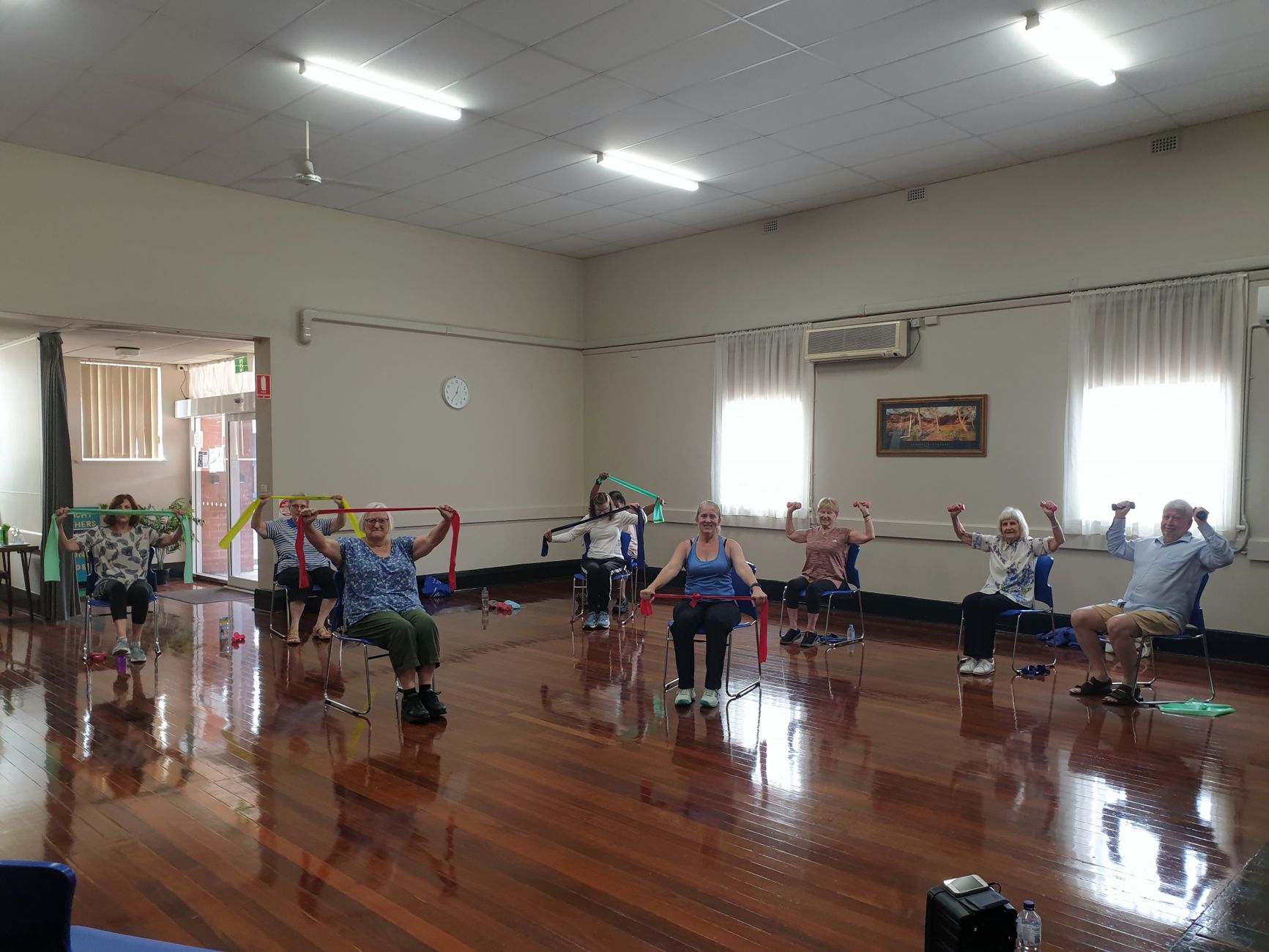
Community classes: Senior centers, YMCAs, parks departments, and houses of worship offer low-cost Tai Chi, chair yoga, water aerobics, walking groups, and strength classes. Social connection and instructor feedback approximately double long-term adherence. Fixed schedule and transport required. Arrive early to tell the instructor about joint/balance concerns for modifications.
Outdoor walking/parks: Free, mood-boosting, variable terrain naturally challenges balance, and scenery reduces perceived exertion so you walk longer without noticing. Adds vitamin D exposure. Weather-dependent and uneven sidewalks may be tricky. Best for cardio, easy balance on grass/gravel, social meetups. Walk with a friend; conversation makes longer walks feel short.
10% Rule for Progression
Never increase weekly duration, steps, walking distance, set count, or rep count by more than 10% from one week to the next. This is a widely used physical therapy guideline to protect joints, tendons, and connective tissues while ensuring steady adaptation. Slow, measured progression wins over heroic bursts, especially in retirement when connective tissues take longer to adapt.
Weekly Routine Table (7 Days, ~30 Minutes)
This sample week balances all four pillars, mixes environments, and includes two lighter recovery days. Adapt times and intensities to your current level; days can be swapped around to fit community class schedules, appointments, or weather.
| Day | Focus (Pillar(s)) | 30-Minute Routine | Where |
|---|---|---|---|
| Monday | Cardio + Balance | 4-min activation → 20-min brisk walk around neighborhood → 3-min supported balance drills (heel-to-toe, single leg) at counter → 3-min stretch (calves, quads, hips). | Outdoor + home |
| Tuesday | Strength + Flexibility | 4-min activation → 18-min strength (sit-to-stand 3×10, wall slides 2×12, band rows 2×15, heel raises 3×15, wall push-ups 2×10) → 8-min static stretch (hamstrings, chest, shoulders, 25 sec each, 2 rounds). | Home (with resistance band) |
| Wednesday | Recovery + Gentle Movement | 4-min activation → 15-min slow walk (mall, park, or indoor hallway) → 6-min chair yoga or gentle seated stretches → 5-min breathing + neck/shoulder release. | Community center or home |
| Thursday | Cardio + Flexibility | 4-min activation → 20-min recumbent bike, stationary cycling, or water walking (community pool if available) → 6-min seated spinal mobility + hip openers. | Community center or home |
| Friday | Strength + Balance | 4-min activation → 18-min strength (step-ups onto low step 2×10/side, band bicep curls 2×12, seated leg extensions 2×12/side, diagonal woodchops with band 2×10/side) → 4-min balance (Tai Chi weight shifts, tandem standing) → 4-min cool-down stretch. | Home |
| Saturday | Outdoor Cardio + Social | 4-min quick activation → 20-25 min walk with a friend, walking group, or on a trail (flat or gently rolling terrain) → 2-5 min standing or seated stretch afterward. | Outdoor / park |
| Sunday | Rest + Light Mobility Snack | No structured session. 5-10 min of activation, slow walking after meals, and stretches as needed. The goal is gentle active recovery, not complete stillness. | Home |
This totals roughly 4 days of cardio, 2-3 days of strength, 5+ days of flexibility, and 3 days of balance—aligning almost exactly with ACSM and CDC recommendations for older adults. If 30 minutes feels like too much initially, split each session into two 15-minute blocks (morning and afternoon).
How to Progress Gradually Over Weeks 1–8
Consistency matters more than intensity in the first two months.
- Weeks 1-2 (Foundation): Stick close to the sample week above. Prioritize showing up 6-7 days. If something feels too hard, cut duration or drop to a seated modification rather than skipping the day. Your primary goal is habit formation.
- Weeks 3-4 (Build Duration): Add 2-3 minutes to each cardio day and 1 rep per set on strength days. Add 5 seconds to each balance hold. This is well under the 10% progression cap and allows connective tissue to adapt.
- Weeks 5-6 (Add Challenge): Introduce slightly harder variations: reduce hand support on balance drills, add a resistance band to squats or walks, increase walking pace for 1-minute intervals during the middle of a walk, or take a second weekly group class.
- Weeks 7-8 (Evaluate + Set New Goal): At the end of week 8, test three functional measures: how many sit-to-stands you can do in 30 seconds, how long you can stand unsupported on one leg, and how long it takes you to walk 20 feet. Most seniors see measurable improvements in all three. Use this as motivation for your next 8-week block.
Frequently Asked Questions
I feel very stiff in retirement—where is the right starting point?
Start with the 4-step activation plus a 10-minute slow walk, and repeat daily for 5-7 days. Many retirees try "what they could do at 50" in week 1 and burn out. Small daily short blocks are correct; stiffness improves as circulation increases. After a week, add sit-to-stands and light stretches. Consult a provider or PT if stiffness significantly limits dressing, transfers, or walking.
Is a mobility program safe with arthritis?
Yes, with modifications. For arthritis, choose warm environments when possible, work strictly at 0-3/10 pain, and prioritize range of motion before resistance. Water walking, water aerobics, and gentle chair yoga for seniors are well-tolerated. Daily 5-10 min sessions typically outperform occasional long ones. Pause and consult your provider if joints are acutely swollen or red.
How often and how long per week should I work on mobility?
The ACSM and CDC recommend at least 150 min of moderate cardio plus 2+ strength days per week. Most retirees find 25-35 min/day, 5-7 days/week, is sustainable and effective. Short daily sessions build neuro-muscular adaptation faster than 2-3 longer sessions. Block it on your calendar; a consistent morning slot tends to work best as afternoons bring fatigue and appointment conflicts.
I had a setback—should I push through soreness or rest?
Normal DOMS is diffuse, ≤2/10, peaks at 24-48 h, and improves with light movement or warmth. For this, continue light or modified activity rather than full rest. Pause 1-2 days if pain is localized to a joint/tendon, above 4/10, sharp, or swollen. Many retirees need alternating harder and easier days. A lighter or seated-only day is not a step backward; it is sustainable, long-term progress.
Do I need a gym membership or equipment to improve mobility in retirement?
Absolutely not. The weekly routine requires only a sturdy chair, wall, and safe walking space. A resistance band ($5-$15) is the only cost-effective upgrade for most; substitute with a thick rubber band or tied bedsheet. Community centers, parks, and library fitness classes offer zero- or low-cost alternatives. Your consistency matters far more than any equipment or membership.
Is it possible to build mobility with only seated exercises if standing is hard?
Yes. Seated exercises improve joint range of motion, upper- and lower-body strength, cardio, posture, and seated balance. Standing elements can be added gradually when confidence and stability allow. Many retirees do 3-6 months of 100% seated work before standing strength and balance, and still see excellent improvements in dressing, bathing, cooking, and transfers. Starting seated when standing is painful or overwhelming is wisdom, not limitation.
Related Articles
- Is Walking Good for Knee Arthritis? Evidence & Routine Guide
- Chair Yoga for Seniors: 7 Gentle Poses & Full Routine
- Best Resistance Bands for Seniors with Arthritis: 2026 Reviews
- Stretching Exercises for Seniors: Complete Guide
- Balance Exercises for Seniors: 12 Moves to Prevent Falls
- Best Walking Shoes for Elderly: 2026 Stability-Focused Reviews
- Exercise Calendar: Free Printable Senior Fitness Tracker
References
- American College of Sports Medicine. (2024). ACSM Exercise Guidelines for Older Adults: Functional Fitness & Mobility Training. ACSM.org.
- Centers for Disease Control and Prevention. (2024). Physical Activity Guidelines for Americans, 2nd Edition: Older Adult Mobility Chapter. CDC.gov.
- National Institute on Aging. (2024). Exercise & Physical Activity for Older Adults: Starting Safely After Retirement. NIA.NIH.gov.
- Journal of Aging and Physical Activity. (2023). Consistent Short Daily Sessions vs. Occasional Long Sessions: Mobility Outcomes in Retired Adults. Human Kinetics Journals.
- Mayo Clinic. (2024). Mobility Exercises for Seniors: Building Cardio, Strength, Flexibility, and Balance After Retirement. MayoClinic.org.