Is Walking Good for Knee Arthritis?
Stiffness greets you when you swing your legs out of bed. You stand, take two steps toward the kitchen, and that familiar ache in your right knee announces itself like an uninvited guest. You consider the morning walk your doctor mentioned, then hesitate: won't walking just make the arthritis worse? This dilemma—wanting to move, yet fearing movement—is one of the most common struggles for adults living with knee osteoarthritis.
A Centers for Disease Control and Prevention (CDC) study of adults with arthritis found that those who walked regularly reported 25% less self-reported pain and 30% better physical function scores than sedentary peers over 18 months. A 2024 meta-analysis in Arthritis Care & Research further concluded that structured walking interventions reduced the risk of developing radiographic knee OA progression by 18% in adults over 65.
This guide covers exactly why walking benefits arthritic knees (not harms them), the correct biomechanics to minimize joint stress, the equipment that matters most, how to progress safely from 5 minutes to 30, and what to do when you experience pain before or after a walk.
📌Key Takeaways
- Walking delivers synovial fluid to nourish cartilage and builds quadriceps support for the knee
- 30 minutes of moderate walking, 5 days/week, reduces arthritis pain by ~25% per CDC data
- Proper stride (heel-to-toe, shorter steps, neutral foot) cuts peak knee force by ~20%
- Warm up 5 minutes, cool down, and use heat/ice strategically to manage post-walk soreness
- Always stay below a pain level of 3/10—sharp or lingering pain means adjust or rest
Quick Start: 3 Things You Can Do Today
First, take a 5-minute walk around your block or apartment building right now. Walk slowly, focus on landing on your heel and rolling through to your toe, and stop if pain climbs above a 3 out of 10. Small starts build consistency.
Second, check the tread on your most commonly worn walking shoes. Press your thumb into the midsole under the heel; if it feels rock hard or if the tread pattern is worn smooth, it is time to start shopping for a new pair. Supportive footwear is the single biggest variable you control with every step.
Third, do two minutes of seated leg extensions while you warm up. Sit on the edge of a sturdy chair, straighten one knee, hold for two seconds, and lower slowly. Ten repetitions per side activates the quadriceps, which offloads the knee joint before you even take your first step.
Why Walking Is Good for Arthritic Knees
Cartilage Nutrition Through Movement
Knee cartilage is a slippery, shock-absorbing cushion between your thigh bone and shin bone. Unlike most tissues in the body, cartilage has no direct blood supply; it receives nutrition and removes waste products through the pumping action of joint movement.
Every step you take compresses and releases the cartilage, drawing in fresh synovial fluid rich in oxygen and nutrients, and squeezing out metabolic waste. This is why sedentary adults with arthritis experience faster cartilage degeneration than their active peers: in the absence of regular movement, the cartilage starves. The ACSM and the Arthritis Foundation both recommend walking as a first-line lifestyle intervention for knee OA precisely because of this joint-nourishing mechanism.
Quadriceps Strength as Knee Armor
The quadriceps—the four muscles running along the front of your thigh—are the knee's primary shock absorbers. When quadriceps are weak, as they commonly are in sedentary older adults, more of the walking impact goes directly into the joint surface rather than being absorbed by muscle.
Walking is a low-load quadriceps strengthener. With every step, your quadriceps fire to control knee flexion during the stance phase and propel you into the next step. Over weeks and months, this repeated, controlled contraction increases quadriceps endurance and modestly builds strength, reducing peak joint forces by 15 to 20% compared to pre-walking baseline. Pairing walking with dedicated quadriceps exercises such as seated leg extensions or chair squats accelerates this protective effect.
Weight Management and Inflammation Reduction
Excess body weight is the single biggest modifiable risk factor for knee osteoarthritis progression. Every pound of body weight translates to roughly 3 to 4 pounds of additional force across the knee joint during walking. Walking burns calories, supports gradual, sustainable weight loss, and—critically—reduces systemic low-grade inflammation through a variety of metabolic pathways.
A 5% loss of body weight can reduce self-reported knee pain by 15 to 20% in overweight adults with knee OA, per the NIH Osteoarthritis Initiative. Walking supports that loss without placing the high joint stress of running on already sensitive knees. Regular walking also improves sleep quality, mood, and insulin sensitivity, each of which indirectly reduces perceived arthritis pain.
关节痛 vs 肌肉酸痛如何区分 (Joint Pain vs Muscle Soreness)
Joint pain from arthritis is typically sharp or aching, localized to the knee joint line or behind the kneecap, and appears during or immediately after activity with potential swelling. Muscle soreness from increased walking is dull, diffuse (thigh or calf area), peaks 24-48 hours post-walk, and improves with gentle movement and light stretching. If symptoms persist more than 2 hours after walking or wake you at night, they may indicate joint stress rather than ordinary muscle soreness. Consult your provider if sharp pain or swelling lasts more than a day.
Correct Walking Technique for Knee Arthritis
Proper walking technique dramatically reduces the shear and compressive forces on the arthritic knee. It is not about speed or distance; it is about the quality of each step.
Stride Length and Rhythm
Shorter, quicker steps place dramatically less stress on the knee joint than long, reaching strides. Aim for roughly 100 to 110 steps per minute (use a metronome app to build this rhythm initially). Shorter steps reduce peak knee flexion at impact and limit how far your center of gravity travels past your foot, cutting the shear force on the meniscus and articular cartilage.
Landing on your heel, rolling smoothly through the midfoot, and pushing off through your big toe is the correct gait pattern for knee comfort. Avoid stomping, landing flat-footed, or pushing off primarily from the outside edge of your foot, as each of these creates uneven joint loading. Your feet should track straight ahead, not toe out significantly or cross the midline of your body.
Surface Selection
Where you walk matters as much as how you walk. Softer, more compliant surfaces absorb more impact and reduce joint stress. Your hierarchy of preferred surfaces should be: padded athletic track or rubberized trail (lowest impact) > grass or dirt trail in good condition > paved asphalt sidewalk > concrete sidewalk > hard tile or indoor flooring (highest impact).
Avoid uneven terrain, steep hills (both up and down), and sand or loose gravel until you have built sufficient strength and confidence to handle them safely. Downhill walking in particular can double the eccentric load on the knee joint, so choose flatter routes on days when your knees feel especially sensitive.
Upright Posture and Arm Swing
Stand tall with your chest lifted, shoulders back and relaxed (not hunched up near your ears), and gaze 10 to 15 feet ahead rather than looking straight down at your feet. Good upright posture aligns the knee under the hip and ankle, reducing valgus (knock-knee) or varus (bow-leg) loading patterns that accelerate wear on one side of the joint.
Your arms should swing naturally at roughly 90 degrees, opposite to your legs: right arm forward with left leg, left arm forward with right leg. This cross-body swing stabilizes your torso and reduces the rotational torque on your lower body, which translates to less torsional stress on the knee joint itself.
Equipment for Arthritis-Friendly Walking
📋10-Point Walking Gear Checklist
0/10 completed- Walking shoes: supportive midsole, firm heel counter, wide toe box, non-slip outsole, < 500 miles or 6-12 months of use.
- Moisture-wicking socks: acrylic/polyester blend, no tight ankle bands that restrict circulation.
- Weather-appropriate layered clothing: reflective elements near traffic, sun hat, rain jacket as needed.
- Knee brace or sleeve if your PT recommends it: unloader braces for meniscus/lateral OA; neoprene sleeves for warmth/mild support.
- Orthotic insoles for flat feet, high arches, or uneven sole wear: OTC for mild, custom from podiatrist for moderate-severe.
- Water bottle or hydration pack for walks > 20 min or warm weather; dehydration raises perceived pain.
- ID card and emergency contacts, or medical ID bracelet if on blood thinners or with a heart condition.
- Fully charged phone for safety/GPS; waistband holder is more stable than holding it.
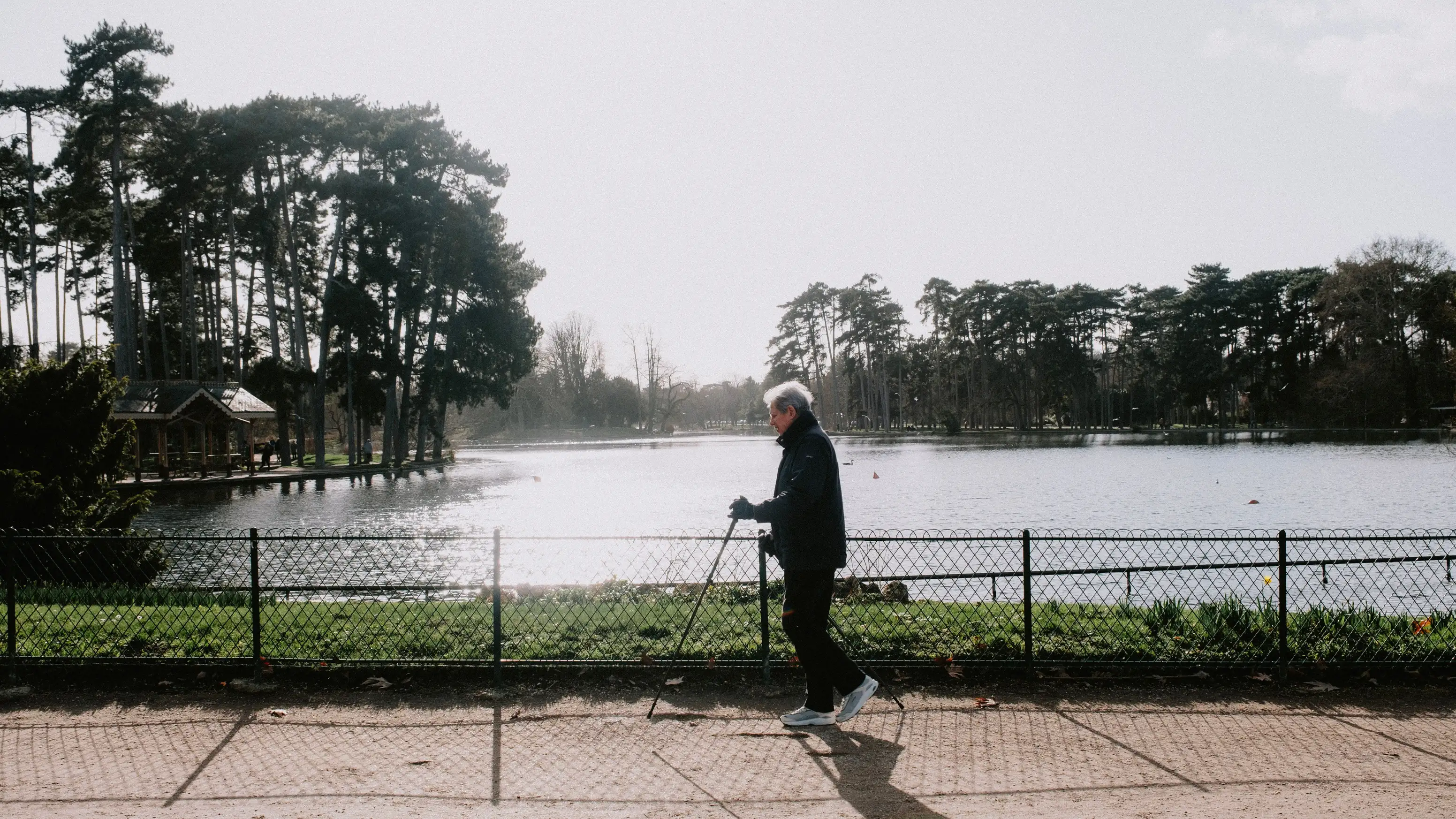
- Walking poles for balance issues or upper-body engagement; poles transfer 15-20% weight off lower extremities.
- Post-walk recovery options: cold pack, heating pad, or OTC anti-inflammatory per your doctor's advice.
For specific product recommendations, see our reviews of the best shoes for arthritis and best knee braces for arthritis. Correct equipment removes preventable stressors so the walking itself can do its good work.
Progression: From 5 Minutes to 30 Minutes Safely
Start with 5 to 10 minutes of walking per session, 3 to 5 days per week. Set a timer, walk at a pace where you can hold a conversation without gasping, and stop on time even if you feel great. Building the habit is more important than proving endurance on any single day.
Add 2 to 3 minutes per session every 1 to 2 weeks, and only if the previous week's walks left you with no more than mild, short-lived soreness. If you feel pain that persists for more than 2 hours after walking or lasts into the next day, drop back to the previous week's duration for another round before trying to increase again.
Use the talk test as your intensity guide: you should be able to say a full sentence but not sing. Overdoing it risks a flare-up.
It is perfectly acceptable—and often smart—to accumulate your daily minutes in chunks. Three 10-minute walks spread across morning, midday, and evening give you the same arthritis benefit as one 30-minute session, and they are often much easier on your knees. If 30 consecutive minutes feels like a stretch, start with the split approach.
Managing Pain: Before, During, and After Walking
Warm-Up and Cool-Down Routines
Never skip the warm-up. A 5-minute warm-up before you walk lubricates the knee joint, activates surrounding muscles, and increases tissue temperature, which reduces stiffness and injury risk. Try marching in place, seated leg extensions, bodyweight glute bridges, and slow, supported heel-to-toe shifts.
Cool down with 3 to 5 minutes of gradual slow-down walking, followed by 2 to 3 minutes of gentle static stretching: hamstring stretch, quad stretch, calf stretch, and seated hip flexor stretch. Hold each stretch for 20 to 30 seconds without bouncing. Static stretching after a walk reduces next-day muscle soreness and maintains range of motion in the knee joint.
Heat and Cold Application
Use heat before walking if morning stiffness is your primary issue. A 15-minute heating pad or warm shower relaxes the muscles around the knee and increases blood flow to the joint, which loosens things up before you begin.
Use cold after walking if you experience swelling, throbbing, or sharp post-walk pain. Apply a cold pack wrapped in a thin towel to the affected knee for 10 to 15 minutes. Cold therapy reduces inflammation and numbs local pain receptors.
Adjusting Your Routine When Pain Flairs
A pain flare-up is not a failure, and it does not mean you should quit walking entirely. It means your body is telling you to adjust the dose. On flare-up days, cut your walk duration in half, walk at a slower pace, switch to a flatter or softer surface, or do a seated chair exercise routine instead. Skip only if the pain is severe (7 out of 10 or worse) or accompanied by significant swelling, redness, or fever—in which case, contact your provider.
For those struggling with gait stability alongside knee pain, our article on improve coordination in older adults offers additional strategies. And for footwear guidance for walks of any distance, see our best walking shoes for elderly roundup.
4-Week Walking Progression Plan for Knee Arthritis
| Week | Walk Duration per Session | Sessions per Week | Surface Priority | Target Pain Level | Notes |
|---|---|---|---|---|---|
| 1 | 5-8 minutes | 3 | Indoor track or rubberized surface | Stay below 3/10 | Accumulate 2 sessions if needed |
| 2 | 10-12 minutes | 4 | Flat paved path or mall | Stay below 3/10 | Add one more session vs Week 1 |
| 3 | 15-20 minutes | 4-5 | Mix of track and pavement | Stay below 3/10 | Begin single longer sessions |
| 4 | 25-30 minutes | 5 | Pavement or trail as tolerated | Stay below 3/10 | Split into two 15-min sessions if knees prefer it |
After completing 4 weeks, maintain the Week 4 pattern or add 5 minutes per session every 2 weeks as long as pain remains controlled and recovery is consistent.
Frequently Asked Questions
How long should I walk if I have knee arthritis?
Start with 5-10 minutes per session, 3-5 times weekly, building toward 30 minutes on most days. Time may be accumulated in 5- or 10-minute chunks. ACSM and Arthritis Foundation target is 150 minutes of moderate joint-friendly activity weekly; progress slowly and consult your PT or doctor before increasing.
Is walking on a treadmill better than outdoors for knee arthritis?
Treadmills offer a flat, consistent, weather-independent surface with easy speed adjustment, which can help beginners. Outdoor walking on paved trails or tracks provides terrain variation and fresh air. Choose whichever is safest, most enjoyable, and most sustainable for you.
Should I walk through knee pain?
Walk only through mild discomfort rated 1-3 out of 10. Stop for sharp pain, swelling, catching, or locking, or if pain persists more than 2 hours after walking. Thigh soreness 24-48 hours post-walk is expected; lingering joint pain means you overdid it. Consult your physical therapist if unsure.
Can walking make knee arthritis worse over time?
No. Large prospective studies in Arthritis & Rheumatology consistently show regular moderate walking does not accelerate cartilage loss and may slow OA radiographic progression. Problems come from ramping up too quickly, poor technique, or inadequate footwear—not walking itself.
What time of day is best to walk with knee arthritis?
Late morning or mid-afternoon (after morning stiffness loosens) works best for most. A 5-minute warm-up before walking reduces strain regardless of time. Evening walking is also fine; pick whatever consistent window you can stick with. Consistency matters more than any specific time.
What shoes are best for walking with knee arthritis?
Choose supportive walking shoes with cushioned midsoles, a firm heel counter, wide toe box, and 10-12 mm heel-to-toe drop to reduce knee flexion at impact. Avoid flat or minimalist styles and pairs with compressed midsoles or worn tread. See the best shoes for arthritis and best walking shoes for elderly reviews for specific picks.
Related Articles
- Best Knee Braces for Arthritis (2026 Reviews)
- Best Shoes for Arthritis (2026 Reviews)
- Best Walking Shoes for Elderly Walkers
- Improve Coordination in Older Adults
- Chair Exercises for Seniors: Full-Body Routine
- Download: Exercise Calendar (PDF)
References
- Centers for Disease Control and Prevention. (2024). Physical Activity Guidelines for Adults with Arthritis. CDC.gov
- American College of Sports Medicine. (2024). Exercise Management for Osteoarthritis of the Knee. ACSM.org
- National Institutes of Health / Osteoarthritis Initiative. (2024). Walking as a Disease-Modifying Intervention for Knee OA. NIH.gov
- Mayo Clinic. (2024). Osteoarthritis of the Knee: Lifestyle Modifications and Walking Prescription. MayoClinic.org
- Arthritis Care & Research / Wiley. (2024). Meta-analysis: Walking Interventions and Knee OA Progression. Arthritis.org