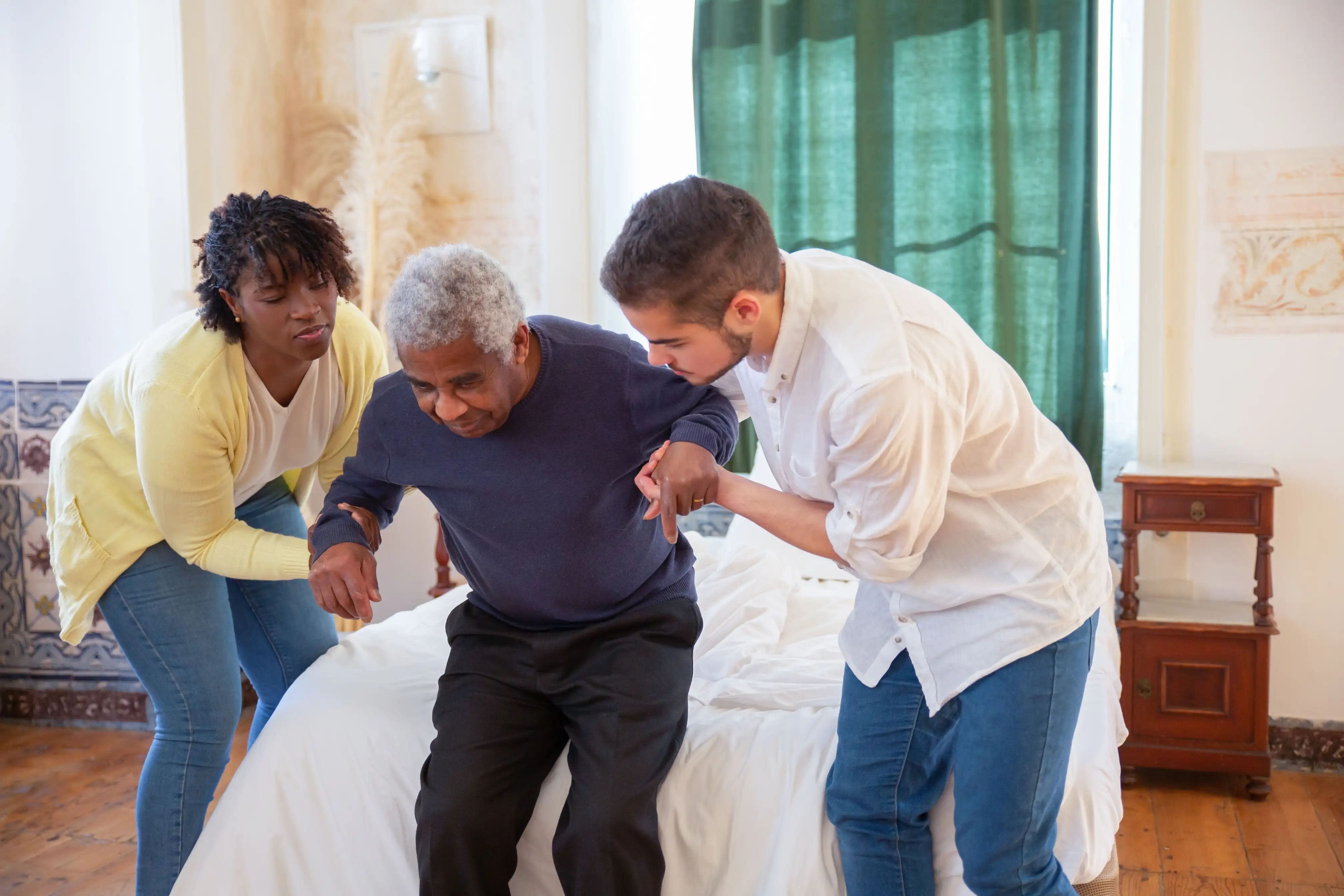
Helping an aging parent stand up can be stressful for both of you. A simple movement from a chair can suddenly become difficult when your parent has weak legs, stiff joints, poor balance, dizziness, or fear of falling.
The good news is that you do not have to rely on strength alone.
A safer transfer starts with the right setup: stable furniture, clear instructions, good foot placement, and enough support for the person's actual ability. Just as important, caregivers need to know when not to provide hands-on lifting and when professional help or equipment is the safer choice.
The CDC reports that more than one in four adults age 65 and older fall each year in the United States, and falling once can increase the chance of falling again. :contentReference[oaicite:7]7
This guide explains how to help an elderly parent stand up more safely from a chair, bed, or toilet, what common mistakes to avoid, and when a gait belt, lift chair, walker, or professional assessment may be appropriate.
📌Key Takeaways
- Set up the environment before the transfer: stable furniture, clear floor space, good lighting, and secure footwear
- Ask your parent to do as much of the movement as they safely can rather than trying to lift them
- Avoid pulling on the arms, wrists, or shoulders; a transfer belt may help some people but is not a lifting device
- Move slowly when your parent has dizziness or a history of orthostatic hypotension
- If your parent cannot bear weight safely or you cannot control the transfer, stop and get professional help rather than using more force
Why Standing From a Chair Can Be Hard for Older Adults
Standing from a chair is more complicated than it looks.
A sit-to-stand movement requires coordinated movement of the trunk, hips, knees, and ankles while the person shifts their center of mass forward and then rises. Research comparing younger and older adults has found age-related differences in sit-to-stand speed, trunk movement, postural sway, and lower-extremity force production. :contentReference[oaicite:8]8
Lower seats can also make the movement harder. Studies have found that chair height affects the amount of lower-limb effort required during sit-to-stand, with lower chairs generally creating greater physical demands. :contentReference[oaicite:9]9
This is why a parent who can stand comfortably from a firm dining chair may struggle much more with a deep sofa or low recliner.
Other factors can add to the problem:
- Leg weakness or muscle loss
- Arthritis or painful joints
- Poor balance
- Limited ankle or hip movement
- Fear of falling
- Vision problems
- Dizziness after changing position
- Medication side effects
- A chair or bed that is too low
- A walker or other mobility aid that is positioned incorrectly
If standing has recently become much harder, do not assume it is simply "getting older." A new decline in mobility deserves attention from a healthcare professional.
📋Before Helping Your Parent Stand: Safety Check
0/8 completed- Make sure the chair, bed, or toilet is stable and will not slide or tip during the transfer
- Clear the floor around the transfer area of rugs, cords, pets, footstools, bags, and other trip hazards
- Make sure both of your parent’s feet can reach a firm, non-slip surface
- Place the walker or other mobility aid where it can be reached safely after standing rather than requiring an awkward turn
- Make sure the room is well lit, especially when getting out of bed at night
- Check that clothing, robe hems, slippers, and shoelaces will not interfere with the transfer
- If transferring from a bed, make sure the bed is stable and positioned appropriately before starting
- Check your own footing and position. Do not place yourself where you could trip or lose your balance while assisting
CDC and the National Institute on Aging recommend removing trip hazards, improving lighting, and installing appropriate grab bars in bathrooms as part of fall prevention. :contentReference[oaicite:10]10
8 Practical Techniques for Helping an Elderly Parent Stand Up
1. Explain the Movement Before You Start
Do not surprise your parent with a sudden pull.
Tell them what you are going to do:
"Let's move to the edge of the chair first. Put your feet on the floor. Lean forward, then push up together."
Clear communication is especially important when a person has slower reactions, hearing problems, vision impairment, or cognitive difficulties.
Give one instruction at a time if your parent becomes overwhelmed by several directions.
The goal is cooperation, not speed.
2. Move Toward the Front of the Seat
Ask your parent to move toward the front of the chair before attempting to stand.
Both feet should be firmly supported on the floor, with enough room for the person to lean forward.
Avoid having the person try to stand from a deep, reclined position unless the chair is specifically designed to assist with standing.
If the chair is unusually low or soft, consider whether a different chair would make the transfer easier.
Chair height can significantly affect sit-to-stand performance in older adults. :contentReference[oaicite:11]11
3. Encourage a Forward Lean and Leg Push
One important part of standing is moving the body's weight forward before rising.
A simple instruction is:
"Bring your shoulders forward, then push through your feet."
Your parent should use their own legs as much as they safely can.
If the chair has sturdy armrests, they may be able to use them for support when beginning the movement. Do not encourage them to push against a lightweight table, rolling furniture, or another unstable object.
The exact hand and foot position should be adapted to the person's strength, balance, joint limitations, and mobility needs.
There is no single foot position that is ideal for every older adult.
4. Coordinate the Movement With a Simple Count
If your parent benefits from predictable instructions, use a simple countdown:
"Ready? Lean forward. One, two, three — stand."
The purpose is coordination rather than adding force.
If you are providing hands-on support, avoid suddenly pulling upward before your parent begins to move. Your job is to provide stability and guidance while allowing them to contribute as much of the movement as they safely can.
If you find yourself lifting most of their body weight, the transfer may be beyond what you can safely perform by yourself.
5. Pause After Standing
Do not rush directly from sitting to walking.
Once your parent is upright, give them time to establish their balance.
Ask:
"Are you steady?"
"Do you feel dizzy?"
"Are your feet firmly on the floor?"
This is particularly important for someone who experiences dizziness after standing.
Orthostatic hypotension is a recognized fall risk in older adults. CDC STEADI includes orthostatic blood-pressure assessment as part of fall-risk evaluation, and studies have found that blood-pressure responses during the first seconds after standing can be important when assessing this problem. :contentReference[oaicite:12]12
If your parent feels dizzy, do not tell them to walk through it. Help them remain safely supported or return to a stable seated position if necessary.
Repeated dizziness should be discussed with a healthcare professional. Medication review is also an important part of fall prevention because several types of medications can contribute to dizziness, sedation, balance problems, or orthostatic hypotension. :contentReference[oaicite:13]13
6. Move to the Walker Only After They Are Stable
If your parent uses a walker, do not rush them forward immediately after standing.
First make sure they are balanced.
Then follow the mobility technique recommended by their physical therapist or other healthcare professional.
A walker should be positioned correctly for the individual. It should not be placed so far away that your parent has to reach forward or twist to grab it.
If your parent routinely needs significant physical assistance to transfer to a walker, ask a physical therapist to assess the transfer.
7. Consider a Gait or Transfer Belt for the Right Person
A gait belt, sometimes called a transfer belt, can provide a caregiver with a more secure handhold during certain transfers.
However, it is not a substitute for lifting equipment.
OSHA guidance describes gait or transfer belts as appropriate for some people who are partially dependent, can bear some weight, and can cooperate with the transfer. It also specifically states that belts should not be used for lifting a person. :contentReference[oaicite:14]14
A transfer belt may not be appropriate for everyone.
For example, additional caution may be needed with certain abdominal or back conditions, recent surgery, or a person who cannot reliably bear weight or follow instructions.
If you have never used one, the safest approach is to ask a physical therapist, occupational therapist, nurse, or other qualified professional to demonstrate the technique.
8. Know When You Need More Than Hands-On Help
One of the most important caregiver skills is recognizing when a transfer is too difficult to perform safely.
Do not try to compensate for severe weakness by:
- Pulling harder
- Bracing your back and lifting
- Dragging the person upward
- Pulling on their arms
- Trying to catch their full body weight
- Repeating the transfer until they "eventually get up"
If your parent cannot reliably bear weight, repeatedly slides back into the chair, becomes severely dizzy, or requires you to lift most of their body weight, ask for a professional mobility assessment.
Depending on the situation, the safer solution may involve:
- A different chair height
- A lift chair
- A properly fitted walker
- A transfer aid
- A second trained caregiver
- A mechanical lift
- Physical therapy
- Occupational therapy
- A home safety assessment
OSHA notes that manual patient handling and transfers can create significant musculoskeletal risks for caregivers and healthcare workers, particularly when transfers require heavy lifting or awkward postures. :contentReference[oaicite:15]15
How to Help From a Chair, Bed, Toilet, or Sofa
The basic principles stay the same, but each location has different risks.
Chair or Armchair Transfer
A firm chair with a suitable seat height is usually easier to stand from than a very low, deep sofa.
If your parent struggles with their usual chair:
- Move toward the front of the seat.
- Place both feet securely on the floor.
- Lean the upper body forward.
- Push through the legs and use stable armrests if appropriate.
- Stand slowly.
- Pause and check balance.
- Reach for the walker or begin walking only after they are stable.
Do not use a lightweight side table, floor lamp, or rolling furniture as a handhold.
If the chair is too low, discuss a safer seating option with a physical therapist or occupational therapist.
Bed Transfer
Getting out of bed can be more difficult because the person begins from a lying position.
A safer sequence is:
- Raise the upper body gradually.
- Move into a seated position.
- Place both feet securely on the floor.
- Pause and check for dizziness.
- Stand only when ready.
- Stabilize before beginning to walk.
If your parent routinely becomes dizzy when getting out of bed, talk with their healthcare professional. Orthostatic hypotension, medication effects, dehydration, and other conditions may contribute to the problem. CDC STEADI specifically includes orthostatic blood-pressure assessment and medication review in fall prevention. :contentReference[oaicite:16]16
If you are considering bed rails, read the safety information in Best Bed Rails for Seniors before choosing a product.
Toilet Transfer
Bathrooms create several fall risks at once: slippery surfaces, limited space, poor lighting, and the need to manage clothing while maintaining balance.
CDC recommends installing grab bars next to the toilet and in bathing areas as part of home fall prevention. :contentReference[oaicite:17]17
Do not rely on a towel rack or toilet paper holder as a support.
Before the transfer:
- Make sure the floor is dry.
- Make sure the grab bar is secure.
- Keep the path clear.
- Avoid rushing clothing management.
- Use the mobility aid recommended for your parent.
If your parent regularly needs hands-on assistance in the bathroom, consider a professional home safety assessment.
Sofa or Deep Recliner Transfer
A soft, low sofa can make standing harder because the person begins from a lower position and the cushion can compress beneath them.
Instead of repeatedly pulling your parent upward, consider whether the seating itself is part of the problem.
A firmer and appropriately elevated seat may make the transfer easier.
If your parent continues to struggle, a lift chair may be worth discussing with a healthcare professional. See Best Lift Chairs for Seniors.
Avoid Pulling Your Parent Up by the Arms
Do not routinely pull a person upward by the wrists, forearms, or upper arms.
This can place unnecessary stress on the shoulders and can also put the caregiver in a poor position for controlling the person's movement.
If your parent needs more support than they can provide through their own legs, do not simply pull harder. Consider a transfer belt when appropriate, additional trained assistance, or professional assessment.
A gait or transfer belt should be used for support and control, not as a device for lifting someone who cannot bear weight. OSHA specifically advises that transfer belts are not intended for lifting. :contentReference[oaicite:18]18
What to Do If Your Parent Starts to Fall
A common caregiver instinct is to grab an arm and try to stop the fall.
That can put both people at risk.
If your parent begins to lose balance:
- Stay as calm as possible.
- Avoid trying to catch their full body weight.
- Use the support method you have been trained to use.
- Guide them toward a safe landing area when possible.
- Once they are on the floor, do not immediately pull them back up.
The most important question is whether they may be injured.
Look for:
- Severe pain
- New inability to move an arm or leg
- Obvious deformity
- Severe neck or back pain
- Trouble breathing
- Loss of consciousness
- New confusion
- Severe headache
- Repeated vomiting
- Difficulty speaking
- New weakness or numbness
- A suspected head injury
If any of these are present, seek urgent medical help rather than attempting to get the person back into a chair.
Falls can cause serious injuries in older adults, including traumatic brain injuries. CDC notes that older adults may have TBI symptoms that are missed or mistaken for other conditions. The risk of bleeding in the brain is particularly important when a person takes anticoagulant or antiplatelet medicines. :contentReference[oaicite:19]19
👩⚕️ When to Seek Medical Care After a Fall
Consult a healthcare provider if you experience any of the following:
- •Loss of consciousness with persistent difficulty waking or responding
- •Seizure
- •Severe breathing difficulty
- •Suspected serious head, neck, or spinal injury
- •Major bleeding or an obvious serious fracture
- The person lost consciousness or was difficult to wake
- There is severe or worsening pain, especially in the hip, back, neck, or head
- The person cannot normally move or bear weight on a limb
- There is an obvious deformity or significant swelling
- There is new confusion, unusual behavior, difficulty speaking, or new weakness
- There is a severe headache, repeated vomiting, or other concerning symptoms after a possible head injury
- The person takes blood thinners or antiplatelet medicines and may have hit their head
- The fall was unexplained or happened together with chest pain, shortness of breath, fainting, or other new symptoms
If there is no obvious injury and your parent is able to move independently, NIA describes a gradual floor-to-chair recovery approach: remain calm, assess for injury, roll to the side, move onto hands and knees, crawl toward a sturdy chair, and use the chair to slowly rise. Do not attempt this if the person is injured or cannot safely control the movement. :contentReference[oaicite:20]20
What If Your Parent Refuses Help?
Some older adults strongly value independence and may become frustrated when family members offer assistance.
Try changing the language.
Instead of:
"You need my help."
Try:
"I'll stay nearby in case you need a hand."
Or:
"Let's take our time."
The goal is to provide enough safety without unnecessarily taking control away from your parent.
However, independence does not mean ignoring repeated falls or near-falls.
If your parent is increasingly struggling to stand, ask a healthcare professional to assess their mobility. A physical therapist or occupational therapist can evaluate strength, balance, walking, transfers, and the home environment.
This can turn the conversation from:
"Mom, you need help."
into:
"Let's find a safer way for you to do this yourself."
When a Gait Belt, Walker, or Lift Chair May Help
The right equipment depends on how much assistance your parent actually needs.
A gait or transfer belt may help when:
- The person can bear some of their own weight.
- They can understand and follow instructions.
- The main problem is stability or balance.
- A trained caregiver knows how to use the belt correctly.
A belt should not be used to lift a person who cannot support themselves. :contentReference[oaicite:21]21
A walker may help when:
- Your parent needs additional stability while walking.
- A healthcare professional has recommended one.
- The walker has been correctly fitted and your parent knows how to use it.
A walker should not automatically be treated as the solution to a transfer problem. Your parent still needs to be able to stand safely before relying on the walker for walking.
A lift chair may help when:
- Your parent repeatedly struggles to rise from their favorite chair.
- The chair is unusually low or soft.
- They can benefit from powered assistance during the transition.
See Best Lift Chairs for Seniors.
Professional transfer training may be the best option when:
- You are lifting most of your parent's body weight.
- Your parent cannot reliably bear weight.
- You are worried about injuring your back.
- Transfers have become unpredictable.
- Your parent has recently had a stroke, surgery, fracture, or major change in mobility.
- Falls or near-falls are happening repeatedly.
A physical therapist or occupational therapist can show you a transfer technique based on your parent's actual condition instead of relying on a generic technique.
Build Strength to Make Standing Easier
Helping someone stand is only part of the long-term solution.
If your parent is medically able to exercise, strength and balance activities can help maintain physical function and independence. The National Institute on Aging recommends strength and balance exercises as part of fall prevention and healthy aging. :contentReference[oaicite:22]22
However, do not start a new exercise program based only on an online article if your parent has significant weakness, pain, dizziness, recent surgery, or a history of falls.
A physical therapist can choose exercises that match their current ability.
Simple exercises may include:
- Seated marching
- Seated knee extensions
- Supported heel raises
- Repeated chair stands
- Balance exercises performed with appropriate support
The goal is not to make your parent exercise harder.
The goal is to help them remain strong enough to perform daily activities safely.
📋Simple Daily Mobility Routine
0/6 completed- Start with exercises your parent can perform safely and comfortably
- Use a stable chair and keep a sturdy support nearby when appropriate
- Stop if they develop chest pain, severe shortness of breath, fainting, or significant dizziness
- Progress gradually rather than increasing repetitions quickly
- Ask a physical therapist or healthcare professional for individualized exercises when weakness or falls are significant
- Track changes in standing ability, walking confidence, and near-falls rather than focusing only on exercise repetitions
Daily Transfer Safety Checklist
| Moment of Day | Safer Practice | Confirmation Check |
|---|---|---|
| Morning bed exit | Sit up gradually and pause before standing | No significant dizziness before walking |
| Before meals | Use a stable chair and clear the path | Feet are secure and the chair will not move |
| Bathroom trips | Keep grab bars and mobility aids accessible | Floor is dry and clothing will not interfere |
| After prolonged sitting | Stand slowly and allow time to regain balance | No rushing immediately into walking |
| Getting into or out of a car | Allow extra time and avoid rushing | Stable footing before stepping away |
| Evening bedtime | Turn on adequate lighting before standing | Clear path from chair to bed or bathroom |
When Standing Becomes a New Problem
If your parent used to stand independently but suddenly cannot, that change deserves attention.
Contact their healthcare professional if you notice:
- A sudden decline in walking or standing ability
- Repeated dizziness when standing
- New falls or near-falls
- New weakness
- New pain
- Increasing difficulty getting out of a chair
- New confusion
- A medication change followed by dizziness or instability
CDC STEADI emphasizes that fall prevention should include assessment of fall history, gait and balance, medications, and other modifiable risk factors. :contentReference[oaicite:23]23
Sometimes the solution is not a stronger caregiver.
It is finding and treating the reason the transfer became difficult.
The Bottom Line
Helping an elderly parent stand safely is less about lifting and more about positioning, communication, stability, and knowing your limits.
Start with a stable environment. Give your parent time to move forward and use their own leg strength. Avoid pulling on their arms. Pause after standing if dizziness or balance problems are possible. Use equipment only when it is appropriate for their ability, and get professional instruction when the transfer requires substantial physical assistance.
Most importantly, do not turn a difficult transfer into a test of caregiver strength.
If you are regularly lifting your parent, struggling to control transfers, or worrying about your own back, that is a signal to get help—not a sign that you need to try harder.
Related Articles
- Best Lift Chairs for Seniors
- Best Bed Rails for Seniors
- Best Walkers for Seniors
- What Home Modifications Improve Safety
- How Can Caregivers Reduce Fall Risk
- Best Non-Slip Mats for Seniors
- Download Mobility Tracker
References
- Centers for Disease Control and Prevention (CDC). Facts About Falls. 2026.
- Centers for Disease Control and Prevention (CDC). STEADI — Older Adult Fall Prevention: Clinical Resources. 2025.
- Centers for Disease Control and Prevention (CDC). Coordinated Care Plan to Prevent Older Adult Falls.
- Centers for Disease Control and Prevention (CDC). Medications Linked to Falls.
- Centers for Disease Control and Prevention (CDC). Preventing Falls and Hip Fractures.
- National Institute on Aging (NIA). Falls and Fractures in Older Adults: Causes and Prevention.
- National Institute on Aging (NIA). Preventing Falls at Home: Room by Room.
- Occupational Safety and Health Administration (OSHA). Ergonomics — Nursing Home Guidelines: Transfer from Sitting to Standing Position; Ambulation.
- Sadeh S, Gobert D, Shen KH, Foroughi F, Hsiao HY. Biomechanical and neuromuscular control characteristics of sit-to-stand transfer in young and older adults: A systematic review with implications for balance regulation mechanisms. Clinical Biomechanics. 2023.
- Demura S, Yamada T. Height of chair seat and movement characteristics in sit-to-stand by young and elderly adults. Perceptual and Motor Skills. 2007.
- Kuo YL. The influence of chair seat height on the performance of community-dwelling older adults' 30-second chair stand test. Geriatric Nursing. 2013.